Recommended resources
The freely available resources this lesson will direct you to.
- How Does Blue Light & Other Light Affect Your Sleep? | Dr. Andrew Hubermanwww.youtube.com
- AMA #14: 2023 Philanthropy, Evening Routine, Light Therapy, Health Metrics & Morewww.youtube.com
- Home Lighting Before Usual Bedtime Impacts Circadian Timingpmc.ncbi.nlm.nih.gov
- Improve Your Sleepwww.hubermanlab.com
Hello! Welcome to your next lesson in the "Circadian Management with Light" module.
In our last lesson, we established the critical morning protocol for light exposure. You learned how to use morning sunlight as the "on" switch to anchor your circadian rhythm, trigger alertness, and start the countdown for sleep later that day.
Today, we build the essential "off" switch. This lesson is focused on a protocol to manage your light environment in the evening. Our goal is to execute an evening light reduction protocol starting 2-3 hours before your target bedtime.
Failing to manage evening light is like trying to start a business with a great launch plan but no sales process; you might get initial momentum, but you won't close the deal. Here, the "deal" is a night of deep, restorative sleep. By controlling your evening light, you allow your body to naturally produce the sleep hormone melatonin, ensuring you feel tired at the right time.
The Core Principle: The "Diabolical Twist" of Light
Your brain's sensitivity to light changes dramatically throughout the day.
- Morning: You need a lot of bright light to wake up your system and feel alert.
- Evening: It takes very little light to suppress melatonin and disrupt your sleep.
This is the crucial principle to understand. Even moderate indoor lighting in the evening can trick your brain into thinking it's still daytime, delaying the onset of sleepiness.
Let's watch a short clip where Dr. Huberman explains this concept and introduces the fundamental rules for evening light.
How Does Blue Light & Other Light Affect Your Sleep? | Dr. Andrew Huberman
In this clip, 'How Does Blue Light & Other Light Affect Your Sleep?', Dr. Huberman explains why your brain is more sensitive to light at night and the problem with overhead lighting.
Please watch these two key segments: 01:16 - 01:46: Focus on the explanation of how little light it takes to disrupt your clock at night. 04:58 - 05:48: Pay close attention to the reason why overhead lights are especially problematic.
The Evening Light Reduction Protocol
Think of this as a 3-hour countdown to your target bedtime. This protocol is designed to systematically reduce the intensity and change the color of the light in your environment.

T-minus 3 to 2 Hours Before Bed: Kill the Overheads
This is the first and most impactful step.
- The Action: Turn off all bright, overhead ceiling lights.
- The Rationale: As you just heard, your eyes are most sensitive to light coming from the upper visual field. Overhead lights mimic the sun and are exceptionally powerful at signaling "daytime" to your brain's master clock, which suppresses melatonin.
- The Replacement: Switch to using only low-positioned light sources like desk lamps, table lamps, or floor lamps. The goal is to have just enough light to see and function safely.
T-minus 2 Hours Before Bed: Shift the Color & Dim Down
Now that you've changed the position of the light, the next step is to change its color and intensity.
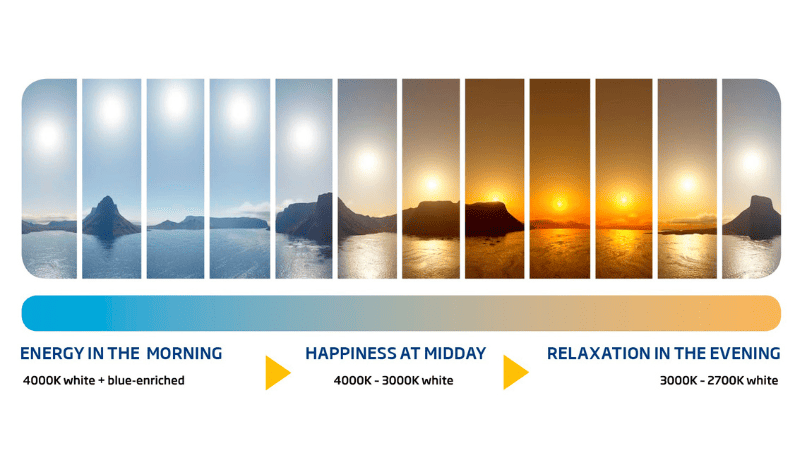
-
The Action:
- Dim all lights as low as you can comfortably tolerate.
- If possible, use light sources that are warmer in color (yellow, orange, or red).
-
The Rationale: Bright white and blue wavelengths of light are the most potent at inhibiting melatonin. Shifting to warmer, dimmer light significantly reduces this disruptive signal.
-
Implementation Options:
- Good (Zero Cost): Use existing lamps but ensure they are positioned low and dimmed if possible.
- Better (Low Cost): Replace the bulbs in your key evening lamps (e.g., bedside lamp, living room lamp) with "warm white," orange, or red-hued bulbs.
- Best: Use smart bulbs that allow you to control both the brightness and the color temperature, programming them to automatically shift to a warm, dim red light in the evening.
Dr. Huberman discusses the benefits of using red lights in the evening in the following clip.
AMA #14: 2023 Philanthropy, Evening Routine, Light Therapy, Health Metrics & More
In this segment from an AMA, Dr. Huberman explains the practical benefits of using red light bulbs in the evening to reduce stimulating blue light.
Watch from 15:28 to 17:35. Focus on how red light helps reduce cortisol and promote sleepiness, and the practical ways to implement it (even with affordable options like party lights).
The Evidence: Real-World Impact of Home Lighting
You appreciate seeing the research behind these protocols. A fascinating study directly tested this principle in a real-world setting.
Home Lighting Before Usual Bedtime Impacts Circadian Timing
This study, 'Home Lighting Before Usual Bedtime Impacts Circadian Timing', provides direct evidence for the protocol. We'll look at what they did and what they found.
Please read the Abstract and the final paragraph of the Discussion section (starts with 'The results of this study highlight that...'). Focus on the difference in light levels between the 'bright' and 'dim' weeks and the resulting shift in the participants' internal clocks.
The Key Takeaway: Just by maximizing their normal household lights (to an average of only ~65 lux, which is still quite dim), participants delayed their internal clock (melatonin onset) by 1 hour and 3 minutes compared to when they minimized their lights. This demonstrates that even small changes in your home lighting have a significant, measurable impact on your biology.
Test your understanding!
A friend argues that their overhead kitchen light isn't that bright, so it shouldn't affect their sleep. Based on the lesson, what are the two distinct reasons this is incorrect?
Show answer
- Position: The light is overhead, which is the most powerful location for activating the circadian-alerting neurons in your eyes, mimicking sunlight.
- Sensitivity: Your brain is extremely sensitive to light at night. The study showed that even a dim light of ~65 lux was enough to significantly delay the body's clock. Your friend's kitchen light is almost certainly brighter than that.
Summary: Your Evening Light Protocol Checklist
Here is the protocol in a simple, step-by-step format. Assume a target bedtime of 11:00 PM.
-
8:00 PM (T-minus 3 hours):
- Turn OFF all overhead lights.
- Switch to low-level lamps for ambient light.
-
9:00 PM (T-minus 2 hours):
- Dim lamps to the lowest comfortable level.
- If possible, ensure light sources are warm-toned (yellow/red).
-
10:00 PM (T-minus 1 hour):
- Begin your wind-down routine (we will cover this in a later module).
- Light should be minimal, ideally restricted to a single dim bedside lamp if you are reading.
Conclusion
You now have a complete, evidence-based protocol for managing your evening light environment. Just as morning sunlight sets your clock's "start time," this evening protocol creates the ideal conditions for your body to prepare for sleep, ensuring the timely release of melatonin.
Key Takeaways:
- Your brain is highly sensitive to light at night; even dim light can delay your sleep.
- Start your light reduction protocol 2-3 hours before bed.
- The protocol has two main variables: position (get lights low) and intensity/color (get lights dim and warm).
- Turning off overhead lights is your highest-leverage first step.
In this lesson, we focused on controlling the light in your general environment. However, the brightest light sources are often the screens we hold right in front of our faces. In our next lesson, we will build a specific protocol to tackle this by applying software-based blue light filters to your digital devices.