Recommended resources
The freely available resources this lesson will direct you to.
Hello! Welcome back to our module on building sustainable learning habits.
In our last lesson, we explored the habit formation curve. You learned that building an automatic habit is a long-term process, often taking months, and that perfect consistency isn't necessary for success. The key is to keep showing up, even after missing a day or two.
But relying on willpower alone to "keep showing up" is a fragile strategy, especially on days when motivation is low. This is where today's topic comes in. We will explore one of the most powerful external tools for maintaining consistency: accountability.
Your learning outcome for this lesson is to identify an accountability partner or method to maintain your learning habits. We'll look at what makes accountability effective, the different forms it can take, and how you can find the right fit for your specific learning goals, whether that's tackling data analysis or a new coding language.
Why Accountability Works
At its core, accountability introduces a positive form of social pressure. When we know someone else is aware of our goals and will be checking in, we are far more likely to follow through. Research from the American Society of Training and Development found that your probability of completing a goal is 65% if you commit to someone. And if you have a specific accountability appointment with that person, your chance of success climbs to 95%.
To understand the mechanics, let's look at the core elements of effective accountability.
This article from the UNC Learning Center, titled 'Accountability Strategies,' breaks down why accountability is so effective. It will help you understand the foundational principles before we dive into specific methods.
Please read the section titled 'What are the core elements of accountability?'. Focus on the three key elements described: peers, public goal tracking, and inviting feedback.
As you just read, effective accountability isn't just about being watched. It's about a combination of:
- Peers: Creating a sense of solidarity and mutual support.
- Public Tracking: Making your progress (or lack thereof) visible.
- Feedback: Creating a loop that motivates improvement and helps you course-correct.
These elements can be combined in different ways. You might find them in a formal study group, a structured online program, or a one-on-one partnership. Let's explore the most common and powerful methods.
Method 1: The Accountability Partner
The most classic form of accountability is the one-on-one partner, or "accountability buddy." This is a reciprocal relationship where you both agree to support and check in on each other's goals.
What to Look for in a Partner
Choosing the right partner is crucial. It's less about finding a clone of yourself and more about finding someone with compatible traits. A great partner for learning a UX methodology might be a friend learning to cook, as long as you share a commitment to the process.
5 Steps to Succeed with an Accountability Partner
The video '5 Steps to Succeed with an Accountability Partner' provides a structured overview of what an accountability partnership entails and the benefits it offers.
Watch from the beginning to 06:12. Pay close attention to the definition of a partner, the benefits listed, and the first few steps of the process, especially the advice on searching for a partner and considering people from different backgrounds.
To build on that, let's get more specific about the desirable qualities.
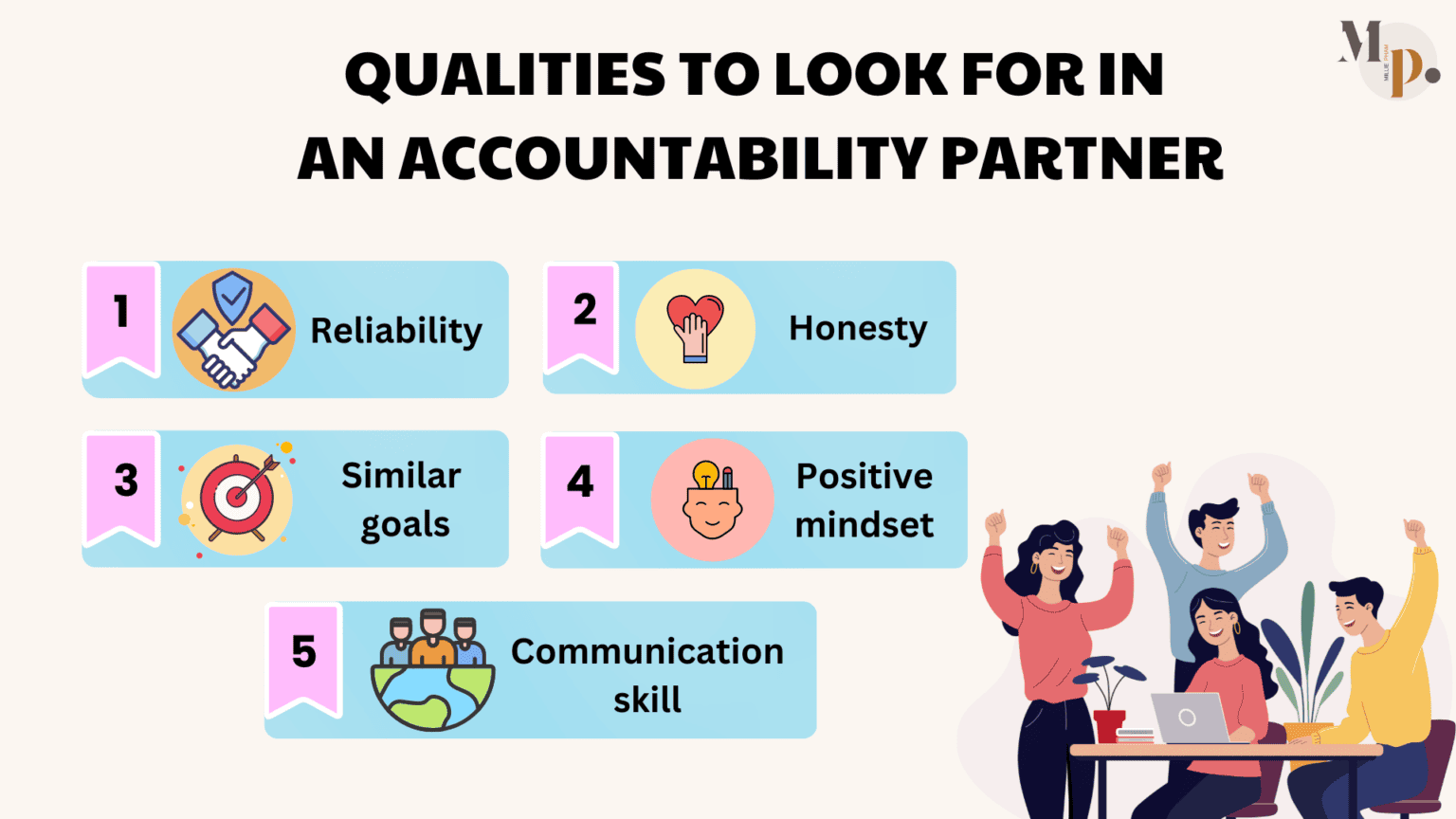
The article "7 Best Ways to Find an Accountability Buddy Online" provides a useful list of "green flags" (good signs) and "red flags" (warning signs) to watch for.
Green Flags ✅
- Consistent and reliable
- Asks thoughtful questions
- Shares their own struggles
- Celebrates your wins
- Is honest but kind with feedback
Red Flags 🚩
- Frequently cancels or misses check-ins
- Unresponsive or gives vague replies
- Makes the conversation all about them
- Overly negative or critical
- Makes constant excuses for their own lack of progress
How to Find and Set Up a Partnership
Finding a partner can seem daunting, but you have several options, both offline and online.
Why you need an accountability buddy (+ where to find one!)
Let's watch another perspective. In her video 'Why you need an accountability buddy,' YouTuber The Bliss Bean offers practical advice on where to look for a partner and how to initiate the conversation.
Watch from 01:53 to 03:43 to learn about looking within your existing network, and then from 05:56 to 08:08 for a step-by-step guide on initiating the partnership and structuring your initial meetings.
As you've seen, your network of friends and colleagues is a great place to start. For a broader reach, online communities are excellent resources.
7 Best Ways to Find an Accountability Buddy Online (Free in 2025)
The article '7 Best Ways to Find an Accountability Buddy Online' provides an exhaustive list of online platforms. We won't read it all, but let's look at the actionable steps it recommends.
Please read the section '5-Step Process to Find Your Perfect Accountability Buddy.' This gives you a clear, actionable template for finding and vetting a partner.
Test your understanding!
Let's apply what you just learned. Imagine you want to find a partner to help you stick to your goal of spending 4 hours a week learning data analysis fundamentals.
Using the template from the "7 Best Ways to Find an Accountability Buddy Online" article, draft a "Partner Wanted" post that you could theoretically post on a platform like LinkedIn or a relevant subreddit (e.g., r/GetMotivatedBuddies).
Make sure your post clearly states:
- Your goal
- The duration
- Your preferred check-in method and frequency
- Your timezone
- What you need and what you offer
Show answer
Here is an example of a strong post:
"Subject: Accountability Partner for Data Analysis Learning Goal
Hi everyone,
I'm a UX/UI designer looking for an accountability partner to maintain consistency with a professional development goal.
Goal: Spend 4 hours per week (e.g., 1 hour Mon-Thurs) studying foundational data analysis concepts.
Duration: Starting with a 30-day commitment, with the option to extend.
Check-in method: A brief 5-minute text/Slack check-in at the end of each weekday to confirm the session was completed, and a 15-minute call on Fridays to review the week and plan the next.
Timezone: GMT (London). Open to partners in similar European timezones.
What I need: Someone to help me stay on track with my daily goal and provide encouragement.
What I offer: I am reliable, supportive, and happy to offer the same level of commitment and encouragement for your goals, whatever they may be!
Let's start with a 1-week trial to ensure our styles are a good match. Comment or DM if you're interested!"
Method 2: System-Based Accountability
A one-on-one partner isn't for everyone. Sometimes, you may prefer a more structured, less personal, or more "on-demand" form of accountability. Given your background in UI/UX, you'll appreciate how different platforms have designed systems to solve this problem.
Here are a few popular types of system-based accountability:
-
Virtual Coworking (e.g., Focusmate):
- How it works: You book a 50-minute session and are paired with a random partner. You each state your goal at the beginning, work in silence with cameras on, and confirm your progress at the end.
- Best for: Overcoming procrastination for a specific, focused task (e.g., "Complete this 1-hour coding tutorial," "Read and summarize this chapter on user research methods"). The accountability comes from the shared, silent presence.
-
Gamified Habit Trackers (e.g., Habitica):
- How it works: This app turns your habits into a Role-Playing Game (RPG). You create a character that gains experience for completing tasks but takes damage if you fail to do your daily habits. You can join a "party" with other users, where your collective success or failure affects the whole group.
- Best for: Maintaining small, daily learning habits (e.g., "Review 10 flashcards," "Code for 15 minutes"). The accountability comes from the social pressure of not wanting to let your party down.
-
Cohort-Based Platforms (e.g., Cohorty):
- How it works: Instead of finding one partner, you join a small group (a "cohort") of people all working on the same structured challenge (e.g., "30-Day Python Challenge"). The platform facilitates group check-ins and progress tracking.
- Best for: Those who want the support of a group without the administrative work of finding a partner and setting up a system from scratch.
Identifying the Right Method for You
So, which method should you choose? The best approach depends on your specific goal and personal style.
- If your goal is long-term consistency on a broad learning project (like mastering data analysis), a dedicated Accountability Partner is often the most effective. The personal relationship provides sustained motivation.
- If you struggle with task initiation and just need to get started on a specific work block, a Virtual Coworking session on Focusmate can be incredibly effective.
- If you are motivated by games, points, and community challenges, a Gamified Habit Tracker like Habitica could be a great fit for your smaller, daily learning rituals.
- If you want a group experience focused on a single, time-bound goal, a Cohort-Based Platform could provide the structure and peer support you need.
It's also not an either/or choice. You might use Focusmate for deep work sessions during the week while also having a weekly check-in with a long-term accountability partner.
Conclusion
Today, we've moved from the internal psychology of habit formation to the external power of accountability. You now have a toolkit of methods to ensure you stay consistent with your learning goals, even when motivation wanes.
Key Takeaways:
- Accountability dramatically increases your chances of achieving your goals by leveraging social commitment.
- An accountability partner is a reciprocal relationship built on reliability, honesty, and mutual support. You can find them in your existing network or on various online platforms.
- System-based accountability uses technology—like virtual coworking, gamification, or cohort platforms—to provide structure and social pressure.
- The right method depends on your goal and personality. The key is to define your goal clearly and then select the tool or person that best supports it.
What's Next?
Establishing a habit and an accountability system are foundational steps. But to make real progress in a skill, the habit can't stay the same forever. In our next and final lesson of this module, we will discuss how to apply the principle of 'progressive overload' to gradually increase the difficulty and scope of your learning, ensuring your habits lead to meaningful growth.