Recommended resources
The freely available resources this lesson will direct you to.
Introduction
Welcome to the final lesson of our module on Reinforcement Learning and MLOps Principles. Over the past few lessons, we have assembled the conceptual components of a production machine learning system, covering experiment tracking, model serving, and, most recently, the critical importance of monitoring for data and model drift. We established that production is not a destination but the beginning of a continuous lifecycle, where a model's performance must be actively managed.
This lesson will synthesize these MLOps concepts by addressing a crucial point of comparison for anyone with a background in software engineering: how the Continuous Integration and Continuous Deployment (CI/CD) paradigm is fundamentally reshaped when applied to machine learning. While traditional CI/CD focuses on validating and deploying code, CI/CD for ML must manage a more complex, dynamic interplay of code, data, and models. You will learn why simply applying traditional software CI/CD practices to ML projects is insufficient and how the process is extended to incorporate essential steps like data validation, model evaluation, and automated retraining, thereby closing the MLOps loop we have been constructing.
The Anatomy of CI/CD: Traditional vs. Machine Learning
From your extensive experience in computer science, you are intimately familiar with the principles of traditional software CI/CD. The workflow is well-defined and code-centric.
- Trigger: A developer commits code to a version control repository like Git.
- Continuous Integration (CI): The system automatically builds the software and runs a series of deterministic tests (unit tests, integration tests). The primary question being answered is: "Does the new code work as specified and integrate correctly with the existing codebase?"
- Continuous Deployment (CD): If CI passes, the validated code is packaged (e.g., into a container) and automatically deployed to production.
This process is powerful because it automates the verification and release of a single, primary artifact: the application code.
Machine learning systems, however, are not built from code alone. They are the synthesis of code, data, and the model that results from training the former on the latter. This tripartite nature introduces complexities that traditional CI/CD is not equipped to handle.
The textbook chapter "ML vs Traditional Software Development" provides an excellent, structured comparison that forms the theoretical basis for our discussion.
Please read the entire section, starting from the introductory paragraphs. Pay close attention to the table titled "Traditional vs ML Development", which succinctly summarizes the core differences across key dimensions like problem definition, testing, and maintenance. The footnotes in this section are particularly insightful. Note the explanation of how continuous deployment for ML differs due to the need for statistical validation and performance-based rollbacks.
As the reading highlights, ML development replaces deterministic specifications with probabilistic optimization and static behavior with dynamic adaptation. This fundamental shift necessitates a complete reimagining of the CI/CD pipeline.

The MLOps CI/CD Pipeline: A New Workflow
Let's dissect the CI/CD pipeline for ML, contrasting each stage with its traditional counterpart. A helpful analogy, presented in the video we'll see shortly, is that traditional software is like building a house from a blueprint—it's static once built. An ML system is like a house that constantly rearranges itself based on who lives in it and the changing weather outside.
MLOps Explained - What It Is, Why You Need It and How It Works
This video from TechWorld with Nana uses a clear analogy and a practical example to explain why MLOps is necessary and how it differs from DevOps.
First, watch the segment explaining the core difference between the two development styles, starting from the analogy. Then, watch the direct comparison of DevOps and MLOps, which emphasizes the shared tooling but differing concepts.
The MLOps CI/CD pipeline is designed to manage this dynamic, self-arranging system.
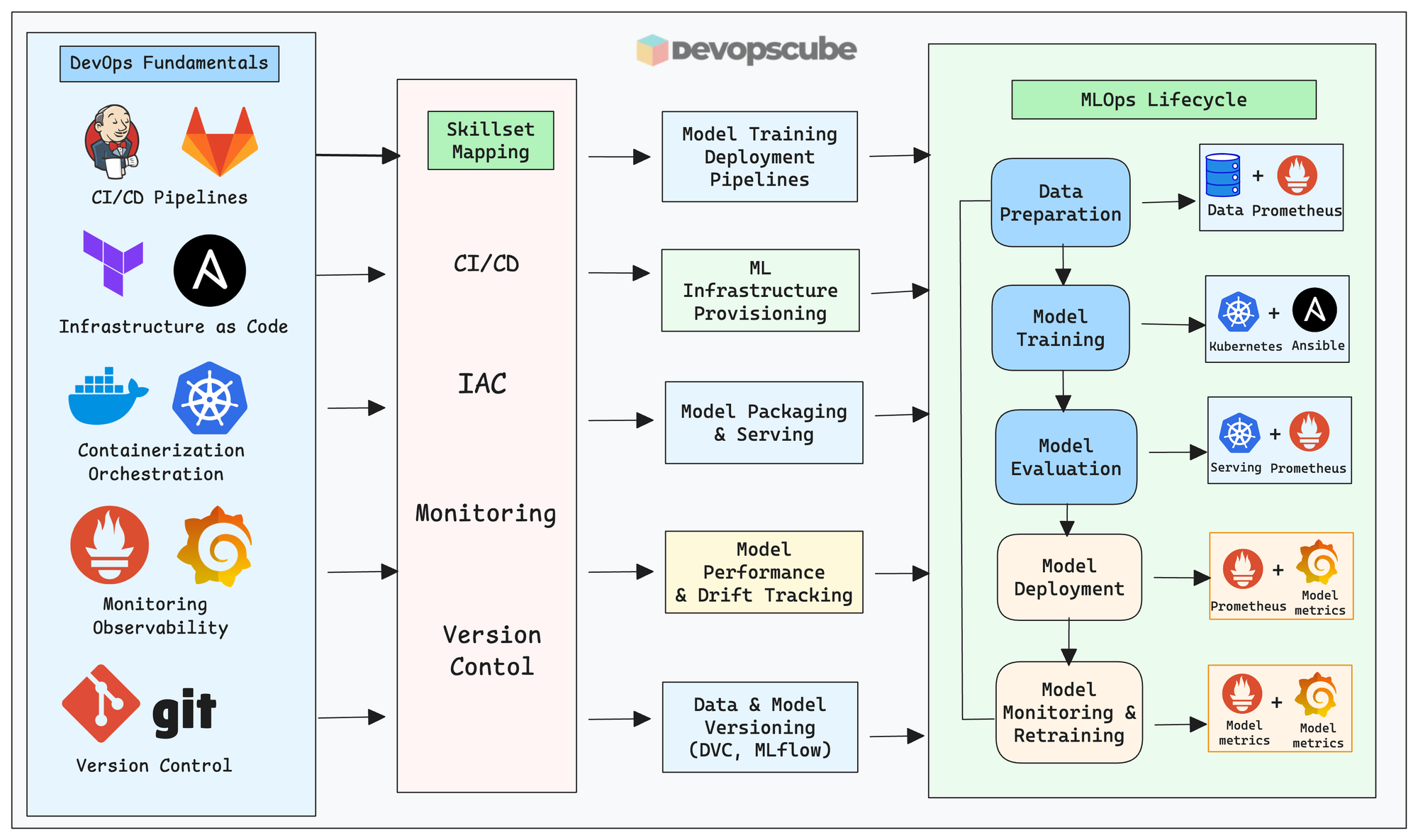
1. Triggers for the Pipeline
In traditional CI/CD, the trigger is almost always a code commit. In MLOps, the triggers are more diverse:
- Code Change: A data scientist improves the feature engineering logic or a machine learning engineer refactors the model architecture code. This is analogous to the traditional trigger.
- New Data: A fresh batch of labeled data is ingested. This can trigger a pipeline to retrain the model to incorporate new information, a concept foreign to traditional CI/CD.
- Performance Degradation (Drift): As we discussed in the last lesson, a monitoring system detects that the live model's performance has dropped below a threshold. This can automatically trigger a retraining pipeline. This is a production-driven trigger, which is a powerful MLOps pattern.
- Scheduled Runs: The pipeline is configured to run periodically (e.g., weekly) to ensure the model stays fresh, regardless of other events.
2. Continuous Integration (CI) for Machine Learning
The "integration" in ML CI is far broader than just integrating code. It's about integrating code, data, and model validation into a single, automated process.
MLOps Explained - What It Is, Why You Need It and How It Works
This video continues by detailing the components of an end-to-end MLOps workflow, which are the core of CI/CD for ML.
Please watch the section that describes the full automated workflow, from data validation to deployment and monitoring. Notice how many new automated testing and validation steps are introduced compared to a traditional pipeline.
A typical CI pipeline for ML includes these automated steps:
-
Data Validation: The pipeline first validates the input data (either the new batch or the full training set). This is a critical first gate. It checks for:
- Schema Conformance: Does the data have the correct columns and data types?
- Statistical Properties: Are the distributions of key features within expected bounds? This step can catch data drift before any expensive training is done.
- Data Integrity: Are there null values, outliers, or other anomalies?
-
Model Training: If data validation passes, the training code is executed to produce a model. This step is computationally intensive and, due to its stochastic nature (e.g., random weight initialization, data shuffling), non-deterministic.
-
Model Validation and Evaluation: This is the most crucial validation step and the heart of the contrast with traditional CI. Instead of binary pass/fail unit tests, we perform a statistical evaluation:
- Performance Testing: The model's performance (e.g., accuracy, F1-score for classification; MSE for regression) is measured on a held-out test set. The pipeline checks if this performance exceeds a predefined threshold (e.g.,
accuracy > 90%). - Comparative Testing: The new model is often compared against the currently deployed model or a business-relevant baseline. A new model is typically promoted only if it shows a statistically significant performance improvement.
- Behavioral Testing: The model is tested for robustness, fairness, and lack of bias across important slices of the data. For example, a loan approval model must be checked to ensure it performs equally well across different demographic groups.
- Performance Testing: The model's performance (e.g., accuracy, F1-score for classification; MSE for regression) is measured on a held-out test set. The pipeline checks if this performance exceeds a predefined threshold (e.g.,
-
Model Registration: If all validation steps pass, the trained model, along with its metadata (e.g., training data version, performance metrics, code version), is versioned and saved to a central Model Registry. This creates an immutable, auditable artifact that is ready for deployment.
3. Continuous Deployment (CD) for Machine Learning
Once a model is validated and registered, the CD phase manages its release into production.
- Packaging: The model is bundled with its inference code into a deployable format, typically a container image with a REST API endpoint for serving predictions.
- Deployment: The container is deployed to the target environment. Because of the inherent uncertainty in ML model performance, deployment strategies are often more cautious than in traditional software.
- Shadow Deployment: The new model runs in parallel with the old one, receiving a copy of live traffic. Its predictions are recorded but not shown to users. This allows for comparison of its behavior against the current model in a risk-free way.
- Canary Release: The new model is initially rolled out to a small subset of users (e.g., 5%). Its performance is closely monitored. If it behaves as expected, traffic is gradually shifted until it serves 100% of requests.
- A/B Testing: Multiple model versions are deployed simultaneously, with users randomly assigned to each. This allows for direct comparison of business metrics (e.g., click-through rate, conversion rate) driven by each model.
The ability to roll back is also more complex. In traditional software, you roll back to a previous code version. In ML, rolling back to a previous model might be necessary, but this older model might not be compatible with changes in the data or upstream systems, a challenge that requires careful pipeline design.
The Central Role of Data and Model Validation
To summarize, the core distinction between traditional CI/CD and MLOps CI/CD lies in the expansion of the concept of "validation."
[PDF] A Comparative Case Study of CI/CD Pipeline Implementations for AI ...
This research paper synthesizes findings from real-world MLOps implementations. Its conclusions highlight the exact principles we've been discussing.
Please read the section "RQ2: What are the key success factors, design principles, and best practices?". Focus on the principles listed: "Embrace a Data-Centric View" and "Design for Testability". These directly address the new forms of validation required for ML systems.
Let's crystallize this difference:
- Traditional Software Validation is concerned with code correctness. It asks: "Does the code do what the specification says?" Tests are deterministic and verify logical behavior.
- Machine Learning Validation is concerned with system behavior and performance. It is a multi-layered process:
- Data Validation: Asks, "Is the data we are using to build and run our system reliable and consistent?" It is the foundation of the entire system's quality.
- Model Validation: Asks, "Does the model make sufficiently accurate predictions on unseen data?" It is a statistical, probabilistic assessment, not a deterministic check.
- Operational Validation: Asks, "Can the model serve predictions within latency and throughput requirements in a production environment?"
This expansion of testing is precisely why Google engineers noted that platforms like TFX "had to reinvent CI/CD principles for ML, introducing concepts like 'model validation' and 'data validation' that have no equivalent in traditional software," as mentioned in a footnote of the ML Systems Textbook.
Conclusion
In this lesson, we have bridged the gap between traditional software engineering and modern machine learning operations by contrasting their respective CI/CD paradigms. While they share tools and a philosophy of automation, their practical implementation diverges significantly due to the unique nature of ML systems.
Here are the key takeaways:
- Expanded Triggers: ML pipelines are triggered not just by code changes, but also by the availability of new data and by performance degradation detected in production.
- Compound Artifacts: The pipeline manages a trio of artifacts—code, data, and models—requiring versioning and lineage tracking for all three.
- Probabilistic, Multi-faceted Validation: The core of the difference lies in validation. Deterministic unit tests are insufficient. MLOps CI/CD introduces mandatory data validation to ensure data quality and model validation to statistically evaluate performance, fairness, and robustness.
- Cautious Deployment: ML deployment often favors gradual rollout strategies like canary or shadow deployments to mitigate the risk associated with the probabilistic nature of model performance.
This concludes our module on MLOps principles. You now have a comprehensive theoretical framework for the entire machine learning lifecycle, from conceiving a model, to training and evaluating it, and finally to deploying, monitoring, and maintaining it as a robust, production-grade system. This holistic understanding of the end-to-end process is a critical foundation for any aspiring AI/ML engineer.