Recommended resources
The freely available resources this lesson will direct you to.
Introduction
In our journey through the core concepts of AI and machine learning, we have focused primarily on the algorithms and mathematical theories that enable models to learn from data. Our last lesson on policy gradient methods concluded our exploration of the main paradigms of reinforcement learning. Now, we will pivot from the "what" of machine learning—the models and algorithms—to the "how": how these models are developed, deployed, and maintained in a reliable, scalable, and reproducible manner in real-world applications.
This lesson introduces the field of MLOps (Machine Learning Operations). Drawing upon your background in computer science and systems, you'll recognize that MLOps adapts the principles of DevOps to the unique challenges of the machine learning lifecycle. We will explore the theoretical framework of an MLOps pipeline and then focus on three foundational pillars that enable it: experiment tracking, model versioning, and model registries. These concepts are the bedrock for moving from isolated, experimental models to robust, production-grade AI systems.
The Need for MLOps: From Manual Experimentation to Automated Systems
A typical machine learning project often begins with a data scientist performing exploratory data analysis, feature engineering, and model training within an interactive environment like a Jupyter Notebook. While this is excellent for initial discovery and experimentation, it quickly becomes a source of significant technical debt when moving towards a production system. This manual process is often difficult to reproduce, hard to scale, and creates a problematic handoff between the data science team that builds the model and the engineering team that must deploy and maintain it.
This initial, manual stage is what is often referred to as "MLOps Level 0".
MLOps: Continuous delivery and automation pipelines in ...
This document from Google Cloud provides a structured overview of MLOps maturity levels. Understanding the initial, manual state is crucial for appreciating the problems that MLOps aims to solve.
Please read the section "MLOps level 0: Manual process" to understand the characteristics and challenges of a purely manual ML workflow. Pay attention to the disconnection between ML and operations, the lack of CI/CD, and the absence of active monitoring.
The core motivation for MLOps is to overcome these challenges by introducing automation, reproducibility, and monitoring. Just as DevOps brought systematic rigor to software development and deployment, MLOps brings a similar discipline to the machine learning lifecycle.
MLOps explained | Machine Learning Essentials
This short video from Microsoft Azure clearly articulates the "why" behind MLOps by walking through the typical challenges in a machine learning workflow.
Please watch the segment from "So why is MLOps needed?". The speaker highlights the need for versioning data, tracking experiments, source controlling code, and using pipelines for reproducibility. These are the exact problems we will address.
The MLOps Pipeline: A Theoretical Framework
An MLOps pipeline automates the end-to-end process of taking data and code to generate a trained, validated, and deployed model. While implementations vary, the conceptual stages are generally consistent and represent a significant departure from traditional software CI/CD.
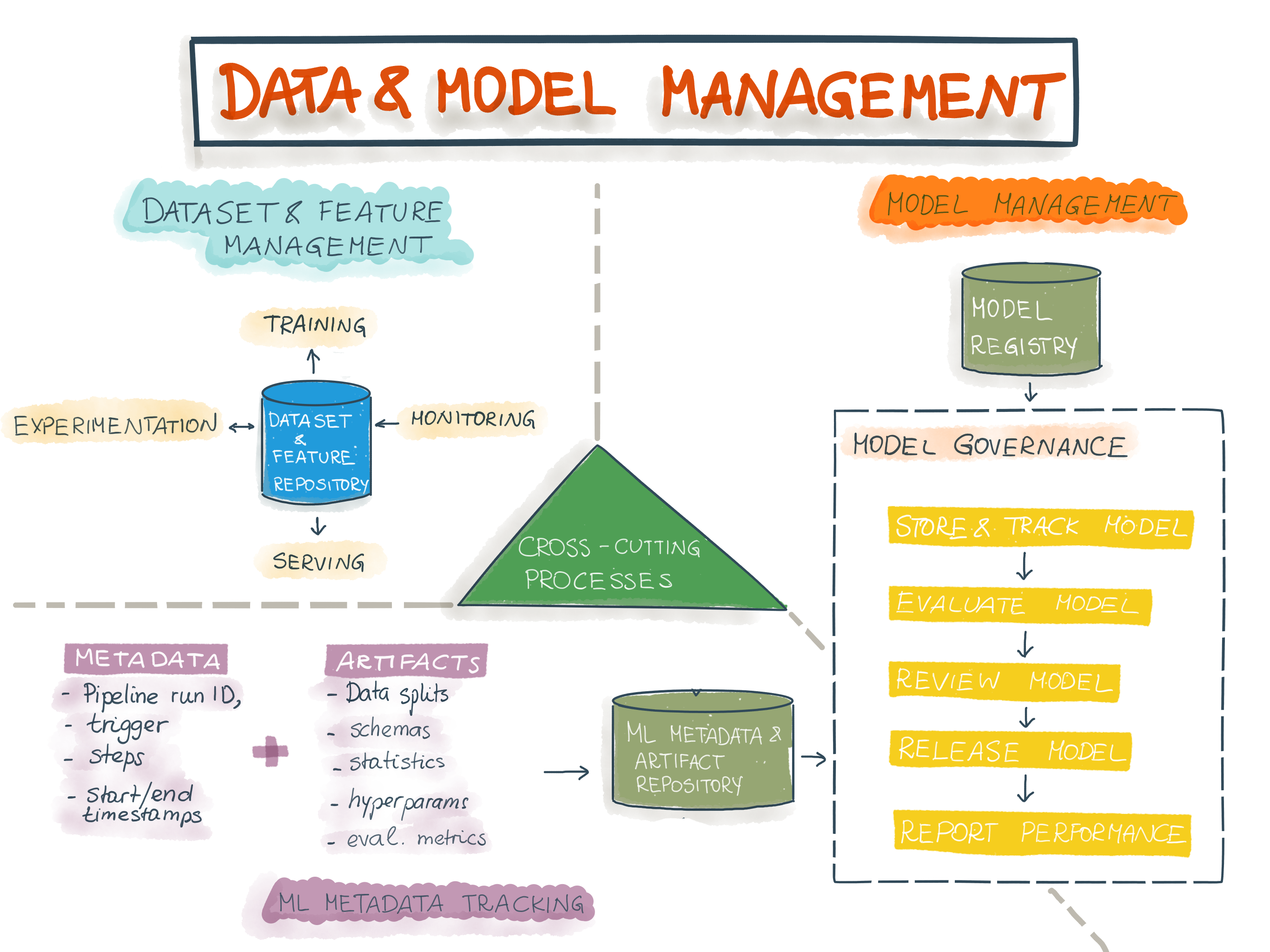
The key difference lies in the introduction of new triggers and artifacts. In traditional CI/CD, a code change triggers the pipeline. In MLOps, a pipeline can be triggered by:
- A code change (e.g., new model implementation, updated feature engineering logic).
- A data change (e.g., new data arriving that requires the model to be retrained).
- A schedule (e.g., retrain the model weekly).
- A monitoring alert (e.g., model performance in production has degraded).
This leads to a new set of "Continuous" practices unique to ML:
- Continuous Integration (CI): Expands beyond just testing code to include testing and validating data, data schemas, and models.
- Continuous Delivery (CD): Involves deploying not just a single service, but an entire ML training pipeline that in turn delivers a deployable model.
- Continuous Training (CT): A new concept unique to ML, referring to the automatic retraining of models in response to new data or performance decay.
- Continuous Monitoring (CM): Tracking the performance of the model in production, not just for operational metrics (like latency) but for predictive quality and data drift.
MLOps: Continuous delivery and automation pipelines in ...
Let's revisit the Google Cloud document to formalize the distinction between DevOps and MLOps.
Read the section titled "DevOps versus MLOps". This section explicitly contrasts the two, emphasizing how CI, CD, and the new concept of CT are adapted for the ML context.
Principle 1: Experiment Tracking
Machine learning development is fundamentally an empirical science. To find the best model, data scientists run numerous experiments, tweaking everything from data preprocessing steps and feature sets to algorithm choices and hyperparameter values. Without a systematic way to track these experiments, the process becomes chaotic and irreproducible.
Experiment tracking is the practice of systematically logging all relevant information for each experimental run. This includes:
- Source Code: The version of the code used (linked via a Git commit hash).
- Parameters: The hyperparameters of the model and any other configuration parameters.
- Data: The version of the dataset used for training and validation.
- Environment: Dependencies and library versions.
- Metrics: The resulting performance metrics (e.g., accuracy, loss, AUC).
- Artifacts: The outputs of the run, such as the trained model file itself, visualizations, and log files.
By logging this information, you can compare results across different runs, identify what changes led to improvements, and reproduce any specific result from the past.
Let's consider a practical example: designing a recommendation engine for a social media platform. The process of training this engine involves numerous experiments to find the optimal model.
Design an ML Recommendation Engine | System Design
This video provides an excellent, system-design-oriented walkthrough of building a recommendation engine. It perfectly illustrates how an MLOps component for tracking and storing models fits into the architecture.
First, watch the segment that describes the training process from "tackle the training part first". Notice the basic workflow: a training server fetches data, runs an algorithm, and outputs a model file. The video then immediately points out the need for something more robust to store this file and track its performance. Next, watch the following segment from "over time as the data updates", which introduces a tool called MLflow. Focus on how it is described as a solution to "store our model files" and "track experiments over time". This is the core function of experiment tracking and model registries.
Principle 2: Versioning Everything
In traditional software, version control for code (using tools like Git) is standard practice. In MLOps, this is necessary but not sufficient. To achieve full reproducibility, you must version all three key components of an ML system: code, data, and models.
- Code Versioning: Handled by Git. The commit hash serves as a precise identifier for the state of the codebase.
- Data Versioning: This is crucial because the same code run on different data will produce a different model. Data versioning tools (like DVC, which works with Git) allow you to create lightweight, immutable "snapshots" of your datasets without storing large files directly in your Git repository.
- Model Versioning: The trained model is an artifact derived from a specific version of code and a specific version of data. Versioning the model allows you to roll back to a previous version if a new one performs poorly, debug issues by knowing exactly what produced the model, and satisfy audit and compliance requirements.
This interconnected versioning creates data and model lineage: the ability to trace a specific deployed model all the way back to the exact code, data, and parameters that produced it.
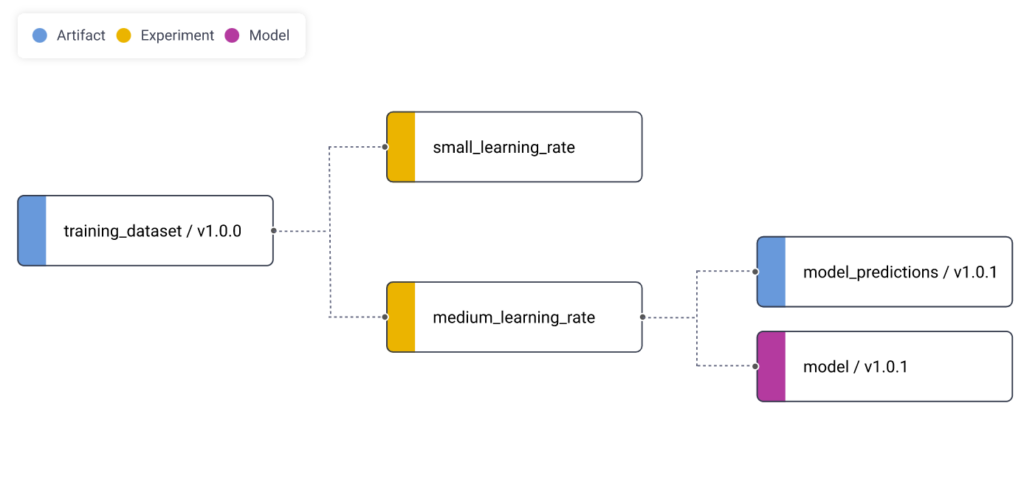
The resource MLOps Principles provides a compelling list of reasons why versioning is so critical.
The ml-ops.org website provides a concise but thorough set of principles. Their section on versioning is particularly useful.
Please read the entire "Versioning" section. The bulleted list gives a comprehensive overview of the business and technical drivers for versioning models and data, from retraining and degradation to compliance and rollbacks.
Principle 3: The Model Registry
Once an experiment yields a promising model, where does that model artifact go? A Model Registry is the answer. It is a centralized system for storing, versioning, managing, and governing trained machine learning models. A registry elevates a model from a simple file to a managed asset.
A Model Registry provides several key capabilities:
- Centralized Storage: A single source of truth for all trained models in an organization.
- Versioning and Lineage: It stores different versions of a model and links them to the experiment run that created them, providing the lineage we discussed.
- Metadata Association: It stores crucial metadata alongside the model artifact, such as the performance metrics on the test set, the training parameters, and documentation.
- Lifecycle Management: It allows you to manage the state of a model. For example, a model might move from a
stagingstate, toproduction, and eventually toarchived. This is critical for governance and controlled deployments.
In the recommendation engine example, the MLflow server acts as both an experiment tracker and a model registry, storing the output of the training server.
Let's revisit the MLOps Principles document to see how registries fit into the overall MLOps setup.
Locate the table titled "MLOps Setup Components | Description". Note the distinct entries for Model Registry, Feature Store, and ML Metadata Store. This highlights that the registry is a core, distinct component of a mature MLOps architecture, responsible for storing the trained model objects.
The combination of an automated pipeline, experiment tracking, comprehensive versioning, and a model registry provides the theoretical and practical foundation for building robust, scalable, and trustworthy machine learning systems.
Conclusion
In this lesson, we transitioned from the world of algorithms to the principles of engineering and operations for machine learning. We established that MLOps provides a structured framework to manage the complexity and lifecycle of ML models, moving them from manual, one-off experiments to automated, production-ready systems.
Here are the key takeaways:
- MLOps applies DevOps principles to the unique lifecycle of machine learning, addressing challenges like reproducibility, scalability, and the experimental nature of ML development.
- An MLOps pipeline automates the stages of data validation, model training, model validation, and deployment, triggered by changes in code, data, or model performance.
- Experiment Tracking is the systematic logging of parameters, code, data, metrics, and artifacts to ensure reproducibility and enable systematic model improvement.
- Versioning is critical for code, data, and models. This practice enables rollbacks, debugging, and provides a full audit trail or lineage for every model.
- A Model Registry is a centralized system for storing, versioning, and managing trained models as first-class assets, controlling their lifecycle from staging to production and retirement.
These principles—tracking, versioning, and registering—are the cornerstones that allow data science and engineering teams to collaborate effectively and deliver value through machine learning reliably and at scale.
In our next lesson, we will build directly on this foundation. Having seen how a model is trained, tracked, and stored in a registry, we will explore the next logical step: model serving strategies, examining the architectural tradeoffs between deploying models for batch versus real-time inference.