Recommended resources
The freely available resources this lesson will direct you to.
Hello and welcome to our next lesson. In the previous session, we established two powerful methodologies for adapting patterns to a new tuning by working with a multi-string tapping lick. We explored the "Transposer's Method" for perfect pitch replication and the "Player's Method" for creative, shape-based exploration.
Today, we'll reinforce and expand on that knowledge by applying the very same principles to a different cornerstone of modern guitar: hybrid picking. The goal is to adapt a hybrid picking pattern from standard tuning to Drop C#. This process will further solidify your ability to navigate the fretboard in this new tuning and demonstrate how these adaptation "algorithms" are technique-agnostic. By the end of this lesson, you'll be able to confidently translate hybrid-picked phrases between tunings, deciding whether to preserve the original sound or generate new musical ideas.
A Quick Refresher on Hybrid Picking
Before we begin adapting patterns, let's briefly recall the hybrid picking mechanic. It involves using both the pick and one or more free fingers of the picking hand (usually the middle and/or ring) to pluck the strings. This "hybrid" approach allows for wide string skips and complex patterns that would be awkward or impossible with a pick alone. It's a key ingredient in the fluid, articulate sound of players like Tim Henson and Scott LePage of Polyphia.
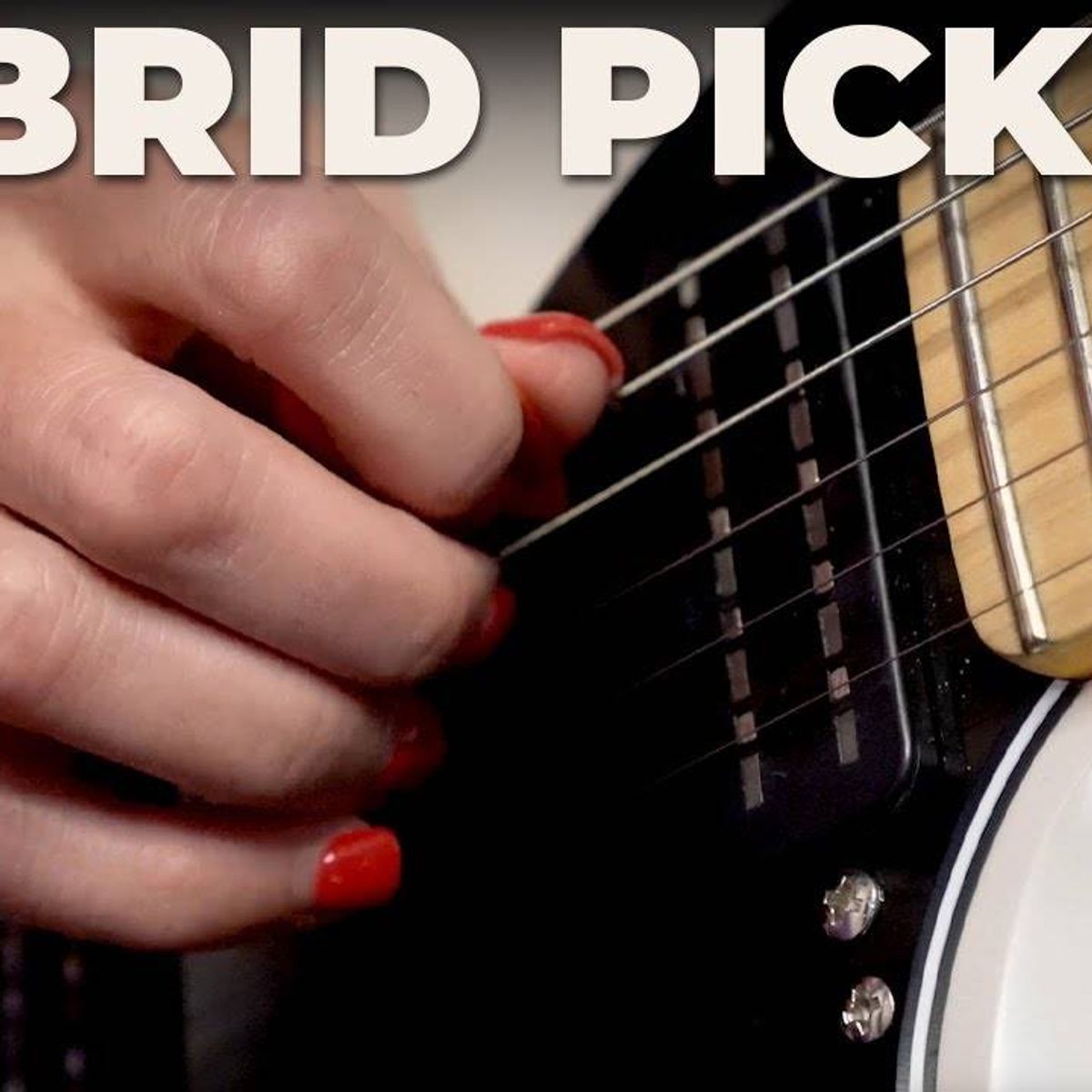
The video "The ULTIMATE Hybrid Picking Lesson!!" is an excellent resource filled with patterns that are perfect for our adaptation exercise. You can think of it as a library of licks to practice and experiment with.
The ULTIMATE Hybrid Picking Lesson!!
Introduce the video by mentioning its title and source, explaining its relevance.
We will use a couple of patterns from this video as our source material. The first one is a classic ascending pentatonic sequence of fours, which the instructor demonstrates starting at this timestamp.
The Source Pattern: A Pentatonic Lick
The lick from the video is an A minor pentatonic sequence. In standard tuning (E-A-D-G-B-e), the tablature looks like this. The pattern ascends by moving the same shape across string pairs.
Hybrid Picking Pattern 1 (Standard Tuning)
  Picking: P   F   P   F     P   F   P   F      P   F   P   F
e|----------------------------------------------------------5-p-8-|
B|------------------------------------------5-p-8-----------------|
G|------------------------5-p-7-----------------------------------|
D|------------------5-p-7-----------------------------------------|
A|------------5-p-7-----------------------------------------------|
E|----------------------------------------------------------------|
P = Pick (downstroke), F = Finger (middle finger pluck)
Now, let's port this pattern to your Gibson SG in Drop C# tuning (C#-G#-C#-F#-A#-D#).
Approach 1: The Transposer's Method (Preserving Pitch)
As we established in the last lesson, this method aims for a note-for-note identical sound in the new tuning. The algorithm is based on the interval shifts:
- For notes on strings 1-5, the new fret is Old Fret + 1.
- For notes on string 6, the new fret is Old Fret + 3.
Our current pattern only uses strings 5 through 2, so we only need the first rule.
- A-string (now G#): Frets 5, 7 become
6, 8. - D-string (now C#): Frets 5, 7 become
6, 8. - G-string (now F#): Frets 5, 7 become
6, 8. - B-string (now A#): Frets 5, 8 become
6, 9.
Here is the transposed tablature. When you play this, it will sound exactly like the original A minor pentatonic lick.
Adapted Pattern 1 (Drop C# - Pitch Preserved)
  Picking: P   F   P   F     P   F   P   F      P   F   P   F
D#|----------------------------------------------------------6-p-9-|
A#|------------------------------------------6-p-9-----------------|
F#|------------------------6-p-8-----------------------------------|
C#|------------------6-p-8-----------------------------------------|
G#|------------6-p-8-----------------------------------------------|
C#|----------------------------------------------------------------|
Approach 2: The Player's Method (Preserving Shape)
This method is about creative exploration. Instead of transposing pitches, you transpose the physical shape. You play the exact same fret numbers from the original TAB, but on your retuned guitar.
Adapted Pattern 1 (Drop C# - Shape Preserved)
  Picking: P   F   P   F     P   F   P   F      P   F   P   F
D#|----------------------------------------------------------5-p-8-|
A#|------------------------------------------5-p-8-----------------|
F#|------------------------5-p-7-----------------------------------|
C#|------------------5-p-7-----------------------------------------|
G#|------------5-p-7-----------------------------------------------|
C#|----------------------------------------------------------------|
The result is a completely new melodic idea. The pattern is no longer in A minor. It's now based around G# minor pentatonic, but the unique intervals of Drop C# will give it a slightly different flavor. This is how you discover sounds that are idiomatic to the tuning itself.
A More Complex Adaptation: String Skipping
Let's take a slightly more complex pattern that involves the 6th string, forcing us to use our complete transposition algorithm. The video we referenced earlier demonstrates a string-skipping lick.
The ULTIMATE Hybrid Picking Lesson!!
Refer back to the same video.
Now, focus on the string-skipping A minor pentatonic lick shown at this point. It involves jumping from the low 6th string to the 3rd string.
The source pattern in standard tuning is:
Hybrid Picking Pattern 2 (Standard Tuning)
  Picking: P   F     P   F
G|-----------5---------7----|
D|--------------------------|
A|--------------------------|
E|-------5---------8--------| (repeats)
Adaptation with Method 1 (Pitch Preserving):
- E-string (6th): Old frets 5, 8. Rule:
Old Fret + 3. New frets are8, 11. - G-string (3rd): Old frets 5, 7. Rule:
Old Fret + 1. New frets are6, 8.
The resulting TAB shows a significant change in the fretting shape, especially the distance between the hands.
Adapted Pattern 2 (Drop C# - Pitch Preserved)
  Picking: P   F     P   F
F#|-----------6---------8----|
C#|--------------------------|
G#|--------------------------|
C#|-------8---------11-------| (repeats)
Adaptation with Method 2 (Shape Preserving):
Here, we just play the original frets on the Drop C# tuned guitar.
Adapted Pattern 2 (Drop C# - Shape Preserved)
  Picking: P   F     P   F
F#|-----------5---------7----|
C#|--------------------------|
G#|--------------------------|
C#|-------5---------8--------| (repeats)
The notes produced here create a very different harmonic color. The 6th string notes are F# and A, while the 3rd string notes are A# and C. This combination is more dissonant and modern-sounding—a territory Polyphia often explores.
Your Turn: Practice and Experiment
Now it's time to apply these concepts.
- Tune your Gibson SG to Drop C# (C#-G#-C#-F#-A#-D#).
- Using a metronome at a slow tempo, work through Pattern 1 using both adaptation methods. Listen carefully to the difference in sound between the pitch-preserved and shape-preserved versions.
- Next, tackle Pattern 2. Pay close attention to the new fretting-hand positions required for the pitch-preserved version. Is it comfortable? How does the sound of the shape-preserved version change the feel of the lick?
- Challenge: Find another hybrid picking pattern—either from the "ULTIMATE Hybrid Picking Lesson!!" video or one you already know—and adapt it yourself using both methods. This is the key step to internalizing the process.
Conclusion
In this lesson, we've successfully transferred the adaptation methodologies from tapping to hybrid picking, proving their versatility. You now have a systematic framework for moving musical ideas between tunings.
Key Takeaways:
- The two primary adaptation methods—pitch-preserving (analytical) and shape-preserving (creative)—can be applied to any guitar technique.
- Adapting patterns that cross the 6th string in Drop C# requires a non-uniform fret adjustment (Old Fret +3) to preserve pitch, often changing the physical feel of the lick.
- Preserving the physical shape of a pattern in a new tuning is a powerful tool for generating new melodic and harmonic ideas that are unique to that tuning.
Your command of the fretboard in Drop C# is growing stronger with each technique you adapt. In our next lesson, we will shift our focus from single-note lines to harmony. You will learn to construct three distinct chord voicings that exploit the open strings in Drop C# tuning, unlocking the rich harmonic potential of this modern setup.