Recommended resources
The freely available resources this lesson will direct you to.
Welcome back! In our last lesson, we analyzed the fretboard in Drop C# tuning, focusing on the new interval relationships and the mental shift required to navigate it effectively. You learned that the key change is the Perfect 5th interval between the 6th and 5th strings, which alters any pattern crossing that boundary.
Today, we'll put that theory into direct, practical application. This lesson is about adapting a familiar technique—multi-string tapping—from standard tuning to Drop C#. You will learn two distinct methods for this "translation" process. This task is analogous to porting a piece of code from one framework to another: you can do a literal, line-by-line translation to preserve the original logic, or you can refactor it to better leverage the architecture of the new environment. Both approaches have their place, and by the end of this lesson, you will be able to apply both to adapt a tapping pattern to your Gibson SG in Drop C#.
The Source Pattern: A Multi-String Tapping Lick
First, we need a pattern to work with. Tapping licks are a staple of modern guitar and are often notated in tablature (TAB), which visually represents the fretboard. The 'T' above a note indicates it should be tapped with the picking hand.
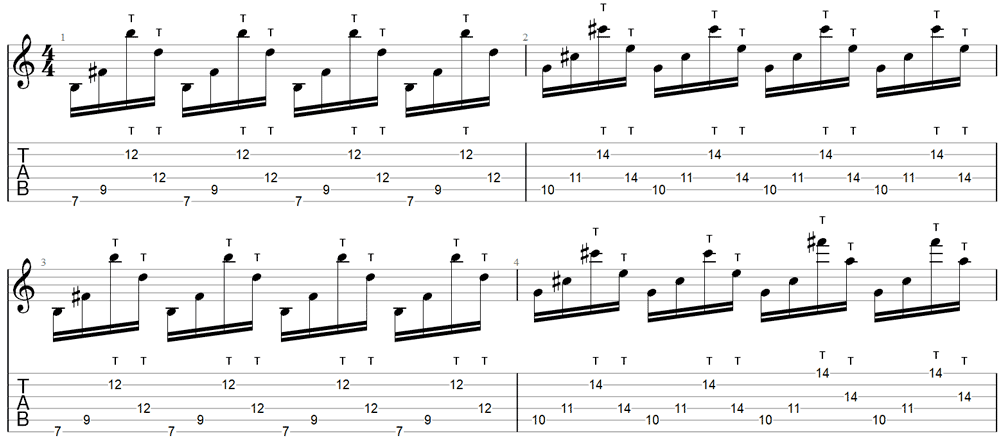
For our adaptation exercise, we'll use a more extensive pattern that traverses all six strings. This will force us to confront the unique geometry of Drop C# tuning.
13 Essential Guitar Tapping Exercises (With TAB)
From the provided article by Guitar Gear Finder, we will use a specific exercise as our foundation. Please familiarize yourself with it.
Scroll down to the section "String Skipping Tapping Patterns" and find Tapping Exercise 9. Look closely at the tablature, which is presented as a descending scale run. This is the pattern we will be adapting. You don't need to master it in standard tuning right now; just understand its structure.
As you've seen, this pattern is a descending lick that moves from the 1st string down to the 6th. Here is the tablature for easy reference (in Standard EADGBe tuning):
Tapping Exercise 9 (Standard Tuning)
e|--T12p8p5-------------------------------------------------|
B|----------T12p8p5-----------------------------------------|
G|------------------T11p7p5---------------------------------|
D|--------------------------T12p7p5-------------------------|
A|----------------------------------T12p7p5-----------------|
E|------------------------------------------T12p8p5---------|
Now, let's explore how to "port" this pattern to Drop C#.
Approach 1: The Transposer's Method (Preserving Pitch)
This first approach is analytical and precise. The goal is to make the lick sound exactly the same, note-for-note, as it does in standard tuning, but played on a guitar in Drop C#. To do this, we need a simple algorithm to find the new fret positions.
In the previous lesson, we established the relationship between standard tuning and Drop C#:
- Strings 1-5 (e, B, G, D, A) are tuned down one half-step to D#, A#, F#, C#, G#.
- String 6 (E) is tuned down three half-steps to C#.
To play the same pitch on a string that has been tuned down, you must compensate by moving up the fretboard. This gives us a clear set of rules for transposition:
- For any note on strings 1 through 5, the new fret position is Old Fret + 1.
- For any note on string 6, the new fret position is Old Fret + 3.
Let's apply these rules to our pattern.
Strings 1-5:
- String 1 (D#): Original frets
12, 8, 5become13, 9, 6. - String 2 (A#): Original frets
12, 8, 5become13, 9, 6. - String 3 (F#): Original frets
11, 7, 5become12, 8, 6. - String 4 (C#): Original frets
12, 7, 5become13, 8, 6. - String 5 (G#): Original frets
12, 7, 5become13, 8, 6.
String 6 (The important one):
- String 6 (C#): Original frets
12, 8, 5become12+3, 8+3, 5+3, which are15, 11, 8.
Assembling this gives us the fully transposed TAB.
Adapted Tapping Exercise 9 (Drop C# - Pitch Preserved):
D#|--T13p9p6-------------------------------------------------|
A#|----------T13p9p6-----------------------------------------|
F#|------------------T12p8p6---------------------------------|
C#|--------------------------T13p8p6-------------------------|
G#|----------------------------------T13p8p6-----------------|
C#|------------------------------------------T15p11p8--------|
This method is perfect when you need to reproduce a piece of music faithfully in a different tuning. The tradeoff is that the fingering can sometimes become more awkward, as you see with the 15-11-8 stretch on the low string.
Approach 2: The Player's Method (Preserving Shape)
This second approach is more creative and exploratory. Instead of preserving the exact pitches, we preserve the physical shape and mechanics of the lick. The process is simple: play the original fret numbers on the retuned guitar.
You are not transposing notes; you are transposing a physical pattern. This is what many guitarists do when experimenting—they take a familiar shape and discover how the new tuning transforms its sound.
Applying this to our exercise, you would simply play the original TAB on your Drop C#-tuned guitar.
Adapted Tapping Exercise 9 (Drop C# - Shape Preserved):
D#|--T12p8p5-------------------------------------------------|
A#|----------T12p8p5-----------------------------------------|
F#|------------------T11p7p5---------------------------------|
C#|--------------------------T12p7p5-------------------------|
G#|----------------------------------T12p7p5-----------------|
C#|------------------------------------------T12p8p5---------|
Naturally, this produces a completely different set of notes. The entire lick is shifted down in pitch, and the internal melodic relationships change where the tuning intervals differ. For example, the pattern on the 6th string (12-8-5) now produces the notes C#, A, and F#—an F# minor arpeggio—instead of the original E, C, and A.
This approach is invaluable for generating new musical ideas that are idiomatic to the tuning you're in. Much of Polyphia's music feels so unique because the licks are conceived within the tuning, exploiting its specific properties.
Practice and Application
Your task now is to put both methods into practice on your Gibson SG.
- Tune your guitar to Drop C#: C# G# C# F# A# D#.
- Practice Approach 1 (Pitch Preserved): Work through the transposed TAB slowly with a metronome. Pay attention to the new fingering on the 6th string. Does the stretch feel manageable?
- Practice Approach 2 (Shape Preserved): Play the original TAB on your retuned guitar. Listen carefully to the new sound. Does it inspire any different melodic or rhythmic ideas?
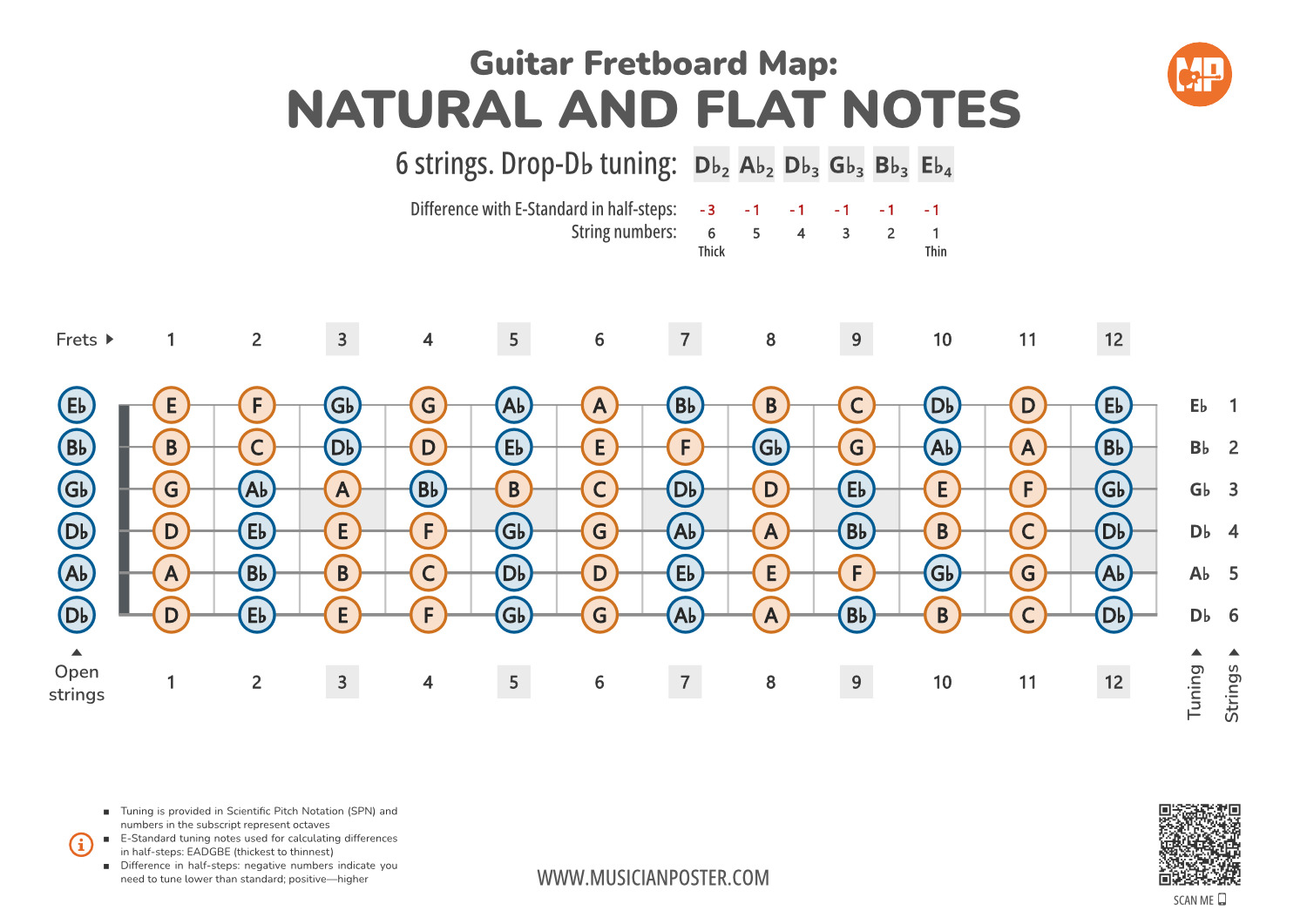
To help you visualize the fretboard as you work, you can refer to the following fretboard map. Note that Db (D-flat) is the same note as C# (C-sharp).
Conclusion
In this lesson, you have learned two powerful methods for adapting a multi-string pattern to a new tuning.
Key Takeaways:
- Pitch-for-Pitch Transposition: This analytical method preserves the original harmony by calculating new fret positions based on the change in tuning. It's essential for accurately playing existing music in a new context.
- Shape-Based Adaptation: This creative method preserves the physical fingering of a lick, applying it directly to the new tuning to generate new sounds and ideas that are idiomatic to that tuning.
- The choice of method depends on your goal: are you trying to replicate a song or create something new?
Mastering both approaches gives you both technical precision and creative flexibility—two cornerstones of the modern guitar style you are aiming for.
In the next lesson, we will continue our work in Drop C# by adapting a hybrid picking pattern. This will further solidify your understanding of these transposition concepts and your command of the fretboard in this new tuning.