Recommended resources
The freely available resources this lesson will direct you to.
Hello! Welcome to the first lesson in our course on Aristotle's theory of the immovable mover.
Introduction
Our ultimate goal is to understand Aristotle's complex and influential argument for a first, unmoved mover. To do that, we must first equip ourselves with the fundamental concepts of his metaphysical system. This first module, "Aristotle's Metaphysical Toolkit," will provide the essential vocabulary and conceptual framework.
Today's lesson focuses on the very first learning outcome: to distinguish between Aristotle's four causes (material, formal, efficient, and final).
You'll find that Aristotle's use of the word "cause" is much broader than our modern scientific usage. Your background in statistics and econometrics has likely trained you to think of causality in terms of predictive relationships or chains of events (A leads to B). Aristotle's framework is a different, more comprehensive way of asking the question "Why?". Understanding this distinction is the key to unlocking his entire physical and metaphysical worldview.
1. What is a "Cause"? Reframing Aitia
Before we dive into the four causes, we need to clarify what Aristotle means by "cause." The Greek word he uses is aitia (αἰτία), which is more accurately translated as "explanation" or "reason." For Aristotle, to have scientific knowledge (episteme) of something is to grasp its why—to be able to give a full account of it.
To explore this crucial point, please read the following brief excerpts.
Aristotle on Causality - Stanford Encyclopedia of Philosophy
First, let's look at the introductory section of the Stanford Encyclopedia of Philosophy (SEP) entry on 'Aristotle on Causality'. It sets the stage by explaining that Aristotle saw himself as refining the work of his predecessors, who he felt had an incomplete grasp of causality.
Please read Section 1, 'Introduction'. Focus on how Aristotle situates his own work in relation to earlier thinkers and why he believed a systematic theory of causality was necessary.
This short resource from Memorial University of Newfoundland provides a very direct clarification of the term 'aitia'.
Please read the first two paragraphs, down to the line '"Cause" is the traditional translation of the Greek aitia...'. This reinforces the point made in the SEP article.
In essence, when Aristotle asks for the "causes" of a thing, he is asking for the four distinct types of explanation that, taken together, provide a complete understanding of that thing. He believed his predecessors had touched upon these explanations but had failed to distinguish them clearly or use them systematically.
2. The Four Explanations
Let's now examine each of the four causes, or explanations. A classic and effective way to illustrate them is by considering the creation of an artifact. We will use the example of a table.
To start, please watch the first few minutes of the following video from Hillsdale College. It provides a clear and concise overview using the example of an apple.
Aristotle's Four Causes | Highlights Ep.43
This video, 'Aristotle's Four Causes', gives a quick and accessible introduction to each of the four concepts.
Watch from the beginning until the 03:40 mark. Pay attention to how each cause answers a different kind of 'why' question about the apple.
As the video shows, the four causes provide a multi-faceted explanation. Let's formalize them, using the example of a bronze statue as discussed in the SEP article, which you'll read next.
Aristotle on Causality - Stanford Encyclopedia of Philosophy
Now, let's turn back to the Stanford Encyclopedia of Philosophy article for a more detailed and rigorous definition of each cause.
Please read the entirety of Section 2, 'The Four Causes'. It defines each cause and uses the excellent example of a bronze statue to show how they work together.
To summarize and structure the concepts from the video and the text:
-
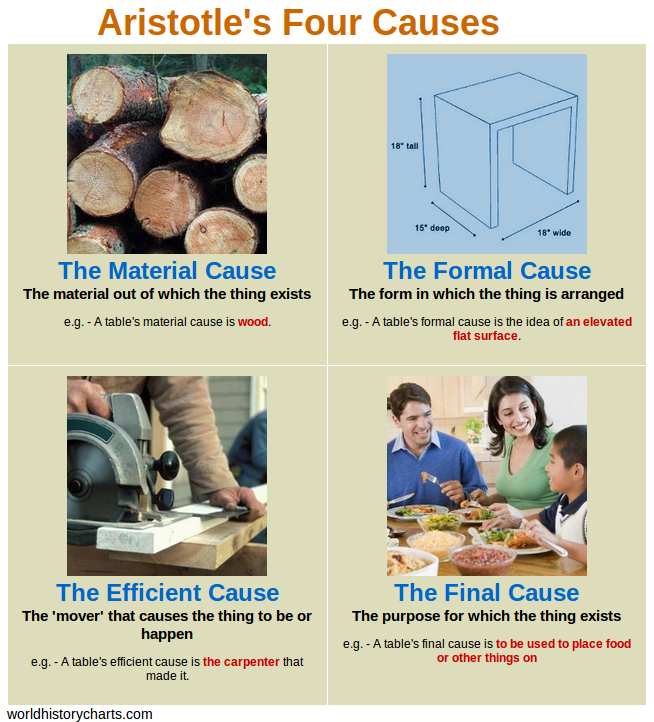
The Material Cause (The "what from?"): This is the matter or substrate out of which a thing is made.
- For a bronze statue, it is the bronze.
- For a wooden table, it is the wood.
- In your MSc project on Multi-Agent Reinforcement Learning, the "material" cause of a specific trained agent could be seen as the underlying code and the data it was trained on.
-
The Formal Cause (The "what is it?"): This is the form, pattern, structure, or essence of a thing. It's the blueprint that makes the matter into a particular kind of thing.
- For the statue, it is the sculptor's design or the shape that makes it recognizable as, say, a statue of Socrates.
- For the table, it is its design—four legs and a flat top.
- For your MARL agent, the formal cause is the neural network architecture, the specific algorithms (like policy gradients), and the mathematical structure of the interactive-POMDP framework itself.
-
The Efficient Cause (The "what by?"): This is the agent or process that brings something about. It's the source of the change or motion.
- For the statue, it is the sculptor. As the SEP article notes, Aristotle would say more precisely it is the art of sculpting within the sculptor.
- For the table, it is the carpenter.
- For the trained agent, the efficient causes are the programmers who wrote the code, the computational process of the training loop (gradient descent, backpropagation), and the environment providing feedback.
-
The Final Cause (The "what for?"): This is the purpose, end, goal, or telos for which a thing exists.
- For the statue, it could be to honor Socrates, to beautify a public square, or to be sold for profit.
- For the table, it is to provide a surface for dining or working.
- For the trained agent, its final cause is the objective it was designed to achieve—winning a game, optimizing a system, or, in the context of your project, making optimal decisions in a multi-agent environment.
This image provides a simple visual summary using the example of a table.
3. Application in Nature and the Interrelation of Causes
Aristotle did not develop this framework just for artifacts. His primary interest was the natural world. In nature, he argued, these four causes are also at play, though sometimes in a more integrated way.
A key Aristotelian phrase is "a human begets a human." Let's analyze this using the four causes to see how they apply to natural generation.
Aristotle on Causality - Stanford Encyclopedia of Philosophy
The SEP article continues by explaining how the four causes are applied specifically to the study of nature.
Please read Section 3, 'The Four Causes and the Study of Nature'. Focus on how the formal, final, and efficient causes can coincide in natural processes.
As the text explains, in the generation of a new human being:
- The material cause is provided by the mother.
- The efficient cause is the father, who initiates the process of generation.
- The formal cause is the "human form" or soul, which the father imparts to the matter.
- The final cause is the end of the process: a fully actualized, mature human being.
Notice the elegant convergence here: the efficient cause (the father) already possesses the form (the formal cause) that he imparts, and this form is directed toward an end (the final cause) which is the full realization of that same form. This idea of form and end being deeply connected is fundamental to Aristotle and will be crucial for understanding his arguments about motion.
Conclusion
In this lesson, we have introduced Aristotle's foundational explanatory framework.
Key Takeaways:
- Aristotle's "four causes" are better understood as four types of explanation (aitia) that answer the question "Why?".
- The four causes are:
- Material: The underlying matter.
- Formal: The structure, essence, or blueprint.
- Efficient: The agent or process initiating change.
- Final: The purpose or end (telos).
- While modern science focuses almost exclusively on material and efficient causes, for Aristotle, a complete explanation must include all four, especially the formal and final causes, which he saw as essential for understanding both artifacts and natural organisms.
This framework is the first and most critical tool in Aristotle's toolkit. Without a firm grasp of this four-fold explanatory structure, his subsequent arguments about change, motion, and the cosmos are unintelligible.
Preview of the Next Lesson:
In our next lesson, we will delve deeper into the concepts of substance (ousia), form, and matter. This will build directly on our discussion of the material and formal causes and further clarify the metaphysical structure of the objects that Aristotle seeks to explain.