Recommended resources
The freely available resources this lesson will direct you to.
Hello! Welcome back to our course on Aristotle's theory of the immovable mover.
Introduction
In our first lesson, we established Aristotle's framework of the four causes, or four types of explanation. We saw that a complete account of anything requires understanding its material, formal, efficient, and final causes. This lesson builds directly on that foundation, focusing on two of those causes—matter and form—to explore the very structure of reality.
Today's learning outcome is to explain the concepts of substance (ousia), form, and matter in Aristotle's metaphysics. This is arguably the most central and foundational topic in Aristotle's entire philosophical system. The question "What is being?" for Aristotle, ultimately becomes the question "What is substance?".
Your background in formal systems from mathematics and computer science will be an asset here, as we'll be dissecting the logical structure of how Aristotle categorizes reality and defines the fundamental constituents of the things we encounter every day.
1. The Centrality of Ousia (Substance)
Before we can analyze substance, we need to be clear on the term itself. The Greek word is ousia (οὐσία), and its standard translation as "substance" can be misleading due to its later philosophical baggage.
To get a better feel for Aristotle's starting point, let's explore the original meaning of the term.
This first reading, from the Internet Encyclopedia of Philosophy (IEP) article 'Aristotle: Metaphysics', explains the translation issue and traces the pre-philosophical meaning of 'ousia'.
Please read Section 2, 'Translating Aristotle', and Section 3, 'The Meaning of Ousia (Being) in Plato'. Focus on why 'substance' can be a problematic translation and the analogy of 'ousia' to 'real estate' or the holdings of a 'man of substance'.
As the article explains, ousia originally connoted stability, permanence, and independence—like real estate, it's what endures. This is the core intuition Aristotle builds upon. He observes that the world is not just a chaotic flux of qualities (like 'redness' or 'hotness'); it is populated by distinct, enduring things—a horse, a tree, a person. These are the primary beings.
Aristotle formalizes this intuition in his work, the Categories, where he argues that these individual things are the fundamental subjects of reality.
Aristotle's Metaphysics - Stanford Encyclopedia of Philosophy
The Stanford Encyclopedia of Philosophy (SEP) entry on 'Aristotle's Metaphysics' provides a more technical account of this idea. It explains how Aristotle distinguishes primary substances from everything else.
Please read Section 2, 'The Categories', and Section 3, 'The Role of Substance in the Study of Being Qua Being'. Pay close attention to the distinction between what is 'in a subject' (like a quality) and what is 'said of a subject' (like a species), and how primary substances are the foundation for everything else.
From these readings, we can establish two key points about ousia:
- Primary Substances are Individuals: The most fundamental realities are individual things like 'this specific man' or 'this specific horse'. They are the ultimate subjects of predication—we can say things about them, but they are not said of anything else.
- Other Categories are Dependent: Qualities (like 'white'), quantities (like 'two meters tall'), and all other categories only exist because they belong to, or inhere in, a substance. There is no free-floating 'whiteness'; there is only the whiteness of a horse or a wall.
Therefore, the study of being, for Aristotle, becomes the study of substance, the primary mode of being to which all others relate.
2. Hylomorphism: The Matter-Form Composite
Having identified individual things (substances) as the primary constituents of reality, Aristotle then asks: what are these things made of? His answer is that every sensible substance is a composite of two principles: matter (hylē) and form (morphē). This doctrine is known as hylomorphism.
Let's start with a quick visual and conceptual introduction to this core idea.
Aristotle's Theory of Substance
This first short video, 'Aristotle's Theory of Substance', introduces the idea that every substance is a composite of matter and form, contrasting Aristotle's view with Plato's.
Please watch the video from the beginning to the 03:14 mark. Focus on how matter and form are presented as the two aspects of any individual entity.
This second video, 'Form and Matter', from The Thomistic Institute, offers a slightly more technical definition, introducing the term 'hylomorphism' and explicitly connecting matter to potentiality and form to actuality.
Watch the video from 00:38 to 02:33. Pay attention to the definition of matter as 'pure potentiality' and the relationship between the matter/form and potency/act distinctions.
These videos give us the basic picture. Let's look at two images that summarize this relationship.

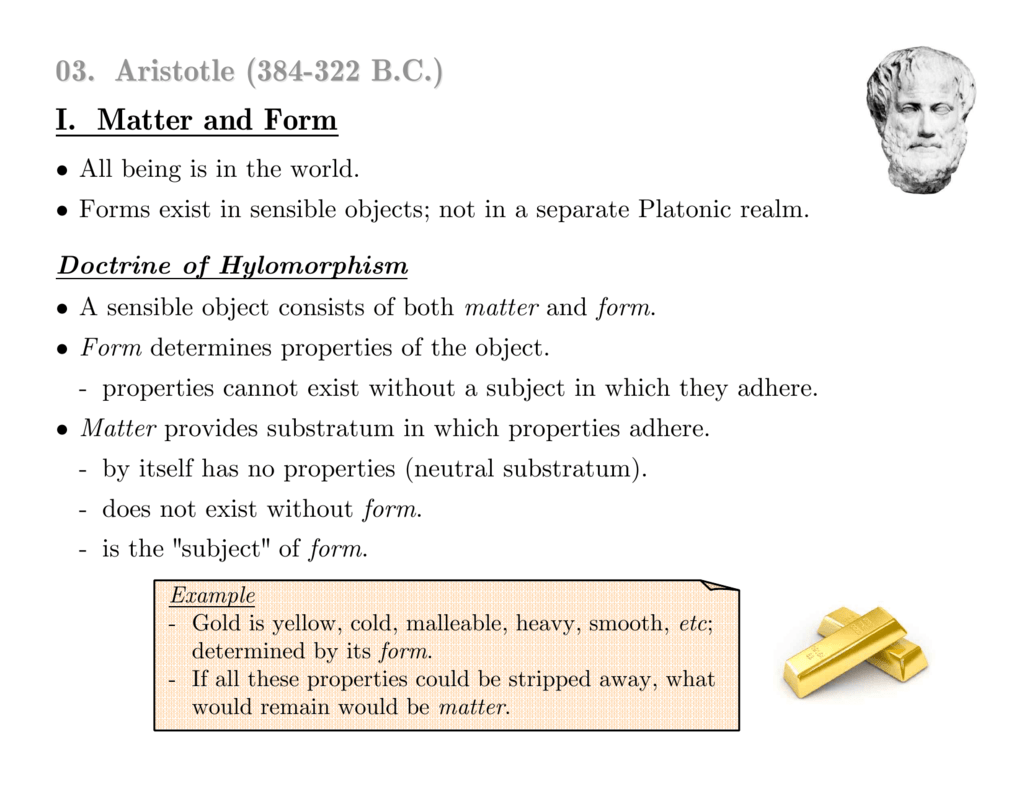
Now, let's deepen this understanding with a more rigorous analysis from the SEP article. Aristotle doesn't just assert this; he argues for it by investigating what could possibly count as the 'substance of' a thing.
Aristotle's Metaphysics - Stanford Encyclopedia of Philosophy
Returning to the SEP article, this section explores the candidates for what makes a substance a substance, ultimately rejecting indeterminate matter as the answer.
Please read Section 5, 'What is Substance?', and Section 6, 'Substance, Matter, and Subject'. Focus on the argument in Section 6 for why matter, when considered as a pure, formless subject, cannot be substance because it is not a determinate individual ('this something') and 'separable'.
The argument is subtle but powerful. If we strip away all properties (form) from a thing in search of its ultimate subject, we are left with something completely indeterminate (what is sometimes called 'prime matter'). But such a thing could not exist on its own and is not a definite 'this'. Therefore, matter alone cannot be what makes a substance what it is.
3. The Primacy of Form as Essence
If matter isn't the substance of a thing, what is? Aristotle's answer is that form is substance in the primary sense. The form is the principle of organization, the structure, the function—in short, the essence—that makes the matter into the specific, determinate thing that it is.
Consider an analogy from your own field. The "matter" of a complex software system could be seen as the millions of lines of code stored on a disk—a vast collection of text characters. But that is not what the software is. The "form" is the architecture, the algorithms, the data structures, and the logical relationships that organize that code into a functioning application (e.g., a trading platform or a multi-agent simulation). This form is the essence of the software; it's what is specified in its design documents and what makes it the specific program it is. The software is its form actualized in the matter of the code.
Aristotle connects this idea of form directly to the concept of essence and definition.
Aristotle's Metaphysics - Stanford Encyclopedia of Philosophy
This final reading from the SEP article solidifies the identification of form with essence and primary substance.
Please read the sections titled 'Essence' (which begins in Ζ.4, part of our 'part 4') and 'Substances as Hylomorphic Compounds' (Ζ.7–9, our 'part 5'). The key takeaways are in the first paragraph of the second section: 'by form I mean the essence of each thing and the primary substance' and 'by the substance without matter I mean the essence'.
The form is what is captured in a definition. The definition of 'human' doesn't mention the particular flesh and bones of an individual; it captures the universal form or essence of what it is to be human (e.g., 'rational animal'). This form is what makes a particular lump of matter a human being, and thus it is the 'substance of' that human being.
Conclusion
This lesson has unpacked the core components of Aristotle's ontology. We have moved from identifying individual things as the basic furniture of the world to analyzing their internal structure.
Key Takeaways:
- Substance (Ousia): In its primary sense, ousia refers to individual, independently existing things (e.g., this person, this tree). All other types of being, like qualities and quantities, depend on substances.
- Hylomorphism: Every physical substance is a composite of matter (hylē) and form (morphē).
- Matter: The underlying stuff or substratum of a thing. It is the principle of potentiality, capable of receiving a form but in itself indeterminate.
- Form: The structure, essence, or organizing principle that makes matter into a determinate, specific kind of thing. It is the principle of actuality.
- Primacy of Form: Because form provides the identity and actuality of a substance, Aristotle considers it to be substance in a more fundamental sense than matter or the composite. The form is the essence.
Preview of the Next Lesson:
We've repeatedly touched upon the ideas of 'potentiality' and 'actuality'. The videos explicitly linked matter to potentiality and form to actuality. Our next lesson, "Analyze the distinction between potentiality (dynamis) and actuality (energeia)," will explore this dynamic pair of concepts in detail. Understanding this distinction is the final and crucial step before we can understand Aristotle's definition of change and motion, which lies at the heart of his argument for an unmoved mover.