Recommended resources
The freely available resources this lesson will direct you to.
Hello! Welcome back to our study of identical particles.
In our last lesson, we established the crucial symmetrization postulate: the total wavefunction for a system of identical fermions must be antisymmetric under the exchange of any two particles. We saw that this principle leads directly to the Pauli exclusion principle and creates a fundamental link between a particle system's spin state (singlet or triplet for two electrons) and the symmetry of its spatial wavefunction. Specifically, a symmetric spin state (triplet, S=1) mandates an antisymmetric spatial wavefunction, while an antisymmetric spin state (singlet, S=0) requires a symmetric one.
This lesson delves into the profound energetic consequences of this rule. We will analyze the exchange interaction in the Helium atom, our first concrete example of a many-body quantum system. You will see how the interplay between the electrostatic Coulomb repulsion and the Pauli principle gives rise to an effective "exchange interaction." This interaction lifts the degeneracy between states of different total spin, providing a quantum mechanical explanation for Hund's rules and forming the conceptual basis for magnetism in solids.
The Helium Atom: Our Prototypical Many-Body Problem
The Helium atom, with two electrons and a nucleus of charge , is the simplest multi-electron atom. Assuming the nucleus is fixed at the origin (a very good approximation given its mass), the Hamiltonian is:
The Hamiltonian consists of two single-electron, hydrogen-like Hamiltonians ( and ) and an electron-electron repulsion term, . This repulsion term couples the coordinates of the two electrons, making the Schrödinger equation inseparable and impossible to solve exactly.
We must therefore turn to approximation methods. We'll use first-order perturbation theory, treating the individual electron Hamiltonians as the "unperturbed" part () and the electron-electron repulsion as the perturbation ().
Why We Must Consider an Excited State
The ground state of Helium has the electron configuration (1s)². Both electrons occupy the 1s spatial orbital. To satisfy the Pauli principle, their spins must be antiparallel, forming a spin singlet state (S=0). Since there is only one possible spin configuration, we can't compare its energy to a triplet state.
To observe the effect of the exchange interaction, we must look at an excited state where the electrons occupy different spatial orbitals, for example, the (1s)(2s) configuration. Now, the Pauli principle allows the electron spins to be either antiparallel (a singlet state, S=0) or parallel (a triplet state, S=1), giving us two distinct states whose energy difference we can calculate.
The following video provides an excellent conceptual overview of this setup and the entire derivation.
To start, watch this video from Nicola Spaldin. It provides a clear, qualitative walk-through of the entire problem, from setting up the Hamiltonian to interpreting the final result.
Watch from the beginning to 15:29. Focus on: Why the first excited state of Helium is the ideal system for this analysis. The construction of the symmetric and antisymmetric spatial wavefunctions. How these spatial symmetries are linked to the anti-parallel (singlet) and parallel (triplet) spin states, respectively.
Constructing the Wavefunctions and Calculating the Energy
As the video explained, and as we saw in the last lesson, the requirement for a totally antisymmetric wavefunction leads to two possibilities for the (1s)(2s) configuration:
-
Singlet State (S=0): Antisymmetric spin part Symmetric spatial part.
-
Triplet State (S=1): Symmetric spin part Antisymmetric spatial part.
Since the Hamiltonian does not depend on spin, the energy correction for these states depends only on their spatial wavefunctions, and . The first-order energy correction is the expectation value of the perturbation, :
The following resource provides a detailed mathematical breakdown of this calculation.
Now, let's work through the mathematics. These lecture notes from MIT provide a clear, step-by-step derivation of the energy splitting.
Please read the section 'Energies of Singlet and Triplet States' on pages 13-15. Follow the derivation that expands the energy expectation value into two key integrals, J and K.
Coulomb and Exchange Integrals
As you saw in the reading, expanding the expectation value integrals leads to two distinct types of terms. The total energy for the singlet and triplet states is:
Where and are the unperturbed hydrogenic energies, and and are two new, all-important integrals:
-
The Coulomb Integral (J):
This integral has a straightforward classical interpretation. It represents the electrostatic repulsion between the charge distribution of the electron in the 1s orbital () and the charge distribution of the electron in the 2s orbital (). It is a purely classical Coulomb energy. -
The Exchange Integral (K):
This integral has no classical analog. Notice how the electron labels are "exchanged" between the initial and final states in the integrand (). This term arises directly from the interference between the two terms in our symmetrized wavefunction and is a purely quantum mechanical effect due to the indistinguishability of the electrons. It can be shown that .
The final energy expressions are:
- Singlet Energy:
- Triplet Energy:
The degeneracy between the singlet and triplet states is lifted by a quantity . This energy splitting is a direct result of the exchange interaction.
Physical Interpretation: Hund's Rule and Spin Correlation
The mathematics gives a clear result: . The triplet state is lower in energy. Why?
The answer lies in the symmetry of the spatial wavefunctions.
- The triplet state has an antisymmetric spatial wavefunction . By definition, . If we set , we get , which means must be zero. The probability of finding the two electrons at the same point in space is zero. In effect, the Pauli principle creates a "correlation hole" around each electron, forcing them to stay apart. This reduces their mutual Coulomb repulsion.
- The singlet state has a symmetric spatial wavefunction . There is no such restriction. In fact, is maximal when is near , leading to a higher probability of finding the electrons close together. This "quantum bunching" increases their average Coulomb repulsion.
Therefore, the exchange interaction is not a new fundamental force. It is the observable energy difference caused by the interplay of the electrostatic Coulomb force and the purely quantum mechanical requirement of wavefunction antisymmetry. The spin state of the electrons dictates the symmetry of their spatial distribution, which in turn determines their average separation and, consequently, their electrostatic repulsion energy.
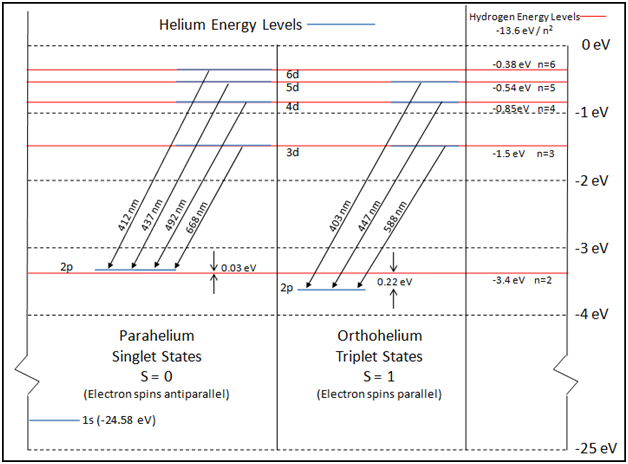
This result is the simplest demonstration of Hund's First Rule: For a given electronic configuration, the term with the highest spin multiplicity has the lowest energy.
The diagram below shows the measured energy levels for Helium, clearly illustrating this principle. States are grouped into "Parahelium" (singlets, S=0) and "Orthohelium" (triplets, S=1). Notice that for any given configuration (e.g., 1s2p, 1s3d), the triplet state is always lower in energy than the corresponding singlet state.
Test your understanding!
Imagine a hypothetical world where electrons are distinguishable particles (let's call them "electron-1" and "electron-2"). For the 1s2s configuration, the wavefunction would simply be , with no need for symmetrization.
What would the first-order energy correction be in this world? What does this tell you about the origin of the exchange integral K?
Show answer
If the electrons were distinguishable, the wavefunction would be a simple product state. The energy correction would be:
Rearranging the terms gives:
The energy correction would just be the Coulomb integral . The exchange integral is completely absent. This proves that the exchange interaction is a direct consequence of the particle indistinguishability and the symmetrization postulate; it does not exist for distinguishable particles.
From Helium to Magnetism: The Heisenberg Model
The idea that the energy of a system depends on the relative orientation of spins is the foundation of magnetism. We can encapsulate the entire effect of the exchange interaction in a simple, effective Hamiltonian that operates only on the spin variables:
(Here, we've absorbed the unperturbed energy into a constant and adjusted the form slightly). Using the identity , we can find the value of :
- For a singlet state, , , . The eigenvalue of is . This gives (The constant offset differs slightly from the direct derivation but the splitting is the key).
- For a triplet state, . The eigenvalue of is . This gives .
This form correctly reproduces the energy splitting and shows that the parallel spin alignment (triplet) is energetically favored. A generalized version of this, , is the famous Heisenberg model, a cornerstone of the theory of magnetism in condensed matter physics.
Conclusion
In this lesson, we dissected our first true many-body problem and uncovered a purely quantum mechanical phenomenon. The analysis of the Helium atom serves as a powerful illustration of fundamental principles with far-reaching consequences.
Key Takeaways:
- The combination of Coulomb repulsion and the Pauli exclusion principle gives rise to the exchange interaction.
- This interaction splits the energy levels of states with different total spin. In the Helium atom, the triplet (S=1) state is lower in energy than the singlet (S=0) state for the same configuration.
- This energy lowering is not due to a direct magnetic interaction between spins, but because the required antisymmetric spatial wavefunction of the triplet state forces the electrons to be further apart on average, reducing their electrostatic repulsion.
- This principle is a general one, codified in Hund's first rule, and it forms the basis for understanding magnetism via effective spin Hamiltonians like the Heisenberg model.
Preview of the Next Lesson:
Manually constructing Slater determinants and calculating these multidimensional integrals for the Helium atom was already quite involved. Scaling this approach to a crystal with electrons is impossible. To proceed, we need a more powerful and abstract formalism. In the next lesson, we will introduce second quantization. We will define creation and annihilation operators that automatically encode the proper bosonic or fermionic statistics, allowing us to build and solve many-body Hamiltonians without ever writing down an explicit N-particle wavefunction. This will be our primary language for exploring the physics of many-electron systems.