Recommended resources
The freely available resources this lesson will direct you to.
Hello! Welcome back.
In our last lesson, we tackled the Helium atom using first quantization. We saw firsthand how constructing properly antisymmetrized wavefunctions and calculating multi-dimensional integrals becomes cumbersome for even the simplest many-body system. We concluded that this approach is intractable for the systems you're interested in, like those in condensed matter physics with electrons.
This lesson introduces a far more powerful and elegant formalism known as second quantization. Instead of manipulating complicated N-particle wavefunctions, we will work with abstract states in a new kind of Hilbert space and operators that automatically handle all the difficult bookkeeping of particle statistics. This formalism is the standard language of many-body physics, from condensed matter to quantum field theory.
Our goal is to construct Fock space and define creation and annihilation operators for bosons and fermions. By the end of this lesson, you will understand the new mathematical arena for many-body quantum mechanics and the fundamental tools used to build states and represent their interactions.
The Arena: Occupation Number Representation and Fock Space
The key idea behind second quantization is to shift our perspective. Instead of tracking each particle's coordinates , we simply specify how many particles occupy each available single-particle quantum state.
Let's say we have a basis of single-particle states (e.g., the 1s, 2s, 2p orbitals of an atom, or the plane wave momentum states in a crystal). A complete many-body state is then defined by the set of occupation numbers , where is the number of particles in state . We denote such a state as .
For example, the ground state of the Helium atom, with two electrons in the 1s orbital, would be written as .
This representation naturally leads to the concept of Fock space. While a standard Hilbert space describes a system with a fixed number of particles , Fock space is a larger structure that encompasses all possibilities. It is the direct sum of the Hilbert spaces for zero particles (), one particle (), two particles (), and so on.
This structure allows us to describe systems where the number of particles can change (e.g., creation/annihilation of electron-hole pairs in a semiconductor, or a system in contact with a particle reservoir) and, as we'll see, provides an incredibly convenient way to handle even fixed-particle-number problems.
The following video gives a concise introduction to the concept of Fock space.
Fock space: variable number of quantum particles
This video from 'Professor M does Science' provides a clear, formal definition of Fock space, starting from the occupation number representation and the concept of direct sums.
Please watch from the beginning up to 05:21. Pay attention to: How Fock space is constructed as a direct sum of N-particle spaces. The definition of a 'Fock state' as a state with a definite particle number. The role of the vacuum state, |0⟩, which is the state with zero particles and forms the basis for the F₀ space.
As the video highlighted, the foundation of Fock space is the vacuum state, . It is the state containing no particles. Every other state in Fock space can be constructed by adding particles to this vacuum.
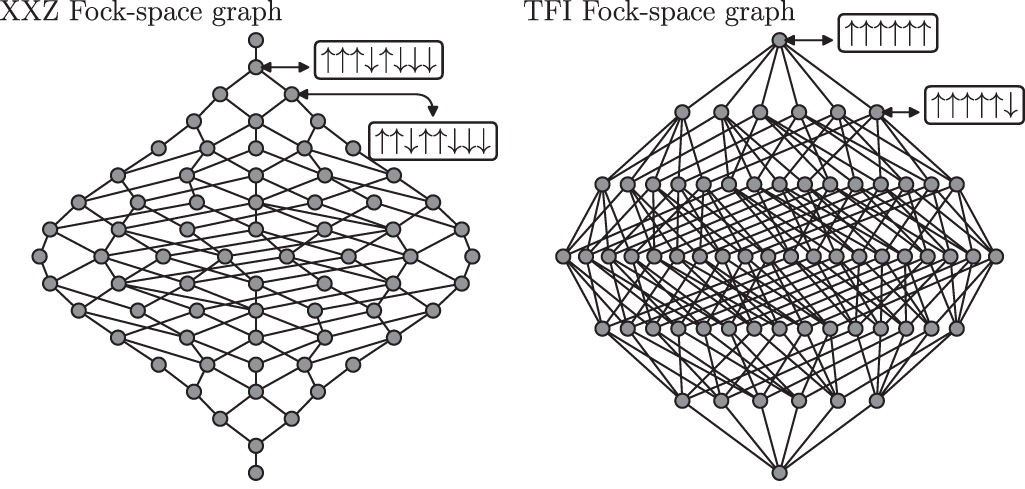
To visualize this abstract space, consider the following image. It shows the Fock space for two common condensed matter models. Each node is a specific occupation-number state (a Fock state), and the lines represent operators that move the system from one state to another.
The Tools: Creation and Annihilation Operators
How do we "add" or "remove" particles to navigate this space? We introduce two new types of operators.
- Creation Operator (): Adds one particle to the single-particle state .
- Annihilation Operator (): Removes one particle from the single-particle state .
The precise mathematical definition of these operators depends on whether the particles are bosons or fermions.
1. Bosons
Bosons, like photons or Helium-4 atoms, have no restriction on how many can occupy a single state. Their creation and annihilation operators are defined by their action on a Fock state and their commutation relations.
The following video gives a complete derivation of the properties of bosonic operators.
Boson creation and annihilation operators
This video, also from 'Professor M does Science', systematically defines the bosonic creation operator, derives the annihilation operator as its adjoint, and then finds their fundamental commutation relations.
Watch from the beginning to 09:12. This is the core of the lesson for bosons. Focus on: The definition of a_i^\dagger and a_i and the origin of the sqrt(n) factors. The derivation of the three canonical commutation relations.
Let's summarize the crucial results from the video. For bosonic operators and :
-
Action on Fock States:
Note that if , the annihilation operator gives zero, as expected: . Specifically, for all . -
Canonical Commutation Relations:
where .
The fact that creation operators for different states commute () is profound. It means the order in which you create particles doesn't matter: . This algebraic property automatically ensures that the many-body state you build is symmetric under particle exchange, fulfilling the requirement for bosons without any manual symmetrization!
Any bosonic Fock state can be built by acting on the vacuum with creation operators:
2. Fermions
Fermions, like electrons, are subject to the Pauli Exclusion Principle. The formalism must reflect this. Instead of commuting, fermionic operators anti-commute.
For a deeper dive into the formalism for both bosons and fermions, the following lecture notes are an excellent resource. We will focus on the sections defining the operators and their properties.
These lecture notes by Dirk van der Marel provide a physically motivated introduction to second quantization, which nicely complements the more formal videos. We'll use them to understand the fermionic case.
Please read Section 2.2 'Fermions' (pages 27-28). Pay close attention to how the anti-commutation relations are defined and how they inherently encode the Pauli exclusion principle.
As explained in the notes, the operators and for fermions obey canonical anti-commutation relations:
where the anti-commutator is defined as .
Let's unpack the consequences:
-
Pauli Exclusion Principle: Consider creating two fermions in the same state . From the second relation, . This implies . It is impossible to create two fermions in the same quantum state. The Pauli principle is built directly into the operator algebra. This restricts occupation numbers to be only 0 or 1.
-
Antisymmetric Wavefunctions: Consider a two-particle state . From the second relation, . Therefore, . Exchanging the order of creation (which corresponds to exchanging the particles) introduces a minus sign. The formalism automatically generates the required antisymmetric state, just as we painstakingly constructed for Helium using Slater determinants.
The action on Fock states is simpler than for bosons since can only be 0 or 1:
where is the number of occupied states before state in a pre-defined order. This "sign string" is a bookkeeping device required to maintain consistency with the anti-commutation relations for . While it can be tricky in practice, for many theoretical calculations it can be handled systematically.
A general fermionic state is built from the vacuum just like for bosons, but without the factorial normalization since :
Test your understanding!
Consider a system with three single-particle states: , , and .
- Write down the Fock state corresponding to two particles in state and one particle in state using creation operators acting on the vacuum, .
- Is this a valid state for bosons? Is it valid for fermions? Explain why, based on the operator algebra.
Show answer
-
The state is constructed as (for bosons) or (for fermions).
-
- Bosons: This is a perfectly valid state. The bosonic creation operators commute, so there is no issue with applying twice. The properly normalized state would be .
- Fermions: This state is not valid; in fact, it is identically zero. The fermionic creation operators anti-commute, which means . Applying the same creation operator twice yields zero, mathematically enforcing the Pauli exclusion principle. You cannot have two fermions in the same state.
Conclusion
This lesson marks a significant shift in our approach to quantum mechanics. We have moved away from the cumbersome first-quantized picture of explicit wavefunctions and entered the abstract but powerful world of second quantization.
Key Takeaways:
- Fock space is the proper Hilbert space for many-body systems, accommodating states with any number of particles. Its basis is the occupation number representation .
- Creation () and annihilation () operators are the fundamental tools for building states and navigating Fock space.
- The statistics of identical particles are encoded in the algebra of these operators:
- Bosons obey commutation relations, which ensures the automatic construction of symmetric many-body states.
- Fermions obey anti-commutation relations, which automatically enforces the Pauli exclusion principle and constructs antisymmetric states.
Preview of the Next Lesson:
We have defined the space (Fock space) and the tools to build states (creation/annihilation operators). The next crucial step is to learn how to express physical observables, like the kinetic energy and potential energy terms in a Hamiltonian, using these operators. We will learn how to translate single-particle operators (like ) and two-particle operators (like the Coulomb interaction ) into the language of second quantization. Once we can write the Hamiltonian in this formalism, we will have a complete and powerful framework for solving problems in many-body quantum physics.