Recommended resources
The freely available resources this lesson will direct you to.
Welcome to the first lesson of your training program, "From Zero to Confirmed Accountant." We are at the very beginning of your journey, starting with Level 1: Accounting Foundations. This first module, "The Language of Business," is designed to give you a solid, unshakable understanding of the core principles upon which all accounting is built.
Today’s lesson focuses on the single most important concept in accounting: the accounting equation. By the end of this session, you will be able to define this equation and clearly explain the relationship between a company's assets, liabilities, and equity. Understanding this is not just an academic exercise; it is the logical framework that underpins the entire double-entry accounting system and the structure of a key financial report, the Balance Sheet.
We will start with the intuitive concept behind the equation and then, in line with your preference for a balanced approach, we'll explore the formal definitions before seeing how it all comes together in practice.
1. The Core Idea: What a Business Owns and What It Owes
At its heart, accounting is about tracking a business's resources and the claims on those resources. Think of it this way: everything a company owns (its resources) had to come from somewhere. It was either financed by borrowing from others (like a bank) or by investments from the owners.
This simple idea gives us the fundamental accounting equation. To get a clear and simple introduction to this concept, please watch the first few minutes of the following video.
The ACCOUNTING EQUATION For BEGINNERS
This video, 'The ACCOUNTING EQUATION For BEGINNERS' from Accounting Stuff, provides an excellent, straightforward explanation of the equation's core logic.
Watch from the beginning until timestamp 01:29. Focus on how the narrator breaks down the idea of 'Stuff the Business Owns' versus 'Stuff the Business Owes' into the three main components.
As the video explains, the accounting equation is:
This equation must always remain in balance. Every single accounting transaction, no matter how complex, will affect the equation in a way that keeps it balanced.
Let's define these terms, introducing the professional French terminology used in Morocco right away:
- Assets (Actif): These are the economic resources owned by the business that are expected to provide future benefits. Examples include cash, inventory, equipment, and buildings.
- Liabilities (Passif or Dettes): These are the obligations of the business, or what it owes to outside parties (creditors). Examples include bank loans, and amounts owed to suppliers.
- Equity (Capitaux Propres): This represents the owners' claim on the company's assets. It's the portion of the assets that is "left over" for the owners after all liabilities have been paid. It is also called the "residual interest."
In the Moroccan context, the Passif side of the equation often refers to the total of both Liabilities and Equity. So, the equation is expressed as:
2. A Deeper Look at the Definitions
Now that you have the basic idea, let's explore the more formal, technical definitions of these components. This will give you the precise understanding required for professional practice.
Assets, Liabilities & Equity: Made Easy!
The video 'Assets, Liabilities & Equity: Made Easy!' from the same channel, Accounting Stuff, delves into the formal accounting definitions. This will help solidify your theoretical understanding.
Please watch the following segments: The definition of Assets (00:55 - 04:54). The definition of Liabilities (09:00 - 10:58). The definition of Equity (18:08 - 20:30). Pay close attention to the key phrases used in the formal definitions, such as 'probable future economic benefit' for assets and 'probable future sacrifice' for liabilities.
To summarize and reinforce these more rigorous definitions:
- Assets are defined as probable future economic benefits obtained or controlled by a particular entity as a result of past transactions or events. The key here is the concept of a future benefit—an asset is something that will help the company generate revenue in the future.
- Liabilities are defined as probable future sacrifices of economic benefits arising from present obligations of a particular entity to transfer assets or provide services to other entities in the future as a result of past transactions or events. This emphasizes that a liability is a present obligation from a past event.
- Equity is the residual interest in the assets of an entity that remains after deducting its liabilities. This is why the equation can be rearranged to show:
This rearranged formula is very powerful. It shows that equity represents the net assets of the business—what would theoretically be left for the owners if the company sold all its assets and paid off all its debts.
3. Visualizing the Equation: The Balance Sheet
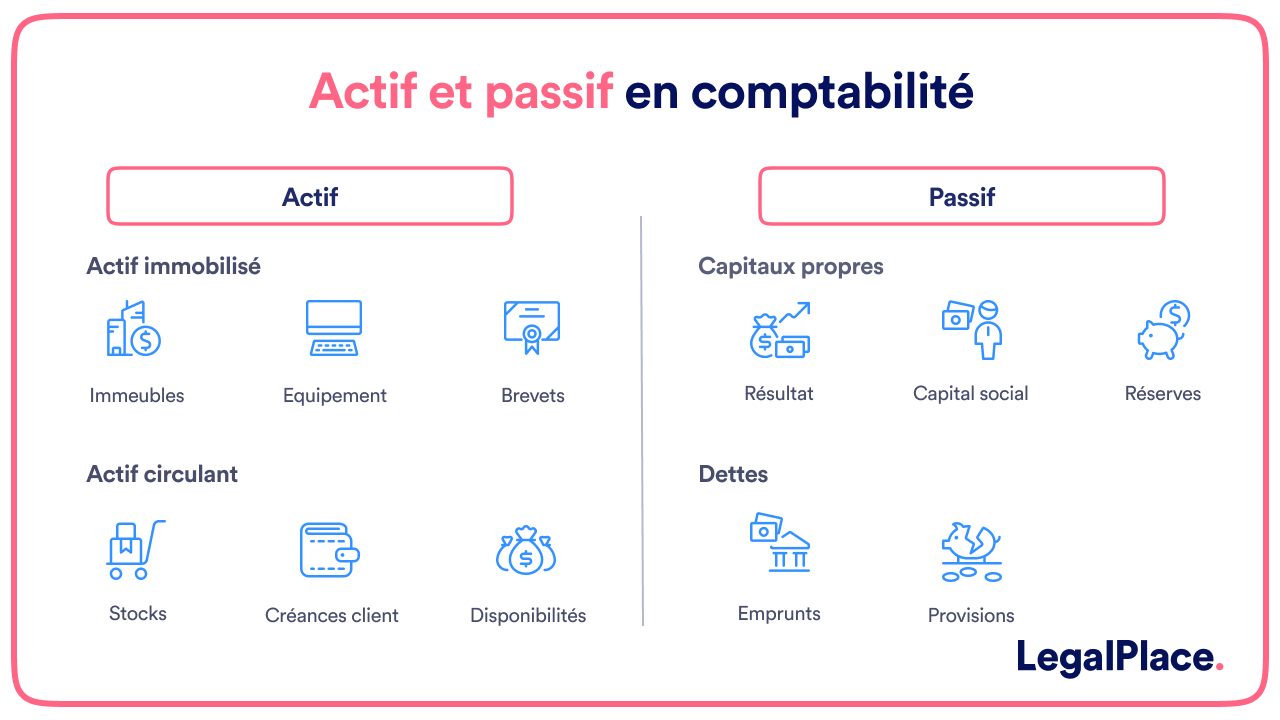
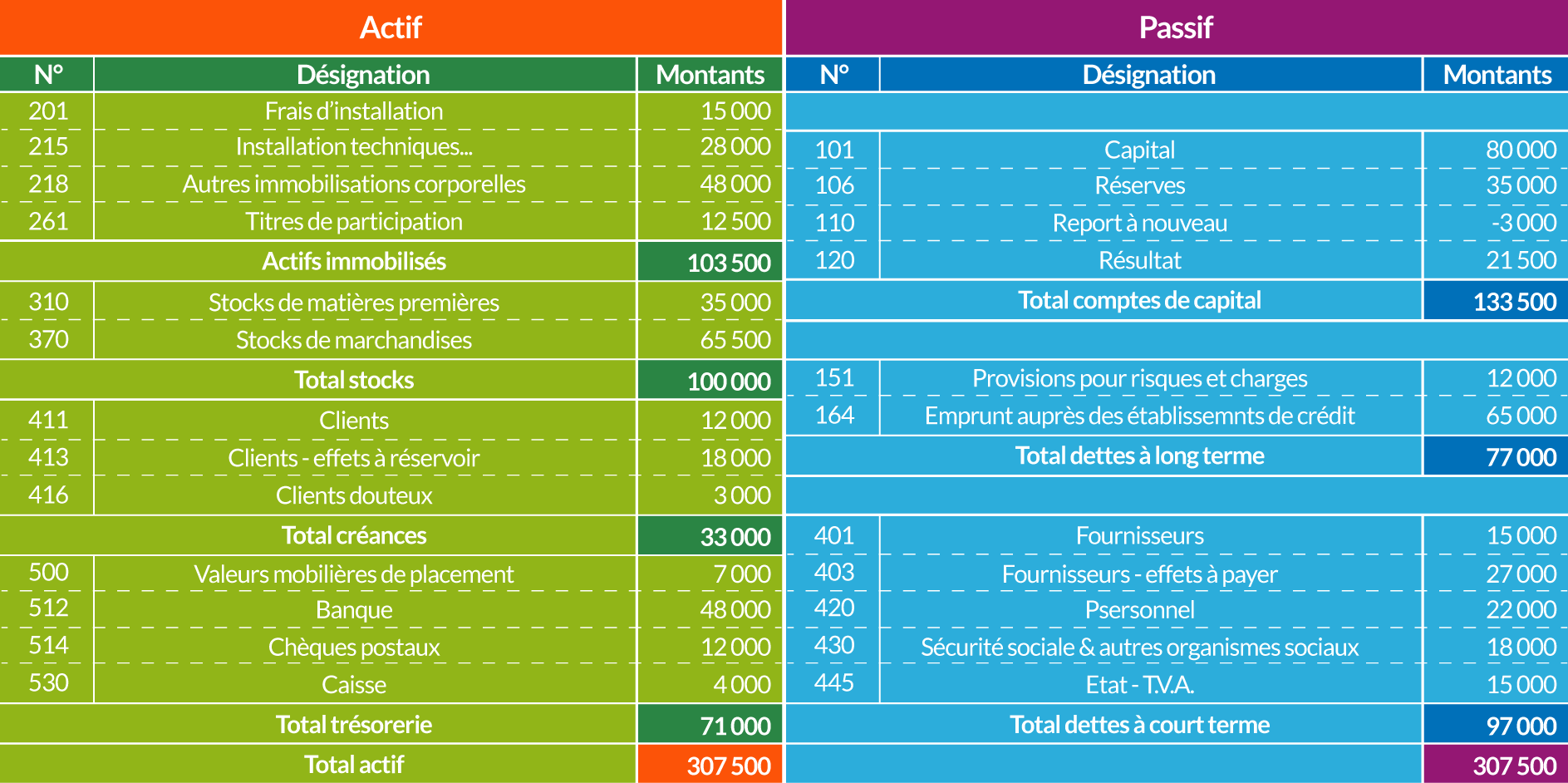
The accounting equation is not just an abstract formula; it is the blueprint for one of the most important financial statements: the Balance Sheet, known in French as le Bilan.
The Balance Sheet is a "snapshot" of a company's financial position at a specific point in time, showing exactly what it owns (Assets) and what it owes (Liabilities and Equity) on that day.
Let's look at how these components are structured.
Now, let's see how this structure ensures the accounting equation is always balanced.
To see how a transaction creates this balance from day one, please read the following short text.
Accounting Basics: In-Depth Explanation with Examples
The resource 'Accounting Basics' from AccountingCoach.com provides a clear, practical example of how an initial investment by an owner affects the accounting equation and creates the very first balance sheet.
Read the section titled 'Sample Transaction #1'. It walks through the first transaction of a new business and shows how it is reflected in both the balance sheet and the accounting equation format.
This example shows that when the owner, Joe, invested $20,000 cash:
- The company's Assets (specifically, Cash) increased by $20,000.
- The owners' claim on those assets, Equity (specifically, Common Stock), also increased by $20,000.
- The equation balanced: Assets ($20,000) = Liabilities ($0) + Equity ($20,000).
Test your understanding!
Let's apply this to a Moroccan SME. A new company, "Services Express SARL," is created.
- The founder invests 150,000 MAD of their own money into the company's bank account.
- The company then obtains a loan from a bank for 75,000 MAD to purchase computer equipment.
After these two transactions, what are the company's total Assets, Liabilities, and Equity? Show that the accounting equation is in balance.
Show answer
Let's break down the effects of the transactions:
-
Founder's Investment:
- Assets (Cash) increase by 150,000 MAD.
- Equity (Capital) increases by 150,000 MAD.
-
Bank Loan and Equipment Purchase:
- Assets (Computer Equipment) increase by 75,000 MAD.
- Liabilities (Bank Loan) increase by 75,000 MAD.
Final Position:
- Total Assets: Cash (150,000) + Computer Equipment (75,000) = 225,000 MAD
- Total Liabilities: Bank Loan = 75,000 MAD
- Total Equity: Capital = 150,000 MAD
Checking the Equation:
Assets = Liabilities + Equity
225,000 MAD = 75,000 MAD + 150,000 MAD
225,000 MAD = 225,000 MAD
The equation is perfectly in balance.
Conclusion
Congratulations on completing your first lesson. You have just mastered the foundational principle of all accounting.
Here are the key takeaways:
- The fundamental accounting equation is Assets = Liabilities + Equity. In French terminology, this is Actif = Passif (Dettes + Capitaux Propres).
- Assets are resources the business owns.
- Liabilities are obligations to external parties.
- Equity is the residual claim of the owners on the assets.
- This equation must always be in balance.
- It provides the structure for the Balance Sheet (le Bilan), which is a snapshot of a company's financial health.
Preview of the Next Lesson
Now that you understand the three main components of the equation, our next step will be to expand this view. In the next lesson, we will learn how to classify accounts into the five main categories: assets, liabilities, equity, and two new ones that drive profitability—revenues (produits) and expenses (charges). This will set the stage for you to begin recording actual business transactions.