Recommended resources
The freely available resources this lesson will direct you to.
Welcome to your second lesson. In our previous session, we established the cornerstone of accounting: the fundamental accounting equation, Assets = Liabilities + Equity. We saw how this equation provides the structure for the Balance Sheet (le Bilan), giving a snapshot of a company's financial position.
Today, we will build directly on that foundation. The learning outcome for this lesson is to classify accounts into the five main categories: assets, liabilities, equity, revenues, and expenses. We will introduce the last two categories—revenues and expenses—and see how they explain the changes in a company's value over time.
This classification is a crucial skill. Think of it as learning the grammar of accounting. Once you can identify the type of each account, you will be prepared to understand the rules that govern how transactions are recorded, which is the subject of our next lesson.
1. Expanding the Accounting Equation
In the last lesson, we focused on the Balance Sheet accounts: Assets, Liabilities, and Equity. But a business is dynamic; its financial position changes daily through its operations. How do we track these changes? This is where revenues and expenses come in.
- Revenues (Produits): These are the earnings generated from a company's primary business activities, such as selling goods or providing services. Receiving revenue increases the company's assets (like cash or accounts receivable) and, consequently, increases the owners' equity.
- Expenses (Charges): These are the costs incurred in the process of generating revenue. Paying for rent, salaries, or supplies decreases a company's assets (like cash) or increases its liabilities, and therefore decreases the owners' equity.
The net result of revenues minus expenses is the company's Net Income (Résultat Net). If revenues exceed expenses, the company has a profit, which increases equity. If expenses exceed revenues, it has a loss, which decreases equity.
This relationship allows us to create the expanded accounting equation:
This expanded view shows how the income statement (revenues and expenses) links directly to the balance sheet (through equity).
To see a clear explanation of how these pieces fit together, let's revisit a portion of a video from our last lesson.
Assets, Liabilities & Equity: Made Easy!
The video 'Assets, Liabilities & Equity: Made Easy!' explains how Equity is composed of initial investments and the accumulated profits (Retained Earnings), which are derived from revenues and expenses.
Please watch the segment on Equity from 18:08 to 27:39. Pay close attention to how 'Retained Earnings' are defined as accumulated profits (revenues minus expenses) and how this links the Income Statement to the Balance Sheet via the expanded accounting equation.
2. The Five Pillars of Accounting
Every transaction a business conducts can be broken down and categorized into one of five fundamental account types. Mastering this classification is non-negotiable for an accountant.
Here is a summary:
| Account Type | French Term | Purpose | Relationship to Equity |
|---|---|---|---|
| Assets | Actif | Resources owned by the business | N/A |
| Liabilities | Passif / Dettes | Obligations owed to others | N/A |
| Equity | Capitaux Propres | The owners' claim on net assets | The base value of ownership |
| Revenues | Produits | Earnings from business operations | Increases Equity |
| Expenses | Charges | Costs incurred to earn revenue | Decreases Equity |
3. Classification in Practice: The Moroccan Chart of Accounts
Now, let's move from theory to professional practice within the Moroccan context. In Morocco, all companies must use a standardized system for classifying accounts called the Plan Comptable Général Marocain (PCGM).
The PCGM organizes all possible accounts into numbered "classes." Understanding these classes is the key to classifying accounts in a Moroccan company.
For our current focus, the most important classes are 1 through 7. They are divided into two main groups:
- Balance Sheet Accounts (
Comptes de Bilan): These track what the company owns and owes. - Income Statement Accounts (
Comptes de Gestion): These track how the company performs (its earnings and costs).
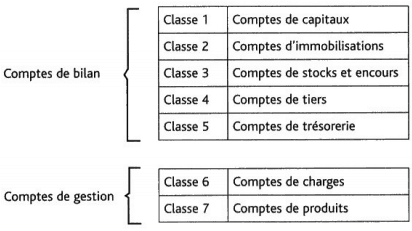
To understand the specific role of each class, please read the following document.
Le Plan Comptable Général des Entreprises (PCGE)
This document, 'Le Plan Comptable Général des Entreprises (PCGE)', provides a concise overview of the structure of the Moroccan Chart of Accounts. It's an essential reference.
Please read the sections titled 'Structure du plan comptable', 'Les classes du bilan (classes 1 à 5)', and 'Les classes regroupant les comptes de CPC (classes 6,7et 8)'. Focus on the title and purpose of each class (e.g., Class 2 is for fixed assets, Class 6 is for expenses).
Based on your reading, here is how the PCGM classes map to the five account types we've discussed:
-
Classe 1:
Comptes de financement permanent- This class includes Equity accounts (e.g.,
Capital social,Réserves) and long-term Liabilities (e.g.,Emprunts- long-term loans). It represents the stable, long-term resources of the company.
- This class includes Equity accounts (e.g.,
-
Classe 2:
Comptes de l'actif immobilisé- This class contains long-term Assets that the company uses to operate, not to sell. Examples include land (
Terrains), buildings (Bâtiments), and machinery (Matériel et outillage).
- This class contains long-term Assets that the company uses to operate, not to sell. Examples include land (
-
Classe 3:
Comptes de l'actif circulant- This class contains short-term Assets expected to be converted to cash or used up within a year. Examples include inventory (
Stocks), customer debts (Clients et comptes rattachés), and short-term investments.
- This class contains short-term Assets expected to be converted to cash or used up within a year. Examples include inventory (
-
Classe 4:
Comptes du passif circulant- This class holds short-term Liabilities due within a year. Key examples are debts to suppliers (
Fournisseurs et comptes rattachés) and tax obligations (État - impôts et taxes).
- This class holds short-term Liabilities due within a year. Key examples are debts to suppliers (
-
Classe 5:
Comptes de trésorerie- This class tracks cash and cash equivalents. It primarily includes Assets like bank balances (
Banques) and cash on hand (Caisse). However, it can also include short-term bank overdrafts, which are Liabilities.
- This class tracks cash and cash equivalents. It primarily includes Assets like bank balances (
-
Classe 6:
Comptes de charges- This class is dedicated entirely to Expenses. It includes all costs like purchases of goods (
Achats de marchandises), salaries (Charges de personnel), rent (Locations), and taxes (Impôts et taxes).
- This class is dedicated entirely to Expenses. It includes all costs like purchases of goods (
-
Classe 7:
Comptes de produits- This class is dedicated to Revenues. The most common account is sales of goods or services (
Ventes de marchandises,Ventes de biens et services produits).
- This class is dedicated to Revenues. The most common account is sales of goods or services (
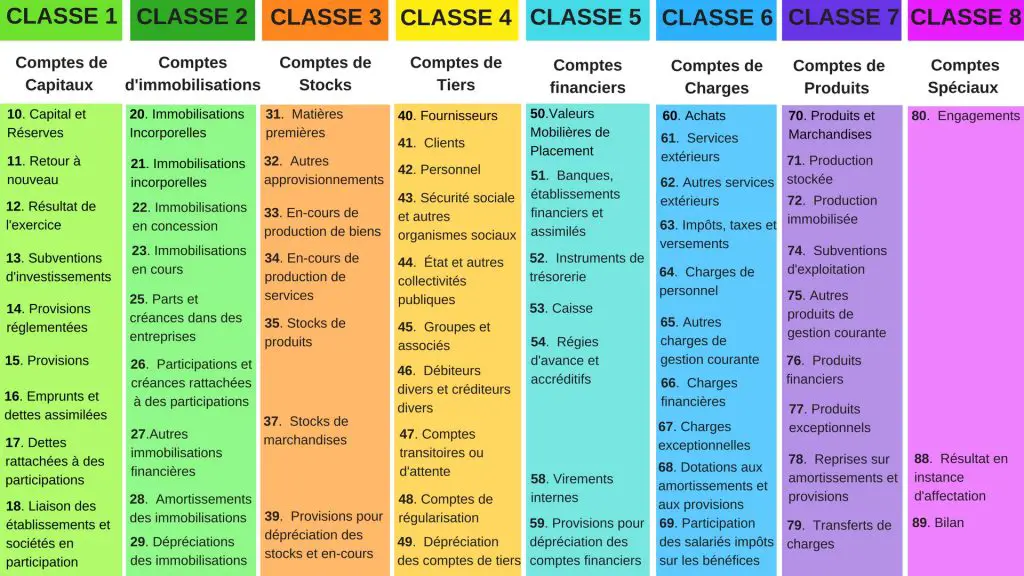
The image below gives a more detailed view of the types of accounts you would find in each class.
Test your understanding!
For each of the following common business accounts, identify its type (Asset, Liability, Equity, Revenue, or Expense) and the corresponding PCGM Class number.
Capital Social(Money invested by owners)Ventes de marchandises(Sales of goods)Fournisseurs(Money owed to suppliers)Matériel de transport(Company vehicles)Salaires et traitements(Salaries paid to employees)Banque(Company's bank account balance)Clients(Money owed by customers)
Show answer
Capital Social: Equity (Classe 1) - It's the core investment from the owners.Ventes de marchandises: Revenue (Classe 7) - It's the primary source of earnings.Fournisseurs: Liability (Classe 4) - It's a short-term obligation to an external party.Matériel de transport: Asset (Classe 2) - It's a long-term resource used in the business.Salaires et traitements: Expense (Classe 6) - It's a cost incurred to generate revenue.Banque: Asset (Classe 5) - It's a resource (cash) owned by the business.Clients: Asset (Classe 3) - It's a right to receive cash in the future from customers.
Conclusion
In this lesson, you have expanded your understanding from the three components of the balance sheet to the five fundamental categories of accounts that drive all of financial accounting.
Here are your key takeaways:
- Accounting is built on five types of accounts: Assets, Liabilities, Equity, Revenues, and Expenses.
- Revenues and Expenses explain the changes in Equity from business operations and form the basis of the Income Statement (
CPC). - The relationship is captured by the expanded accounting equation: Assets = Liabilities + Equity + (Revenues - Expenses).
- In Morocco, the Plan Comptable Général Marocain (PCGM) provides a mandatory, numbered classification system for all accounts.
- Classes 1-5 represent Balance Sheet accounts (
Comptes de Bilan), while Classes 6 and 7 represent Income Statement accounts (Comptes de Gestion).
Preview of the Next Lesson
You can now identify what an account is. The next logical step is to learn how to record changes in these accounts. In our next lesson, we will tackle the mechanics of accounting by learning to distinguish between debits and credits and apply their rules to the five account types you mastered today. This will unlock your ability to start recording transactions.