Recommended resources
The freely available resources this lesson will direct you to.
- Risks of Agentic AI: What You Need to Know About Autonomous AIwww.youtube.com
- The Five Must-Haves of an AI Governance Frameworkwww.youtube.com
- Human-in-the-Loop – A Business Leaders Guide to Responsible AIwww.flowhunt.io
- The Agentic Trust Framework: Zero Trust Governance for AI Agentscloudsecurityalliance.org
Introduction
Hello! In our last lesson, we designed a graduated autonomy plan using the Agentic Trust Framework (ATF). We established a clear, evidence-based path for an agent to earn trust and progress from "Intern" to "Principal," moving from heavy human oversight to responsible autonomy. You now have the technical and architectural blueprint for how to build a system that manages autonomy safely.
Today, we address a different but equally critical challenge: communicating the rationale for human-in-the-loop (HITL) design to non-technical stakeholders. This is the final step in our module on human oversight and a crucial skill for your goal of delivering agentic AI as a service. Your clients will be business leaders, executives, and managers who need to understand not just that a system works, but why it's designed a certain way—especially when that design involves human cost and effort.
This lesson will equip you to translate the technical necessity of HITL into a compelling business case, framing it not as a limitation, but as a strategic feature that drives risk management, compliance, trust, and ultimately, return on investment.
1. Reframing the Conversation: From "Magic Box" to Strategic Asset
A common challenge when selling AI solutions is managing the expectation that you are delivering a fully autonomous "magic box." When a client hears "human-in-the-loop," they may interpret it as "the AI isn't good enough" or "this will be slow and expensive." Your first task is to reframe this conversation.
The goal is to shift the client's mindset from "Why isn't it 100% automated?" to "How do we deploy this powerful technology in a way that is safe, compliant, and builds trust?"
To begin, let's ground the conversation in tangible business risk. Abstract discussions about model failures are less impactful than real-world examples of what happens when AI governance is inadequate.
The Five Must-Haves of an AI Governance Framework
The following clip from the SANS Institute provides powerful, concrete examples of AI systems failing in major corporations. These stories are invaluable for making the abstract concept of 'AI risk' feel immediate and real to a business stakeholder.
Watch from 01:53 to 05:45. As you watch the case studies on McDonald's, Air Canada, and Trivago, consider how you would use these stories to open a conversation with a client about the need for robust governance and oversight.
These examples—costing millions in lost revenue, legal fees, and reputational damage—are not just cautionary tales; they are potent business arguments. They establish the core premise: while agentic AI offers immense opportunity, increased autonomy inherently brings increased risk. HITL is the primary tool for managing that risk.
2. The Four Pillars for Justifying Human-in-the-Loop
To structure your conversation with a non-technical stakeholder, you can build your rationale on four pillars of business value. This approach moves the discussion away from technical details and onto metrics that executives care about. A great resource that's written specifically for this audience is the guide from Flowhunt.
Human-in-the-Loop – A Business Leaders Guide to Responsible AI
The article 'Human-in-the-Loop – A Business Leaders Guide to Responsible AI' is tailored for the very audience you need to persuade. We will use it as a guide to construct our arguments.
First, read the introduction and the section 'What Is Human-in-the-Loop and Why Should Leaders Care?'. Pay close attention to 'The Executive Case: Why HITL Matters', as it outlines the key value propositions.
The article introduces the core arguments we will now expand upon.
Pillar 1: Risk Mitigation & Reputation Protection
This is the most direct and compelling argument. An AI agent acting autonomously can make mistakes at machine speed and scale.
- What to say: "Human oversight acts as a strategic safeguard. It's our quality assurance layer to prevent the kinds of costly errors we saw with companies like Air Canada. Before an agent takes a high-stakes action, we can require a human expert to validate its decision, protecting your brand and bottom line."
- Key Vocabulary:
Safeguard,fail-safe,brand reputation,quality assurance,risk mitigation.
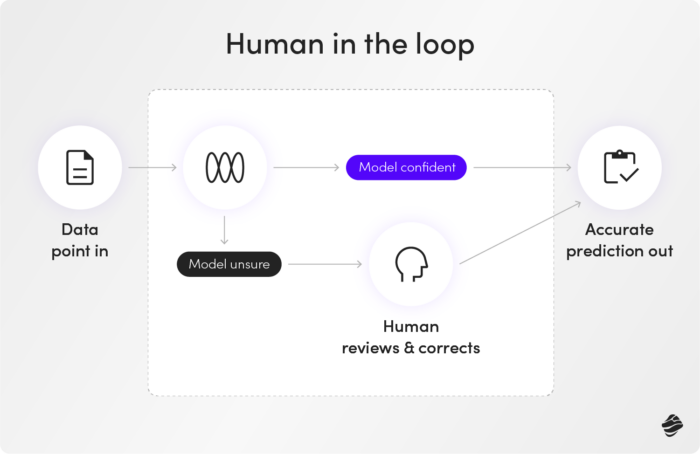
Pillar 2: Regulatory Compliance & Legal Liability
Business leaders are acutely aware of the growing web of regulations around AI.
- What to say: "Global regulations like the EU AI Act now legally mandate 'appropriate human oversight' for many AI systems. By building HITL into our design from day one, we're not just following best practices; we're ensuring your system is compliant and defensible. This creates a complete audit trail, showing regulators that you have exercised due diligence."
- Action: Read the "Compliance: Navigating the Evolving Regulatory Landscape" section of the Flowhunt article (resource LINK) for more detail on this point.
- Key Vocabulary:
Compliance,due diligence,audit trail,accountability,EU AI Act.
Pillar 3: Trust & Accountability
For AI to be adopted, it must be trusted by customers, employees, and partners.
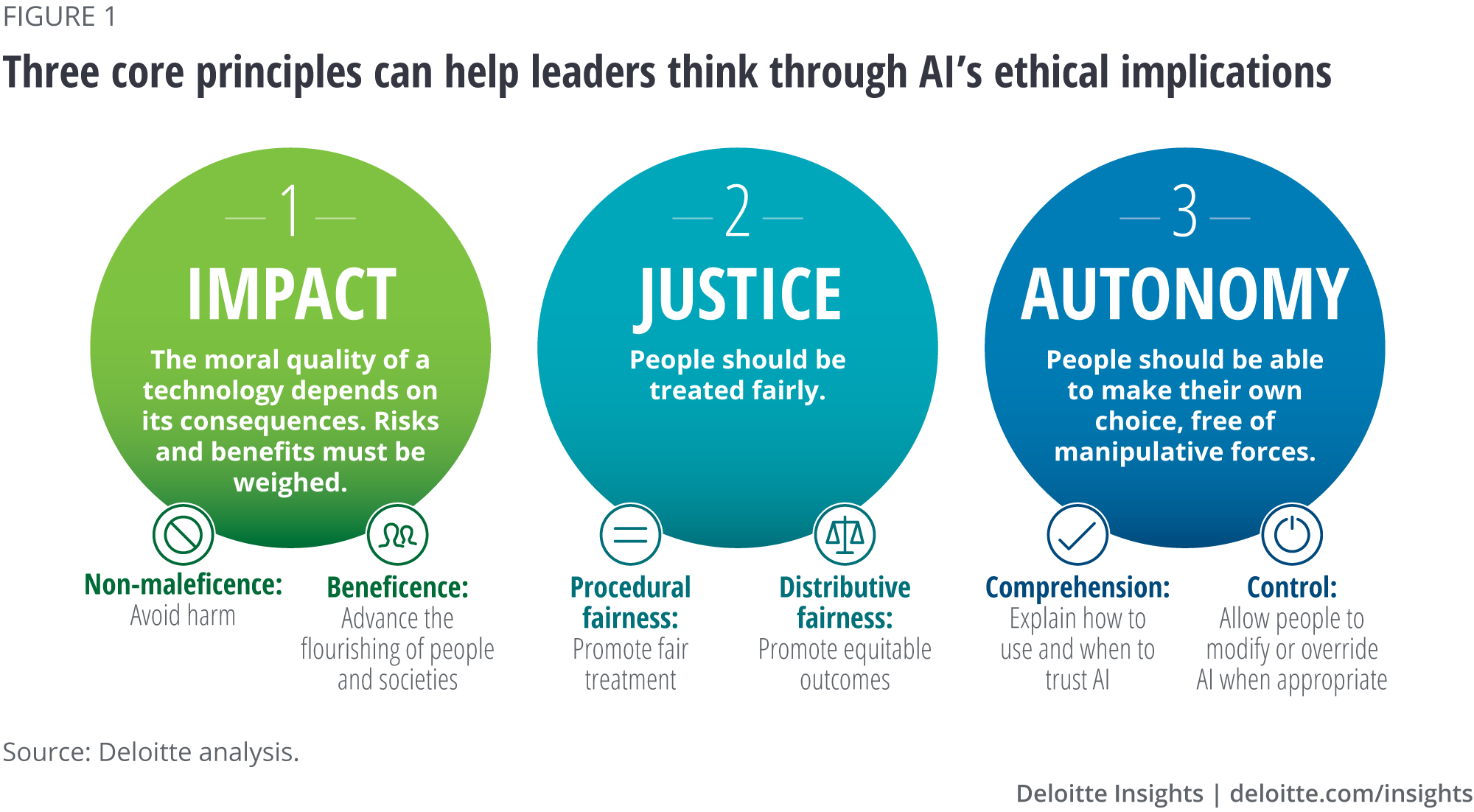
- What to say: "Trust is built on transparency and accountability. Our HITL design ensures that there is always a clear line of responsibility. By keeping humans in control of key decisions, we make the system's behavior understandable and align it with your company's ethical principles. This isn't just about making the AI work; it's about making it trustworthy."
- Action: Review the "Trust and Accountability: Building Stakeholder Confidence" section in the Flowhunt article (resource LINK). Then, look at the image below from Deloitte, which frames this in terms of core ethical principles.
Pillar 4: ROI & Strategic Agility
This pillar counters the objection that HITL is just an added cost.
- What to say: "While there's a cost to human review, it generates a significant return on investment. It improves the quality of the final output, which drives better business outcomes, and it drastically reduces the hidden costs of rework and crisis management. More importantly, this safety net gives us the strategic agility to deploy AI in more complex, high-value problem areas, future-proofing your investment."
- Action: Read the "Business Value: HITL as a Driver of ROI and Competitive Advantage" section of the Flowhunt article (resource LINK).
- Key Vocabulary:
Return on investment (ROI),value creation,reducing rework,strategic agility,future-proofing.
3. The Master Narrative: A Story of Earned Trust
While the four pillars provide the logical justification, the most effective way to communicate your plan is through a compelling narrative. The Graduated Autonomy plan you designed in the last lesson is not just a technical specification; it is your most powerful communication tool.
The "Intern to Principal" analogy from the Agentic Trust Framework is exceptionally effective with non-technical leaders because it maps an abstract technical concept onto a familiar, intuitive business process: onboarding a new employee.
The Agentic Trust Framework: Zero Trust Governance for AI Agents
Let's revisit the Agentic Trust Framework, but this time from a communication perspective. The 'For Business Leaders' section is written precisely for this purpose.
Please review the following sections of the ATF article: 'For Business Leaders: How to Read This Framework': This is your executive summary. Section 4, 'The Agent Maturity Model': Focus on the Intern, Junior, Senior, and Principal descriptions. Section 4.6, 'ATF in Practice': This provides a concise, real-world story of the framework in action.
Using this framework, you can tell a story that addresses the client's desire for automation while underscoring your commitment to safety and responsibility:
"We won't just 'turn on' the AI. We'll deploy it using a phased approach, like onboarding a new team member.
- Intern Phase: Initially, the agent will operate in a read-only mode. It will observe your processes and generate reports, but it won't be allowed to take any action. This allows us to validate its understanding in a completely safe environment.
- Junior Phase: Once we've proven its analytical accuracy, we'll promote it to a 'Junior' level. Here, it will recommend actions, but every single action will require approval from one of your team members before it is executed. This is our core 'human-in-the-loop' stage.
- Senior Phase: We will collect data on the quality of its recommendations. Once it consistently achieves a high accuracy rate—say, over 95% of its recommendations are approved without changes—we can promote it to 'Senior.' At this level, it can act autonomously on routine tasks and will simply notify your team of the actions taken. It will still escalate any novel or high-risk cases for human approval.
- Principal Phase: Eventually, for well-defined domains, the agent can operate with full autonomy, only requiring strategic oversight.
This graduated approach allows us to balance innovation with safety. We increase automation based on evidence, not assumptions, ensuring the system earns your trust every step of the way."
This narrative is powerful because it's proactive, structured, and evidence-based. It shows you have a sophisticated plan for managing risk while still progressing toward greater automation.
Conclusion
In this lesson, you've learned how to translate the technical necessity of Human-in-the-Loop design into a compelling business rationale for non-technical stakeholders.
Key Takeaways:
- Reframe the Conversation: Start by using real-world examples of AI failures to establish the need for governance and shift the discussion from "why not full automation?" to "how can we deploy this safely and effectively?"
- Use the Four Pillars: Structure your argument around the business value of Risk Mitigation, Regulatory Compliance, Trust & Accountability, and ROI & Strategic Agility.
- Tell a Story of Earned Trust: The most effective communication tool is the graduated autonomy narrative. Use the Agentic Trust Framework's "Intern to Principal" model to present a clear, responsible, and evidence-based path toward increasing automation.
With this skill, you are now prepared not only to design robust and safe agentic systems but also to articulate their value and build the stakeholder confidence necessary to get them approved, funded, and deployed.
This concludes our module on Human-in-the-Loop and Guardrails. In our next lesson, we will begin Module 11, "Scaling and Productionizing Agent Workflows," where we'll explore how to identify the key differences between a working prototype and a production-ready agent system. Having secured stakeholder buy-in with your responsible design, the next challenge is to build it to scale.