Recommended resources
The freely available resources this lesson will direct you to.
Hello! Last time, you checked whether a proposed distance really is a metric. Now we will use that distance to decide which subsets are open and closed. The central question is local: from each point of a set, can you move a sufficiently small distance without leaving it?
We will answer that question in the real line and plane, in a discrete space, and in subsets equipped with an induced metric. The last case is especially important: whether a set is open or closed depends not only on the set, but also on the space in which you are considering it.
Balls turn distance into openness
In a metric space , the open ball of radius centered at is
The subscript is a reminder that only points of can belong to this ball. A subset is open in if every has some radius for which . The radius may depend on the point; it need not work uniformly across .
Watch the opening of Functional Analysis 3 | Open and Closed Sets from The Bright Side of Mathematics for the ball definition and its visual interpretation. Then watch the short segment giving the definition of closedness; we will develop that definition from balls below.
Functional Analysis 3 | Open and Closed Sets
The Bright Side of Mathematics introduces open sets through balls around individual points, then defines closed sets using complements.
Watch balls and openness, paying attention to the words “every point” and “some radius.” Skip ahead to closedness for the complement-based definition.
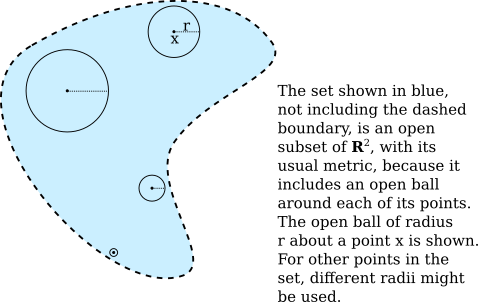
The picture suggests the definition, but the metric makes it precise. On with , a ball is the interval
If , choosing keeps this entire interval inside . Thus is open. In contrast, is not open in : it contains , and every ball around contains points less than .
The shape of a ball changes with the metric. In , a Euclidean ball is a disk; for the maximum metric from the previous lesson it is the inside of an axis-aligned square; for the taxicab metric it is the inside of a diamond. In every case, the test for openness is the same: can you fit an appropriate ball around each point of the proposed set?
Read the ball examples in Notes on Metric Spaces, including its first example of balls in a subspace. This revisits metrics you already know without repeating their axiom checks.
Read the notes’ descriptions of metric balls to connect the abstract definition with squares, diamonds, singletons, and balls restricted to rational numbers.
On p. 3, read Definition 2 and Examples 6–7, from ball examples. Then on p. 4, under Definition 3 and Example 9, read rational balls. In Example 9, focus on why specifying the surrounding space changes which points are eligible to enter a ball.
One fact underlies all these examples: every open ball is itself an open set, in any metric space. This is a useful short proof to read closely.
Read Proposition 6 for a rigorous version of the “fit a smaller ball inside” picture.
In the section “Open and Closed Sets,” find Proposition 6 on pp. 14–15, immediately after Example 19 and before the paragraph about closed balls. Read the proposition and proof. Track why the proposed smaller radius is positive and where the triangle inequality is used.
Here is the proof’s key move in our notation. Given , there is a positive margin . If , then
Consequently . Notice the order of the reasoning: choose an arbitrary point in the original ball, construct a radius that works for that point, and check the containment for every in the smaller ball.
Closed means an open complement
A set is closed in when is open in . Thus you test closedness by taking an arbitrary point outside and finding a ball around it that misses .
For instance, is closed in . If , the positive radius gives a ball that misses ; if , use . These two cases cover its complement. By comparison, is neither open nor closed in : no ball centered at its included endpoint stays inside it, while its complement contains but no ball around stays outside it.
The same argument works for a closed ball
To check it is closed, take outside it, so . Put . For any , the triangle inequality gives
Hence the ball around misses , proving its complement open. This is the same margin idea as before, applied on the outside.
Do not interpret “closed” as “not open.” The empty set and are both open and closed in : openness of the empty set has no points to check, every ball in lies in , and each is the other’s complement. A set can also be neither, as shows.
The discrete metric changes the answer
Recall that under the discrete metric, distinct points have distance . For every ,
Take any subset . Every has the ball , so is open. The same argument applies to , making that complement open too. Every subset of a discrete metric space is therefore both open and closed.
This applies even if the underlying set is . The singleton is not open in with the usual metric, because every usual interval around contains other real numbers. It is open on the same set of real numbers with the discrete metric. Knowing the points alone does not determine the open sets; you need the metric.
The strict inequality in the phrase open ball also does not mean that such a ball cannot be closed. In a discrete space, is both.
Induced metrics: which space contains the ball?
Suppose and carries the induced metric , obtained by restricting to pairs of points in . Directly from the ball definition, for ,
This identity is the safest starting point for a subspace question. It says that a ball in can be shorter, one-sided, or otherwise truncated compared with the ball in . For example, when , the induced-metric ball is , not the entire real interval.
There is a useful general rule:
A set is open in exactly when for some open . Likewise, is closed in exactly when for some closed .
Study the subspace theorem and its proof in LibreTexts’ 3.8: Open and Closed Sets. Neighborhoods. The proof is worth reading as a model of how a statement about all subspace-open sets is built from the ball identity above.
3.8: Open and Closed Sets. Neighborhoods - Mathematics LibreTexts
Read the subspace theorem in Mathematics LibreTexts to see how induced-metric balls yield a complete description of relatively open and closed sets.
In Section 3.8, after the corollary on finite closed sets and the note on families of open and closed sets, start at the paragraph beginning “In conclusion, consider any subspace.” Read the subspace theorem through the proof of Theorem 4. Focus first on the identity expressing each subspace ball as an intersection with the subspace. Then follow how the closed-set statement uses complements taken within the subspace, rather than within the parent space.
For a quick concrete instance, let . The set is open in , since it equals , with open in . It is not open in : the point has no real ball contained in it. Meanwhile, itself is both open and closed in , though it is not open in .
An ambient interval can even become a nontrivial set that is both open and closed in a subspace. Return to the same video for an example with a gap in the surrounding space.
Functional Analysis 3 | Open and Closed Sets
Return to the video’s example of an induced metric. It shows why a point that looks like an endpoint may still have a ball contained in its set.
Watch the gapped subspace. At the point 3, compare a ball in the displayed space with the interval you would obtain if the surrounding space were all of \mathbb R. Note also the video’s conclusion that the proposed subset is both open and closed in its subspace.
In that example, take with the usual distance restricted from , and . At , the ball contains no point of the other component: its points are restricted to , and points greater than are more than away. The other points of also have sufficiently small balls inside , so is open in . Its complement is open in , so is closed there as well. Yet , considered as a subset of , is neither open nor closed.
Takeaways
To determine whether is open, start with an arbitrary point in and find a ball contained in . To determine whether it is closed, start with an arbitrary point outside and find a ball that misses . A failed test needs only one point for which every radius fails; a successful test must account for every relevant point.
Always name the metric space first. Discrete balls make every subset open and closed, while induced-metric balls are intersections with the surrounding space’s balls. Next, we will use these same local ball tests to compute the interior, closure, and boundary of concrete sets.