Recommended resources
The freely available resources this lesson will direct you to.
Hello! In the previous lesson, you used metric balls to decide whether a set is open or closed. This time, the question is more precise: which points are securely inside a set, which points can be approached from it, and which points sit at its edge?
We will compute the interior, closure, and boundary of intervals, disks, discrete-space subsets, and sets in induced metric spaces. The same three ball tests work throughout; what changes is the collection of points available inside a ball.
Three questions to ask at a point
Let , where is a metric space. All balls below are balls in .
A point belongs to the interior of if some ball around it lies entirely in :
An interior point must belong to , since every ball contains its center.
A point belongs to the closure of if every ball around it meets :
A closure point need not belong to . Conversely, every point of is automatically in its closure: the point itself lies in every ball centered there.
Finally, is a boundary point of if every ball around it meets both and its complement :
A boundary point may be included in or excluded from it. Its defining feature is that no ball around it stays entirely on either side.
Watch the boundary segment of Functional Analysis 3 | Open and Closed Sets from The Bright Side of Mathematics. It picks up where the previous lesson’s discussion of open sets left off.
Functional Analysis 3 | Open and Closed Sets
Watch Functional Analysis 3 | Open and Closed Sets from The Bright Side of Mathematics for a visual explanation of the two-sided ball test for boundary points.
Watch boundary points. Focus on why the point need only lie in the surrounding space X, not necessarily in A, and why checking one particular ball is insufficient: the condition must hold for every radius.
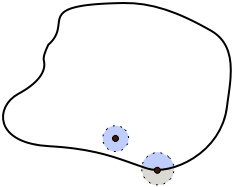
The picture is an aid to intuition, not a substitute for the quantifiers. One ball crossing the outline suggests a boundary point; to establish one, every positive radius must cross both sides.
From ball tests to computations
Consider in with its usual distance. If , a radius smaller than both and gives a ball contained in . At , every ball reaches negative numbers; at , every ball reaches numbers greater than . Thus
Every ball around either endpoint meets , while a point strictly below or above has a sufficiently small ball missing . Hence
At each endpoint, every ball also meets the complement. Points strictly between the endpoints have a ball wholly inside , and points farther away have a ball wholly outside it. Therefore
Notice the distinction: is a boundary point in , while is a boundary point outside .
Read the definitions and this interval example in Open and closed sets, then study its proof of the closure ball test. The proof is a useful refresher in moving between a local condition involving balls and a global description involving closed sets.
Read Open and closed sets by Andrew Rechnitzer to connect the three ball tests with the interior as the largest open subset, and the closure as the smallest closed superset.
In Subsection 5.2.2, “Interior, closure and boundary,” read from the comparison of [0,1], (0,1), and [0,1) through the worked interval and complement calculations: interval and definitions. Then find Theorem 5.2.13, “Properties of the closure.” Read its explanation of balls meeting a set and the first part of its proof, stopping when the proof turns to its second claim: closure ball test. Track precisely where openness of a complement supplies a ball missing A.
Here is a compact way to remember the relationship. The interior is made of points with one ball wholly inside . The closure is made of points for which no ball misses . Consequently,
These inclusions also reconnect the new terms to the last lesson: is open exactly when , and closed exactly when .
Why the boundary is the difference
The boundary has two equivalent descriptions:
The first follows directly from the ball tests. Membership in says that every ball meets ; membership in says that every ball meets its complement. Both are required at a boundary point.
For the second description, consider what it means for not to be interior to . No ball around lies wholly in , so every ball meets . That is precisely . Thus taking the closure of and removing its interior leaves its boundary.
This identity offers an efficient calculation method: find the interior and closure, then take their set difference. Still, the two-sided ball test is the best way to check a doubtful point. In particular, boundary does not mean “points outside the set”.
To see why, take
The point belongs to , but every ball around also contains points outside . It is a boundary point, not an interior point. Direct ball checks give
An isolated point included in a set belongs to its closure automatically, yet need not belong to its interior.
The same tests work in the plane. For a Euclidean disk of positive radius, including none, some, or all of its bounding circle changes whether the set is open or closed. It does not change its interior (the open disk), its closure (the closed disk), or its boundary (the circle). Points strictly inside have room for a ball; points strictly outside have a ball that misses the disk; every ball centered on the circle meets both sides.
Read these geometric examples alongside the contrasting example of the rationals in the Notes on Metric Spaces. The latter is a useful warning that a boundary need not look like a drawn edge.
Read the examples in Notes on Metric Spaces to test the definitions against both familiar shapes and a dense subset of the real line.
Under “Closure, Interior, Boundary, and Denseness,” find Example 21 on printed p. 17 and read the disk example. Find Example 22 on printed p. 18 and read the rational example, noting each change in the surrounding space. Finally, find Example 25 on printed p. 19 and read the boundary examples. Ask which claims use the presence of nearby points of the set, and which use nearby points of its complement.
For instance, in , every interval around a rational contains an irrational, so has empty interior. Every interval around any real contains a rational, so its closure is . The boundary formula then gives
Here every real number is a boundary point, even though no geometric outline encloses .
Change the space, change the answer
The superscript and subscript on our notation emphasize a condition from the previous lesson: a ball in with the induced metric is . Boundary points must belong to the space whose balls you are using.
First, under the discrete metric every singleton is an open ball. For any , a point of has a singleton ball inside , while a point outside has a singleton ball missing . Consequently,
The empty boundary is not peculiar to ; it holds for every subset of a discrete metric space.
For an induced-metric example, let and . In , the point is on the boundary of . In , however, a sufficiently small ball about contains only points of that lie in . Thus
The point has not moved; the surrounding space has stopped supplying points to its left.
An even sharper example uses with its usual induced metric and
The apparent endpoints, and , are not points of . Within , is both open and closed, so
Read Example 5.2.17 in Open and closed sets for the open-and-closed argument. In particular, compare its description of as a ball in with its description as the intersection of and a closed real interval.
Return to Open and closed sets for an example where the points that seem to form an edge are absent from the metric space.
In Subsection 5.2.2, find Example 5.2.17, “\mathbb Q is not so nice (part 1).” Read the question and its solution. Continue through the subspace explanation beginning its key observation. Focus on why both the open and closed real intervals produce the same intersection with \mathbb Q.
If that same set is instead regarded as a subset of , its closure is , its interior is empty, and its boundary is the whole interval . These are not conflicting answers: the balls and allowable boundary points differ between and .
Takeaways
To compute these three sets, specify the metric space first. Then test a point with the appropriate quantifier: some ball contained in for interior; every ball meeting for closure; every ball meeting both and its complement for boundary. The useful shortcut
comes from those tests, rather than replacing them.
Next, we will turn “points arbitrarily close” into a statement about convergent sequences, using the metric to check convergence directly.