Recommended resources
The freely available resources this lesson will direct you to.
Hello again. In our last lesson, we explored the Vacuum Arc Remelting (VAR) process, establishing it as the industry-standard method for converting porous titanium sponge into a solid, refined ingot. We focused on why the vacuum environment is critical for protecting the metal from contamination and actively removing impurities.
While VAR is the workhorse of the titanium industry, it is not without its limitations. For the most demanding applications and for producers seeking specific economic advantages, an alternative technology, Electron Beam Melting (EBM), offers a different set of capabilities and trade-offs.
Today, we will directly compare the operational principles, advantages, and disadvantages of VAR and EBM. Understanding this comparison is crucial for anyone aiming to make strategic decisions in the titanium industry, whether it's evaluating a company's technological moat, planning a capital investment, or assessing operational efficiency.
1. The Alternative Heat Source: Electron Beam Melting
Where VAR uses a high-current electric arc as its heat source, EBM, as the name suggests, uses a focused, high-energy beam of electrons. These electrons are accelerated in a vacuum and strike the metal, converting their kinetic energy into thermal energy to cause melting.
The most common and advanced implementation is Electron Beam Cold Hearth Melting (EBCHM). The "cold hearth" is the key architectural difference from VAR and is central to EBM's unique advantages.
Let's look at a simplified comparison of the two processes.
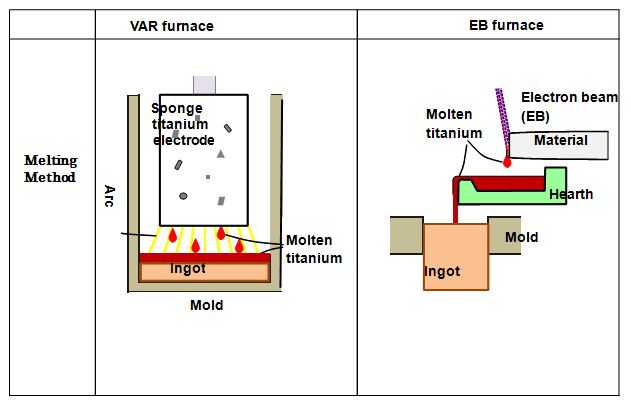
The EBCHM process consists of three distinct stages, all occurring within a high-vacuum chamber:
- Melting: Raw material (which can be loose sponge, scrap metal, or pre-made electrodes) is fed into the furnace. One or more electron guns fire beams that melt this material.
- Refining: The molten metal flows from the melting zone into a water-cooled copper hearth. The metal resides in this hearth for a controlled period, allowing for significant purification before it is cast.
- Casting: The refined, molten metal overflows the hearth into a water-cooled copper mold, where it solidifies into an ingot. The ingot is slowly withdrawn from the bottom, similar to the VAR process.
The magic happens in the refining hearth. To understand how it works and what makes it so effective, let's turn to a technical paper on the topic.
The Electron Beam Cold Hearth Melting Technology
This paper, 'The Electron Beam Cold Hearth Melting Technology', provides an excellent description of the EBCHM process and its operational principles. It explains precisely how the cold hearth enables a level of purification that VAR cannot achieve.
Please read section 3, 'Operation principle' (page 186). Focus on the description of the three work areas (melting, refining, crystallization) and the mechanism for removing high-density and low-density inclusions in the hearth.
As the paper explains, the cold hearth purifies the molten titanium in two ways:
- High-Density Inclusions (HDIs): These are contaminants denser than titanium, such as bits of tungsten carbide from machine tools or refractory metals. In the relatively quiescent pool of the refining hearth, these heavy particles have time to sink. They are trapped in a layer of solidified titanium (a "skull") that forms on the water-cooled bottom of the hearth, permanently removing them from the melt.
- Low-Density Inclusions (LDIs): These are less dense contaminants, including titanium oxides and nitrides. The extended residence time in the molten pool, combined with the intense surface heating from the electron beam, allows these inclusions to dissolve or float to the surface where they can be vaporized or trapped.
This separation of melting, refining, and casting is a fundamental departure from the VAR process, where all three occur simultaneously in the same crucible.
2. Head-to-Head: EBM vs. VAR
Now that we understand the principles of both technologies, we can make a direct comparison. This analysis highlights the critical trade-offs in cost, quality, and flexibility that an operator or investor must consider.
The following resources provide a clear summary of the pros and cons of each method.
Difference between EB and VAR smelting
First, this article from a titanium supplier gives a concise, high-level overview of the differences between EBM and VAR. It's a great starting point for our comparison.
Please read sections 1 ('Principle'), 2 ('Advantages of EB furnace'), and 3 ('Disadvantages of EB furnace'). This will give you a practical summary of the key points.
The Electron Beam Cold Hearth Melting Technology
Now, let's return to 'The Electron Beam Cold Hearth Melting Technology' paper for a more detailed technical breakdown of the advantages and disadvantages.
Please read section 4, 'EBCHM characteristic' (pages 186-187). This section directly compares EBCHM to VAR and lists the specific strengths and weaknesses of the technology.
Synthesizing these sources, we can structure the comparison across several key operational and economic dimensions:
| Feature | Vacuum Arc Remelting (VAR) | Electron Beam Cold Hearth Melting (EBM/EBCHM) |
|---|---|---|
| Refining Capability | Good at removing volatiles (e.g., MgCl₂, H₂). Cannot remove High-Density Inclusions (HDIs). If an HDI exists in the electrode, it will likely end up in the ingot. | Superior refining. The cold hearth effectively removes both HDIs (by settling) and LDIs (by dissolution/floating). Produces the "cleanest" titanium available. |
| Feedstock Flexibility | Low. Requires a pre-fabricated, welded consumable electrode. Limits scrap usage to ~30% of the electrode weight. | High. Can directly melt diverse, lower-cost feedstocks including loose sponge, machine turnings (swarf), and 100% scrap of various shapes and sizes. |
| Alloy Composition Control | Excellent. The starting electrode composition is well-defined, and the process has minimal evaporative losses. | Challenging. The combination of high vacuum and intense heat causes significant vaporization of alloying elements with high vapor pressures (e.g., aluminum, chromium). Requires complex process control and experienced operators to maintain target chemistry. |
| Product Geometry | Limited. Typically produces only solid, round ingots. | Flexible. Can produce round ingots, rectangular slabs (for direct rolling), and hollow ingots, which can significantly reduce downstream processing costs and improve material yield. |
| Capital Cost (Capex) | Lower. Simpler, more mature technology. | Very High. A significantly more complex system (electron guns, multiple vacuum systems, advanced controls). Capital cost can be 3-4 times that of a comparable VAR furnace. |
| Operating Cost (Opex) | Generally lower due to simpler systems. However, the cost of electrode fabrication can be high. | Feedstock cost can be much lower due to scrap recycling capability. However, maintenance costs are higher, and energy consumption can be substantial. Yield improvements from slab casting can lead to lower overall costs per finished product. |
| Process Complexity | Mature and well-understood. Primary safety concern is water-molten metal reaction. | Very complex. Requires expertise in vacuum technology and electron physics. Generates X-rays, necessitating radiation shielding. |
3. Strategic and Economic Implications
The choice between VAR and EBM is not simply technical; it's a strategic business decision.
-
The Case for EBM: A producer would invest in EBM's high capital cost to pursue one of two strategies:
- Cost Leadership through Feedstock Arbitrage: By building a business model around recycling scrap (which is significantly cheaper than virgin sponge), an EBM operator can achieve a lower input cost than a VAR-only competitor. The ability to produce slabs that bypass expensive forging steps further strengthens this cost advantage.
- Differentiation through Ultimate Purity: For the most critical applications (e.g., rotating parts in jet engines), the absence of HDIs is non-negotiable. EBM is the only technology that can reliably guarantee this level of cleanliness. This allows producers to serve a premium market where failures are catastrophic, justifying the higher processing cost. This is why U.S. regulations mandate that certain aerospace-grade titanium alloys must be processed in a cold hearth furnace.
-
The Case for VAR: VAR remains the industry standard because it is a reliable, cost-effective solution for a vast range of applications where the risk of HDIs is acceptable. For a company producing commercially pure titanium or standard alloys for industrial or non-critical aerospace components, the high capital and operational complexity of EBM may not be justifiable.
-
The Hybrid "Best-of-Both-Worlds" Approach: Many leading titanium producers use a hybrid melting route: EB + VAR.
- An initial melt is performed in an EBM furnace to purify low-cost feedstock (like scrap) and create a large, clean, homogenous primary ingot or electrode.
- This clean electrode is then remelted in a VAR furnace. This second melt leverages VAR's superior ability to control chemical composition and achieve a final ingot with a perfect microstructure.
This two-step process combines EBM's powerful refining capability with VAR's precision, representing the pinnacle of titanium melting technology.
Conclusion
You now have a clear framework for comparing the two primary technologies for melting titanium. This isn't just about different furnace designs; it's about fundamentally different business strategies.
Key Takeaways:
- EBM uses an electron beam and a cold hearth; VAR uses an electric arc and a crucible. This core architectural difference dictates their capabilities.
- EBM's main advantages are superior purification (especially HDI removal) and feedstock flexibility (100% scrap capability). This creates opportunities for cost leadership and serving premium quality markets.
- VAR's main advantages are lower capital cost and better control over alloy composition. It remains the industry's reliable workhorse for a wide array of products.
- The choice of technology is a strategic trade-off between capital cost, feedstock cost, final product quality, and operational complexity.
- Hybrid EB+VAR processes are used to produce the highest-quality materials by combining the strengths of both technologies.
In our previous lesson, we mentioned that VAR is used to refine the metal and remove defects. In this lesson, we saw that EBM is even better at removing certain types of defects. In our next lesson, we will delve into the specifics of these common defects in titanium ingots, examining what they are, how they form during the melting process, and why their presence can have catastrophic consequences.