Recommended resources
The freely available resources this lesson will direct you to.
Hello, and welcome back.
In the previous module, we navigated the intricate process of producing titanium sponge, culminating in our analysis of the critical trade-offs between purity, yield, and cost. You now understand how a producer's operational strategy is defined by the type of sponge they choose to make. However, this sponge, regardless of its purity, is a porous, brittle mass. It cannot be used directly to manufacture a jet engine turbine blade or a chemical processing vessel.
This lesson marks the beginning of our next module, where we explore how this sponge is transformed into a solid, workable metal. We will start with the most common and critical technology for this step: Vacuum Arc Remelting (VAR).
Our objective is to describe the VAR process for consolidating titanium sponge and, crucially, to explain why it must be performed in a vacuum or inert atmosphere. Understanding this step is essential, as the melting process has a profound impact on the final material properties, structural integrity, and ultimately, the economic value of the titanium.
1. From Porous Sponge to Solid Ingot
The first challenge in making a usable product from titanium sponge is a simple one of physical form. The sponge is a high-surface-area, porous material. To create a dense, uniform block of metal—an ingot—that can be forged and machined, it must be melted and re-solidified in a controlled manner.
Simply melting titanium in an open-air furnace is not an option. At its melting point (1668°C), titanium is extremely reactive. It acts as a powerful scavenger for oxygen and nitrogen from the atmosphere. This reaction forms hard, brittle compounds (oxides and nitrides) within the metal, a contamination known as "alpha case," which would render the final product useless for any high-performance application.
This is why "premium melting" techniques are required. To learn more about this concept, please read the introductory section of the following document.
An Introduction to Premium Melting
The white paper 'An Introduction to Premium Melting' from Carpenter Technology explains why reactive metals like titanium require special melting processes to protect them from atmospheric contamination.
Please read the first page of the document, up to the heading 'Three types of premium melting furnaces...'. Focus on how elements like titanium react with oxygen and why melting in a vacuum is necessary to control alloy chemistry and produce a clean, uniform product.
The key takeaway is that to preserve the purity we worked so hard to achieve in the Kroll process, we must melt the sponge in a highly controlled environment, free of reactive gases. The primary technology for this is Vacuum Arc Remelting (VAR).
2. The Vacuum Arc Remelting (VAR) Process
VAR is a secondary melting process designed to consolidate material while simultaneously refining it. The entire process takes place inside a sealed, water-cooled vacuum chamber.
Let's break it down into its core steps.
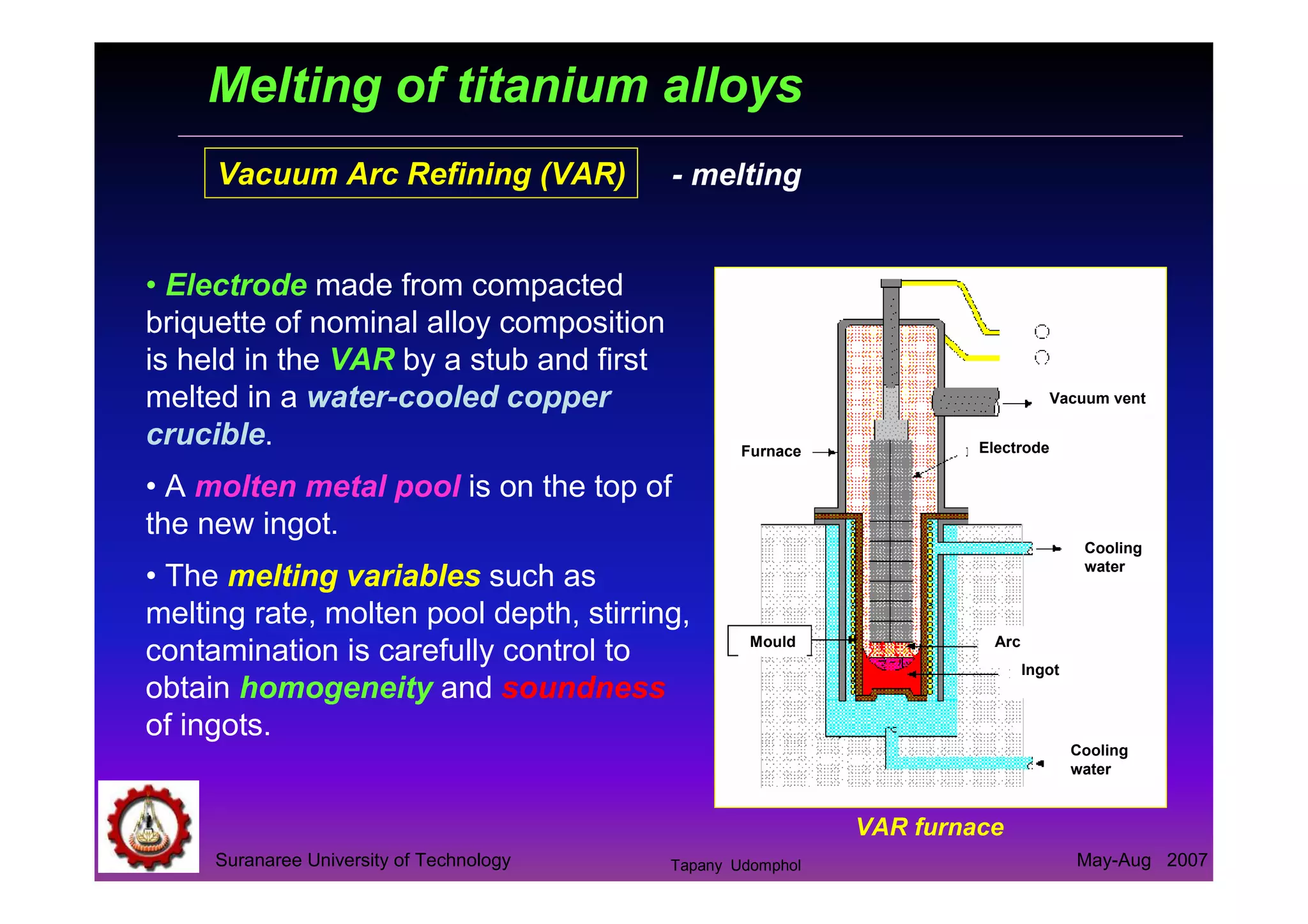
Step 1: Electrode Fabrication
The process begins not with loose sponge, but with a large, solid cylinder called a consumable electrode. This electrode is created by taking titanium sponge, often mixed with recycled titanium scrap, and pressing it into blocks called "compacts." These compacts are then welded together in an inert atmosphere (typically argon) to form a single, long electrode. The density of this electrode is still lower than solid titanium, a factor that, as you'll see, influences the furnace design.
Step 2: Furnace Operation
The consumable electrode is loaded into the VAR furnace, where it is suspended from a movable ram and connected to the negative terminal (cathode) of a high-power DC supply. Below it sits a water-cooled copper crucible, which acts as the mold for the new ingot and is connected to the positive terminal (anode).
The furnace is then sealed and a powerful vacuum is drawn, evacuating the air from the chamber.
This guide from Consarc, a major furnace manufacturer, provides a practical, step-by-step description of the VAR process. It details the furnace setup and the mechanics of the melting phase.
Please read the first three paragraphs on the first page, under the heading 'VAR — The Process'. This covers everything from loading the electrode to the controlled solidification of the ingot. Pay attention to: The description of the furnace components (head, ram, crucible, water jacket). How the arc is struck and the melting begins. The concept of 'directional solidification' and its purpose.
As described in the reading, the process unfolds as follows:
- Arc Ignition: The control system lowers the electrode until it is close to a small amount of starter titanium material at the bottom of the crucible. A high-current DC arc is struck between the electrode and the base.
- Melting: The intense heat of the arc (which can exceed 4000 °C) melts the tip of the electrode. Droplets of molten titanium fall from the electrode into the crucible below, forming a molten pool.
- Ingot Formation: The molten pool is contained within the water-cooled copper crucible. The intense cooling from the crucible walls causes the metal to solidify in a controlled, directional manner from the outside-in and bottom-up. As the electrode is consumed, the ram slowly lowers it, maintaining a constant arc gap, and the solid ingot grows in height.
- Hot Topping: Towards the end of the melt, the power is gradually reduced. This controlled cooling of the last bit of molten metal (the "hot top") helps to minimize a defect called a "pipe" (a central cavity), thereby maximizing the usable yield from the ingot.
The result of this highly controlled process is a dense, solid ingot with a more uniform and refined structure than the initial electrode. For extremely critical applications, such as rotating parts in jet engines, this process is often repeated. An ingot from a first melt is used as the electrode for a second melt (double VAR) or even a third (triple VAR) to achieve the highest possible levels of cleanliness and structural integrity.
3. The Crucial Role of the Vacuum
The use of a vacuum is the defining feature of the VAR process and is essential for producing high-quality titanium. Its functions go beyond simply preventing contamination from the air.
An Introduction to Premium Melting
Let's return to 'An Introduction to Premium Melting' to examine the specific functions of the vacuum in more detail.
Please read the section titled 'VAR' on page 6. This passage explains how the combination of low pressure and high temperature actively refines the metal.
Based on this, we can summarize the two primary roles of the vacuum environment:
-
Protection: As we've established, the vacuum removes ambient oxygen and nitrogen, preventing the formation of brittle oxides and nitrides that would degrade the titanium's mechanical properties. The use of a water-cooled copper crucible, which is non-reactive, also prevents contamination that would occur if a ceramic refractory crucible were used.
-
Purification: The combination of extreme heat in the arc and low pressure in the chamber actively removes impurities.
- Volatiles: Residuals from the Kroll process, such as magnesium chloride (MgCl₂) and unreacted magnesium, have high vapor pressures. The vacuum allows them to boil off from the molten droplets and be pumped out of the system.
- Dissolved Gases: Dissolved gases within the metal, particularly hydrogen, are removed. Hydrogen can cause a dangerous embrittlement phenomenon in titanium, and reducing its concentration is critical.
- Dissociation: Some less stable non-metallic inclusions can dissociate (break down) in the extreme conditions of the arc, further cleaning the metal.
Safety and the Role of Inert Gas
From an operational and risk management perspective, the handling of molten titanium requires stringent safety protocols. Given your experience leading operational teams, you will appreciate the engineering controls involved.
Finally, let's revisit the Consarc guide, which discusses the specific safety features required for melting reactive metals like titanium.
Please read the final paragraph of the document, which describes the 'Reactive Vacuum Arc Remelting Furnaces' (RVAR). Focus on the safety considerations mentioned, such as argon purging, emergency backfill, and protective bunkers.
As the text highlights, there's a significant risk of fire or even explosion if molten titanium comes into contact with air or water. The VAR furnace is therefore equipped with features like emergency argon backfill systems. If a breach occurs (e.g., the arc burns through the crucible wall), the chamber is instantly flooded with inert argon gas to extinguish the arc and prevent a catastrophic reaction. This is why such furnaces are also operated within reinforced concrete bunkers.
Conclusion
In this lesson, you have seen how the porous, brittle titanium sponge is converted into a solid, dense, and refined ingot through Vacuum Arc Remelting.
Key Takeaways:
- Consolidation is necessary: Titanium sponge must be melted to create a solid ingot before it can be used for manufacturing.
- VAR is a premium melting process: It involves melting a consumable electrode using an electric arc inside a vacuum chamber.
- The vacuum is non-negotiable: It serves two main purposes: protecting the highly reactive molten titanium from atmospheric contamination (O₂ and N₂) and actively purifying the metal by removing volatile elements (Mg, MgCl₂) and dissolved gases (H₂).
- The process yields a superior product: Controlled, directional solidification in a water-cooled copper crucible minimizes chemical segregation and results in a clean, homogeneous ingot.
- Safety is paramount: The process involves significant operational risks, requiring engineered safety systems like argon gas backfills and reinforced bunkers.
The VAR process is the industry standard, but it is not the only option. In our next lesson, we will compare VAR to another important technology, Electron Beam Melting (EBM), and evaluate the advantages and disadvantages of each. This comparative analysis is crucial for anyone assessing the technological and economic landscape of titanium production.