Recommended resources
The freely available resources this lesson will direct you to.
Hello! Welcome to the first lesson in our module, "Optimizing Your Sleep Sanctuary."
In our last module, we established a complete system for managing light before you go to bed, using software filters and blue light blocking glasses. We now shift our focus from preparing for sleep to protecting sleep itself. The single most important environmental factor for your bedroom is darkness.
Today's learning outcome is to implement a blackout protocol to achieve near-total darkness in your bedroom for optimal melatonin levels. While we've discussed avoiding bright light in the evening, this lesson is about eliminating even small amounts of light while you sleep. This is not about preference; it's a non-negotiable biological requirement for deep, restorative sleep.
The Science of Darkness: Why "Pretty Dark" Isn't Dark Enough
You might think that as long as your room is generally dark, you're fine. However, research shows that the human body is incredibly sensitive to light, even during sleep.
The goal is not "dim," but as close to 0 lux (total darkness) as possible. To understand why, let's look at the mechanism.
Why Blackout Curtains Fail (And How to Actually Hit 0 Lux)
This article, 'Why Blackout Curtains Fail,' explains the science behind light disruption. It provides a specific, research-backed number for how little light it takes to interfere with your hormones.
Read the section titled 'How Much Light Actually Disrupts Sleep?'. Focus on the '5 Lux Threshold' and what that level of light is compared to in the real world.
As the article highlights, exposure to as little as 5-10 lux—the amount of light from a streetlamp bleeding through a curtain gap—is enough to suppress melatonin production. When melatonin is suppressed, your sleep becomes shallower and more fragmented, robbing you of the deep, restorative stages you need for daytime energy.
Even if you don't consciously wake up, this low-grade light acts as a stressor, keeping your nervous system on a low-level alert and preventing full recovery.
Assess Your Environment: The Bedroom Darkness Scale
Take a look at the image below. Where does your bedroom currently fall on this scale when you're ready for sleep, with all lights off? Be honest. The goal is a 9 or 10. If you're at an 8 or below, you have light leaks that are compromising your sleep.
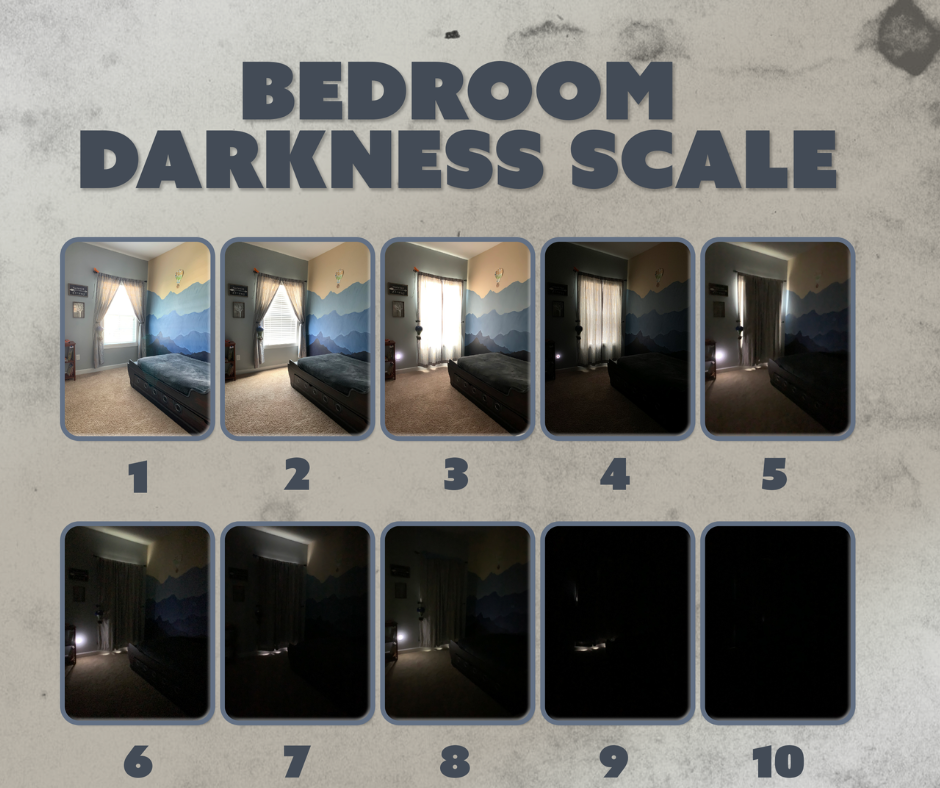
Another simple test: Once you are in bed with the lights out, let your eyes adjust for a few minutes. Then, hold your hand up about 30cm (1 foot) in front of your face. Can you see it? If you can, your room is not dark enough.
The Problem: Why Standard "Blackout" Curtains Fail
You've likely seen curtains marketed as "100% Blackout." While the fabric itself may be opaque, the system as a whole almost always fails. This is due to what's known as the "Halo Effect."
Light doesn't just travel in straight lines; it reflects and bleeds around obstacles. Standard curtains hang from a rod, leaving gaps at the top, bottom, and sides. Light from streetlamps or the morning sun pours through these gaps, creating a "halo" of light that raises the ambient lux in your room far above the 5-10 lux threshold.
This is the critical difference between "room darkening" (a marketing term for opaque fabric) and a true "100% blackout" system, which is engineered to seal these gaps. A 1-inch gap turns your 100% blackout fabric into a 0% blackout system.
The Blackout Protocol: A Step-by-Step Guide to 0 Lux
Achieving total darkness is a systematic process. Follow these steps to identify and eliminate every source of light.
Step 1: Eliminate Internal Light Sources (The Easy Wins)
Before tackling windows, address the sources of light inside your room. These are often small but powerful enough to disrupt melatonin.
- Electronics: Cover all standby lights, charging indicators, and power strip switches. You can use black electrical tape or purchase specialized light-dimming stickers.
- Alarm Clocks: If your clock has an illuminated display, turn it to face the wall or, even better, switch to a non-illuminated clock. Your phone can serve as an alarm from another room or with its screen completely off.
- Smoke Detectors: These often have a persistent green or red light. A small piece of light-dimming tape is usually sufficient to cover it without impairing function.
- Door Gaps: If light bleeds in from under your bedroom door, use a simple draft stopper to block it.
Step 2: Seal External Light Leaks (The Window Protocol)
This is the most crucial step. Here are three methods, from good to best, allowing you to choose based on your budget and living situation.
Method A: The Zero-Cost / Temporary Solution
- What: Completely cover the window glass with an opaque material like aluminum foil (shiny side out to reflect heat) or black construction paper. Secure it with painter's tape to avoid damaging the window frame.
- Pros: Extremely effective (achieves 0 lux), virtually free.
- Cons: Not aesthetically pleasing, blocks all-natural light during the day.
- Best for: Testing the impact of total darkness for a few nights, shift workers, or temporary situations like travel.
Method B: Enhancing Existing Curtains/Shades
If you already have blackout curtains or shades, your goal is to seal the "Halo Effect" gaps.
Make Blackout Shades Better With Light Blocking Strips
This video, 'Make Blackout Shades Better With Light Blocking Strips,' provides a practical, real-world demonstration of how to solve the edge leakage problem. Watch how these simple strips are installed and the immediate difference they make.
Watch from the beginning to 02:28. Pay attention to how the presenter tests the placement of the strips (in front of vs. behind the shade) and the before-and-after effect on the light gaps.
As shown, simple PVC light-blocking strips or side channels can be installed along the vertical edges of your window frame to block light from seeping in around your shades. You can also get creative with solutions like top valances or cornices to block light from the top, and ensure your curtains are long enough to cover the bottom sill.
Method C: The Engineered Solution
- What: Invest in a purpose-built blackout shade system that includes integrated side channels, a top housing, and a bottom seal.
- Pros: The most effective and clean-looking permanent solution for achieving 100% blackout.
- Cons: The most expensive option.
- Best for: Homeowners who are serious about long-term sleep optimization.
Step 3: The Contingency Protocol (For Travel & Uncontrolled Environments)
For a digital nomad, frequent traveler, or anyone who can't modify their bedroom, the protocol is to make yourself light-proof.
- Action: Invest in a high-quality sleep mask. Look for a molded or contoured mask that creates a perfect seal around your eyes without putting pressure on your eyelids. This ensures no light gets in, even when you move. This is also mentioned as a viable option in Dr. Huberman's newsletter on sleep improvement.
Test your understanding!
You've installed a set of expensive "100% Blackout" curtains in your bedroom. At night, you notice a faint glow around the entire window frame. You can still vaguely make out the shape of your hand in front of your face.
- What is the technical term for this light leakage problem?
- Based on the lesson, what is one specific, actionable hardware solution you could implement to fix this without replacing the curtains?
Show answer
- The problem is called the "Halo Effect." It occurs when light bleeds through the gaps at the top, bottom, and sides of a curtain or shade, even if the fabric itself is opaque.
- A specific hardware solution is to install PVC light-blocking strips or side channels along the vertical edges of the window frame. This creates a seal between the curtain and the wall, blocking the light that leaks from the sides.
Conclusion
You have now learned the critical importance of achieving near-total darkness and have a structured, multi-option protocol to make it a reality. Light is the most powerful regulator of your circadian rhythm, and by controlling it both before bed and during sleep, you are taking a fundamental step toward better energy and performance.
Key Takeaways:
- Your sleep goal is 0 lux (total darkness), as even 5-10 lux can suppress melatonin.
- Standard "blackout" curtains fail due to the "Halo Effect"—light leaking around the edges.
- The blackout protocol involves a systematic approach: first, cover internal light sources (LEDs), then seal external light leaks from windows using methods appropriate for your situation.
- A high-quality, molded sleep mask is an essential tool for travel or any environment you can't control.
In this lesson, we secured your sleep sanctuary from light. In the next lesson, we will tackle the second major environmental disruptor: sound. We will cover how to establish a quiet sleep environment using sound masking and blocking techniques to protect your sleep from disruptive noises.