Recommended resources
The freely available resources this lesson will direct you to.
Welcome. This course begins with cell biology before moving through other Biology topics, Chemistry, Physics, and exam practice. In this first module, you will establish the structural vocabulary needed to understand organelles, membranes, and biomolecules.
Today’s task is to compare prokaryotic and eukaryotic cells from NCERT diagrams, rather than memorise two lists of parts. By the end, you should be able to look at an unfamiliar cell drawing, identify the strongest evidence for its classification, and explain your choice in precise exam language.
The distinction to look for first
A cell’s most useful identifying feature here is where its genetic material is housed. A eukaryotic cell has a nucleus: its genetic material is enclosed by a nuclear envelope. A prokaryotic cell has no membrane-bound nucleus; its main genetic material occupies a region called the nucleoid.
A second feature confirms the distinction. Eukaryotic cells contain membrane-bound organelles, such as mitochondria and the endoplasmic reticulum. Prokaryotic cells lack these internal compartments. Both, however, have a plasma membrane, cytoplasm, DNA, and ribosomes. “No membrane-bound organelles” does not mean “no membrane” or “no ribosomes.”
Watch these short portions of Prokaryotic vs Eukaryotic Cells – High School Biology from ClickView for a visual introduction. Keep the nucleus and nucleoid distinct as you watch.
Prokaryotic vs Eukaryotic Cells - High School Biology
ClickView’s comparison introduces the defining structures and then identifies features shared by both cell types.
Watch the main distinction for the nucleus, nucleoid, and internal organelles. Continue with organism examples, then watch shared features. Focus on why finding a ribosome or a plasma membrane does not, by itself, identify a cell as eukaryotic.
Read the NCERT descriptions alongside the diagrams
NCERT Chapter 8, Cell: The Unit of Life, gives the terminology you will need for a written answer. Read the specified passages, then briefly inspect Figure 8.3 to locate a nuclear envelope and other internal structures in the eukaryotic examples. A detailed plant-versus-animal comparison belongs to the next lesson.
Read NCERT’s descriptions of what the two cell types share and how their internal organisation differs. Use the figures to connect each term to something visible.
On p. 89, read the opening passage of Chapter 8, from the recollection of onion-peel and cheek cells through the statement about ribosomes: shared structures. Notice the distinction between a membrane-bound organelle and a non-membrane-bound ribosome. In Section 8.4, “Prokaryotic Cells” (pp. 90–91), read from the examples of prokaryotes through the statement that they lack the organelles found in eukaryotes: prokaryotic structure. Locate the descriptions of the nuclear membrane, main DNA, plasmids, and cytoplasm. In Section 8.5, “Eukaryotic Cells” (p. 92), read from its list of eukaryotes through the sentence on chromosomes: eukaryotic structure. Glance at Figure 8.3 on pp. 92–93 to identify the nucleus or nuclear envelope and several membrane-bound structures; leave the differences between its plant and animal cells for the next lesson.
The DNA distinction is often compressed too far in answers. A nucleoid is a region, not a primitive nucleus enclosed by a membrane. In the typical bacterial cell described by NCERT, the main DNA is not surrounded by a nuclear envelope; some bacteria also contain smaller DNA molecules called plasmids. In a eukaryotic cell, the nuclear envelope encloses the nuclear genetic material, organised into chromosomes.
Reading NCERT Figure 8.2
The supplied NCERT figure puts a typical eukaryotic cell beside bacteria, PPLO, and viruses. Read its labels and internal structures together; size alone is not enough to classify every object shown.
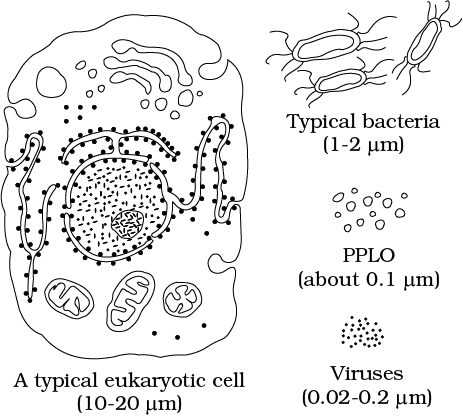
Start with the large cell on the left. Its conspicuous enclosed nucleus and multiple distinct internal structures are evidence of eukaryotic organisation. The folded membrane network and oval structures are further clues that its interior is divided into compartments.
Now inspect the bacteria at the upper right. The drawings show a comparatively simple internal organisation, without an enclosed nucleus or the collection of membrane-bound organelles seen on the left. Their outer boundary and surface projections may be visible, but an outer boundary is not evidence of a nucleus: a prokaryotic cell still has a plasma membrane.
The size labels give a useful typical comparison: the pictured eukaryotic cell is about –, while the pictured bacteria are about –. These are not strict size cutoffs for all cells. If a drawing gives you both size and internal structure, give greater weight to the nuclear envelope and membrane-bound organelles.
The lower-right labels guard against two exam traps. PPLO belongs with the prokaryotes discussed by NCERT; its very small size does not make it a virus. Viruses are acellular, so they should not be placed in either the prokaryotic-cell or eukaryotic-cell column merely because Figure 8.2 shows them for comparison. Also, a cell wall is not a universal test: bacteria commonly have one, but NCERT notes mycoplasma as an exception, while some eukaryotes also have cell walls.
Building a comparison that earns marks
An effective comparison pairs corresponding features instead of describing one cell completely and then starting again with the other.
| Feature | Prokaryotic cell | Eukaryotic cell |
|---|---|---|
| Genetic material | In a nucleoid; no nuclear envelope around it | Enclosed in a nucleus by a nuclear envelope |
| Membrane-bound organelles | Absent | Present |
| Ribosomes | Present; not membrane-bound | Present; not membrane-bound |
| Plasma membrane and cytoplasm | Present | Present |
| Typical size in Figure 8.2 | Bacteria: about – | Pictured cell: about – |
| Examples | Bacteria, including the prokaryotic groups discussed in NCERT | Protists, fungi, plants, and animals |
Notice what the table does not claim. It does not say that prokaryotes lack DNA, that eukaryotes alone possess ribosomes, or that all eukaryotes lack a cell wall. Those statements would turn a useful general comparison into an incorrect one.
In a diagram-based answer, begin with the decisive observation: “The genetic material is enclosed by a nuclear envelope, so this is a eukaryotic cell.” You can then support it by naming visible membrane-bound organelles. For a bacterial diagram, state that the DNA occupies a nucleoid without a nuclear envelope, and note the absence of membrane-bound organelles. If asked for similarities, name shared features separately rather than weakening the distinction.
Key takeaways
Nuclear envelope first, internal compartments second, size as supporting evidence: that is a reliable order for classifying the cells in NCERT-style diagrams. Prokaryotes have a nucleoid but no membrane-bound nucleus; eukaryotes have a nucleus and membrane-bound organelles. Both remain cells with a plasma membrane, cytoplasm, DNA, and ribosomes. Viruses in the size comparison are not cells.
In the next lesson, you will use the eukaryotic diagrams more closely to distinguish plant and animal cells by their observable structures.