Recommended resources
The freely available resources this lesson will direct you to.
Introduction
Welcome back! In our last lesson, we focused on when to study, exploring how to design a spaced repetition schedule to combat the forgetting curve. We established that timing your reviews is crucial for building durable memory.
Today, we shift our focus from when you practice to what you practice within a single study session. This lesson covers interleaving, a powerful technique for learning multiple related concepts. Our learning outcome is to explain how interleaving different but related topics improves your ability to discriminate between concepts.
This directly addresses your goal of improving how you apply knowledge. Knowing many UX principles is one thing; knowing precisely which one to apply in a messy, real-world situation is another. Interleaving is a core strategy for developing that critical judgment.
Blocked vs. Interleaved Practice: What's the Difference?
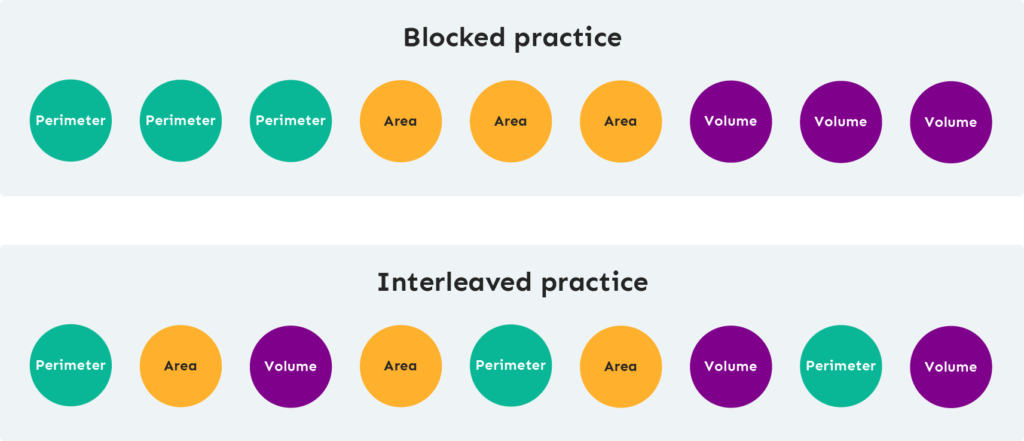
Most of us naturally learn and practice in "blocks." If you have three topics to learn—say, Gestalt principles, WCAG accessibility standards, and prototyping in Figma—you might dedicate Monday to Gestalt, Tuesday to WCAG, and Wednesday to Figma. This is blocked practice.
Interleaved practice mixes these related topics within a single study session. Instead of a deep dive on one topic, you would tackle a problem on Gestalt, then one on WCAG, then one on Figma, and repeat the cycle.
This image provides a clear visual distinction:
To get a dynamic explanation of this concept, let's watch the first part of the following video.
Secrets of Interleaved Practice | How Learning Works
This video from Benjamin Keep provides a concise introduction to interleaved practice by first defining its opposite, blocked practice.
Please watch from the beginning to 01:33. The video uses an algebra example, but the principle is universal. Focus on the distinction between practicing in blocks (AAA, BBB, CCC) and interleaving (A, B, C, A, B, C).
As you can see, the structural difference is simple, but its impact on learning is profound.
The Core Benefit: Building Your Discrimination Muscle
So, why is mixing things up so effective? The primary benefit of interleaving is that it enhances your ability to discriminate between similar but distinct concepts.
When you practice in blocks, you know what strategy to use before you even see the problem. If you're in the "WCAG Contrast" block of your study session, you're not trying to figure out if a contrast problem exists; you're just applying the contrast formula over and over. Your brain is on autopilot.
Interleaving forces your brain off autopilot. For every single problem, you must first ask:
- What kind of problem is this? (e.g., "Is this a design challenge about visual hierarchy, information architecture, or accessibility?")
- What strategy or tool is appropriate for this specific problem? (e.g., "This requires applying the principle of Proximity, not Similarity. I need the card sorting method, not A/B testing.")
This constant process of identifying and selecting the right strategy is what builds robust, flexible knowledge that you can apply in novel situations—exactly like the challenges you face in your design work.
The following resource provides an excellent, in-depth explanation of why this works.
Interleaving: A teacher's guide
This guide from Structural Learning breaks down the cognitive science behind interleaving and provides a direct comparison with blocked practice.
Please read the following two sections: Start at the heading 'Why Does Interleaving Work Better Than Blocked Practice?' and read down to the end of that section. Then, find the table under the heading 'Blocked Practice vs Interleaved Practice: Key Differences' and study it carefully. Pay special attention to the rows on 'Discrimination Skills' and 'Transfer'.
The key takeaway is that blocked practice trains you in a specific procedure, while interleaved practice trains you in both the procedure and the critical skill of choosing the right procedure.
Test your understanding!
Imagine you are learning three different user research methodologies: User Interviews, A/B Testing, and Card Sorting. You want to create practice scenarios for yourself.
Briefly describe a practice problem that would be characteristic of an interleaved session. What makes it different from a problem in a blocked session?
Show answer
A problem for a blocked session would be very direct, for example: "You are practicing User Interviews. Write three open-ended questions you would ask to understand a user's frustrations with a mobile banking app." Here, the method is given to you.
A problem for an interleaved session would be more like a real-world scenario that forces you to choose the method: "Your product manager wants to understand why users are abandoning the new checkout flow. They also want to know which of two proposed 'Buy Now' button designs will perform better. Which research methods would you propose for these two distinct problems, and why?"
This second problem is interleaved because it forces you to discriminate. You have to recognize that "understanding why" points toward a qualitative method like User Interviews, while "which performs better" points toward a quantitative method like A/B Testing.
Interleaving as a "Desirable Difficulty"
In a previous module, we touched upon the idea of 'desirable difficulties'—strategies that make learning feel harder in the moment but lead to much better long-term retention. Interleaving is a classic example.
During interleaved practice, you will likely make more mistakes and feel less fluent than during blocked practice. This can create an "illusion of incompetence," making you feel that the method isn't working. It's crucial to recognize this feeling for what it is: a sign that your brain is engaged in the deeper processing required for durable learning. Blocked practice feels easy and productive, but it's often a deceptive "illusion of competence."
To hear this concept explained by the researchers who coined the term, please watch this short segment.
How to study to maximize performance | Elizabeth Bjork & Robert Bjork | TEDxManhattanBeach
In this TEDx talk, Elizabeth and Robert Bjork, leading cognitive psychologists, discuss interleaving as a key 'desirable difficulty'.
Watch the segment from 10:01 to 13:20. Notice how they emphasize that performance during practice is often a misleading indicator of actual long-term learning.
As a UX designer, you can think of this in terms of user effort. As the article "What does UX in education look like?" mentions, while your job is often to reduce user effort, in the context of learning, introducing the right kind of effort is what creates effective outcomes. Interleaving is precisely that right kind of effort.
Important Caveats: When and How to Interleave
Interleaving is a powerful tool, but it's not a universal solution. There are two key things to keep in mind.
Secrets of Interleaved Practice | How Learning Works
Let's return to the first video to hear about the important limitations of interleaving.
Please watch the final part of the video from 06:59 to 08:50. Pay close attention to the two main caveats he discusses.
To summarize the key points:
- Don't interleave brand-new material. When you are first learning a skill (e.g., the absolute basics of Figma's auto-layout), a little bit of blocked practice is helpful to understand the mechanics. Once you have a basic grasp, you should switch to interleaved practice as soon as possible to connect it with other skills.
- Interleaving is NOT multitasking. Interleaving involves mixing related topics within a single domain (e.g., different UX research methods). Task-switching—studying UX for 10 minutes, then coding for 10 minutes, then personal finance for 10 minutes—is highly inefficient and detrimental to learning due to the cognitive cost of switching contexts.
Conclusion
Today you've learned about interleaving, a method that fundamentally changes how you practice. By moving from blocked to interleaved practice, you shift the focus from simply executing a known procedure to the much more valuable skill of analyzing a situation and selecting the correct procedure.
Key Takeaways:
- Interleaving involves mixing the practice of different but related topics within a study session.
- Its primary benefit is improving concept discrimination—the ability to tell concepts apart and know when to apply each one.
- It works by forcing your brain to identify the problem type before retrieving and applying a solution, which mimics real-world problem-solving.
- Interleaving is a "desirable difficulty": it feels harder and less productive during practice but leads to superior long-term retention and knowledge transfer.
- Use it after you have a basic grasp of the individual concepts, and don't confuse it with multitasking.
What's Next?
We have established the what and why of interleaving. In the next lesson, we will get practical and focus on the how. You will learn how to apply interleaved practice when learning multiple UX methodologies or coding functions, designing practice sessions that build the flexible expertise you need.