Recommended resources
The freely available resources this lesson will direct you to.
Hello! In our last lesson, we established the conceptual foundation of Landau Fermi Liquid (FL) theory, defining quasiparticles as long-lived, "dressed" excitations near the Fermi surface. We introduced the two pillars of the theory's phenomenology: the quasiparticle energy, parameterized by an effective mass , and the residual interaction between quasiparticles, described by the Landau function .
Today, we will connect this abstract framework to concrete, measurable physical properties. Our goal is to see how the phenomenological parameters of FL theory manifest in experiments. Specifically, you will learn to derive the effective mass of a quasiparticle and use it to calculate the low-temperature specific heat of a Fermi liquid. This will show how can be measured and what it physically represents in terms of the underlying interactions.
1. Specific Heat: The Role of Effective Mass
One of the great successes of Fermi liquid theory is its ability to explain why the specific heat of many interacting metals is linear in temperature (), just like a free Fermi gas, but with a different coefficient. The reason, as we will see, is that the thermal properties are governed by a gas of weakly interacting quasiparticles, not bare electrons.
Let's begin by considering the total energy functional we introduced last time:
Here, is the deviation of the quasiparticle occupation number from the zero-temperature ground state. At a finite temperature , these deviations are caused by thermal smearing of the Fermi-Dirac distribution.
A key insight from Landau is that for calculating the leading-order thermal energy, the interaction term (the one with ) can be ignored. Why is this?
PHYSICS 268R: Quantum Phases of Matter: 1. Fermi liquid theory
In this clip, Prof. Subir Sachdev provides a clear physical argument for why the Landau interaction term does not contribute to the leading T-squared term in the total energy, and thus does not affect the linear temperature dependence of the specific heat.
Please watch from 40:40 to 42:58. Focus on the argument about why the interaction term, which depends on products like \delta n \cdot \delta n, contributes at a higher order in temperature than the single-quasiparticle term. He explains that at low T, the total change in occupation number \sum_p \delta n(p) integrates to something much smaller than T, making the interaction energy negligible at the lowest orders. Then, watch the segment from 48:34 to 50:15, which summarizes the result for the specific heat.
As Prof. Sachdev explains, the thermal excitations create quasiparticles above the Fermi energy and quasiholes below it. To leading order, the number of thermally excited quasiparticles equals the number of quasiholes. The net change in occupation number integrated over all momenta is of a higher order in temperature. Consequently, the term quadratic in in the energy functional contributes only to higher-order terms in the specific heat (e.g., ), which we will not consider here.
This leaves us with a remarkable simplification: the low-temperature thermodynamics of an interacting Fermi liquid are identical to those of a free gas of quasiparticles, with the bare mass simply replaced by the effective mass .
The calculation of the specific heat then follows the standard Sommerfeld expansion you've likely encountered in solid-state physics.
This document provides a concise and clear derivation of the specific heat for a Fermi liquid, starting from the first law of thermodynamics and applying the Sommerfeld expansion.
Please read section 9.2.3, 'Low temperature equilibrium properties', focusing on the subsection 'Entropy and specific heat' (pp. 10-11). Follow the steps from the expression for entropy variation \delta S to the final formula for specific heat, c_V, in Eq. (9.44).
The derivation yields the well-known result:
where is the quasiparticle density of states at the Fermi energy. For a 3D isotropic system, the density of states (including spin) is given by:
Since the specific heat of a non-interacting gas () would have the same form but with the bare mass , we arrive at a cornerstone result of Fermi liquid theory:
This result is profound. It tells us that interactions renormalize the coefficient of the linear specific heat (the Sommerfeld coefficient ) by a simple factor of . Measuring the specific heat of a metal is therefore a primary experimental method for determining the effective mass of its quasiparticles.
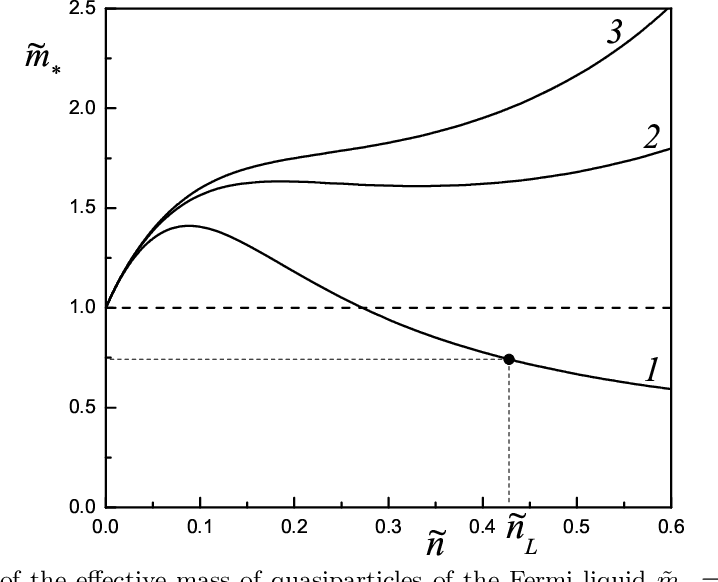
2. Microscopic Origin of the Effective Mass
We have established that is a key parameter that can be measured. But what determines its value? Within the framework of FL theory, is not just an arbitrary fitting parameter; it is directly related to the quasiparticle interactions encoded in the Landau function .
For a system that is Galilean invariant, like liquid ³He (but not, strictly speaking, for electrons in a crystal lattice), we can derive this relationship. The argument is a beautiful piece of theoretical physics that connects a symmetry principle (invariance under boosts) to the microscopic interactions.
The core idea is to consider the energy of a quasiparticle in a reference frame moving with a small, constant velocity . We can calculate this energy in two different ways and demand that the results match.
-
Kinematic Transformation: From Galilean relativity, the energy of a particle with momentum and mass transforms as . The momentum itself transforms as . The quasiparticle energy must follow a similar rule.
-
Interaction-based Transformation: In the moving frame, the entire Fermi sea is shifted in momentum space by . This shift creates a non-equilibrium distribution of quasiparticles, . This change in the background distribution alters the energy of our test quasiparticle via the interaction term .
By equating these two expressions for the transformed energy, we can derive a formula for .
The following text provides the complete derivation relating the effective mass to the Landau parameters, based on the principle of Galilean invariance.
Please read the subsection 'Galilean invariance' on pages 14-15. This is a subtle but powerful argument. Follow it carefully, paying attention to how the quasiparticle energy ilde{\varepsilon}'_{k,\sigma} is expressed first using the shifted distribution (Eq. 9.61) and then using the kinematic transformation (Eq. 9.65). The final comparison yields the desired result.
The derivation culminates in the famous relation:
Here, is the dimensionless Landau parameter corresponding to the Legendre polynomial component of the spin-symmetric part of the interaction function . Physically, describes how the energy of a quasiparticle is affected by a current carried by other quasiparticles.
- If , the interactions tend to oppose the motion of a quasiparticle (a phenomenon known as backflow), increasing its inertia and making . This is the case in liquid ³He.
- If , the interactions would effectively "drag" the quasiparticle along, reducing its inertia and making .
This formula beautifully connects the macroscopic, measurable quantity to the microscopic details of the quasiparticle interactions.
Test your understanding!
In many heavy-fermion materials, the measured effective mass can be hundreds of times the bare electron mass . Based on the formula we just derived, what does this imply about the strength and nature of the component of the quasiparticle interaction in these systems?
Show answer
A very large ratio implies that must be large and positive. This indicates an extremely strong interaction effect where the motion of any single quasiparticle is heavily impeded by a strong "backflow" or polarization of the surrounding Fermi sea. The quasiparticle has to drag an enormous interaction cloud with it, making it appear extremely heavy.
Conclusion
In this lesson, we have solidified our understanding of Fermi liquid theory by connecting its phenomenological parameters to observable physics.
Key Takeaways:
- The low-temperature specific heat of a Fermi liquid is linear in temperature, , just like a free Fermi gas.
- Interactions renormalize the Sommerfeld coefficient such that the ratio of the interacting to non-interacting specific heat directly measures the effective mass: .
- For Galilean-invariant systems, the effective mass is determined by the symmetric Landau parameter: . This formula provides a link between a macroscopic property and the underlying quasiparticle interactions.
Preview of the Next Lesson:
Having explored the properties of the normal metallic state through the lens of Fermi liquid theory, we are now positioned to understand one of the most fascinating phenomena that can emerge from it: superconductivity. The Fermi liquid state, with its sharp Fermi surface of well-defined quasiparticles, is susceptible to an instability where quasiparticles with opposite momenta form bound pairs (Cooper pairs). In our next lesson, we will derive the famous BCS gap equation, which describes this pairing instability and the formation of the superconducting ground state.