Recommended resources
The freely available resources this lesson will direct you to.
Hello! Welcome to the first lesson in our module on collective phenomena.
In our last lesson, we concluded our study of diagrammatic perturbation theory by analyzing the plasmon, a collective quasiparticle of the entire electron gas. We saw how its existence and properties are dictated by the long-range Coulomb interaction, as described by the Random Phase Approximation (RPA).
Today, we shift our focus from collective modes to the low-energy excitations that behave like individual particles. We will address a fundamental puzzle in condensed matter physics: why do many strongly interacting electron systems, like metals, exhibit properties that are remarkably similar to those of a non-interacting Fermi gas? The answer lies in Landau's Fermi Liquid Theory. Our goal is to define the central concept of this theory—the quasiparticle—and to outline the phenomenological basis that makes this description so powerful and successful.
1. The Puzzle and the Adiabatic Hypothesis
The starting point for any many-body problem is a Hamiltonian with kinetic energy and particle-particle interactions. As you know from your work with Hartree-Fock theory, solving this problem exactly is generally impossible for a macroscopic number of particles. Yet, experimentally, the low-temperature specific heat of metals is linear in temperature (), just like a free Fermi gas. This suggests that interactions, however strong, do not completely destroy the free-particle picture.
Landau's genius was to sidestep the impossible task of solving the interacting ground state. Instead, he proposed a powerful hypothesis based on the idea of adiabatic continuity.
These notes from a course on correlated electrons introduce the puzzle of Fermi liquids and Landau's brilliant conceptual leap to resolve it.
Please read the introduction and Section 1 (pp. 2-1 to 2-3). Focus on the core puzzle and Landau's idea of establishing a one-to-one correspondence between the states of an ideal Fermi gas and the interacting system by 'slowly switching on' the interaction.
The core idea is this: if we start with a non-interacting Fermi gas and slowly turn on the interactions, each quantum state of the free system smoothly evolves into a corresponding state of the interacting system without any abrupt changes or level crossings.
This means we can still label the states of the interacting system (the ground state and low-lying excited states) using the quantum numbers of the free particles (momentum and spin ). The elementary excitations of the interacting system, which correspond to adding or removing a particle from the free system, are called quasiparticles and quasiholes.
2. What is a Quasiparticle? The "Dressed" Electron
A quasiparticle is not the same as the original "bare" electron. When an electron moves through the interacting sea of other electrons, it repels those nearby and attracts the positive background, creating a complex disturbance or "cloud" of particle-hole pairs around it. The quasiparticle is the composite object: the original electron plus its surrounding screening cloud.
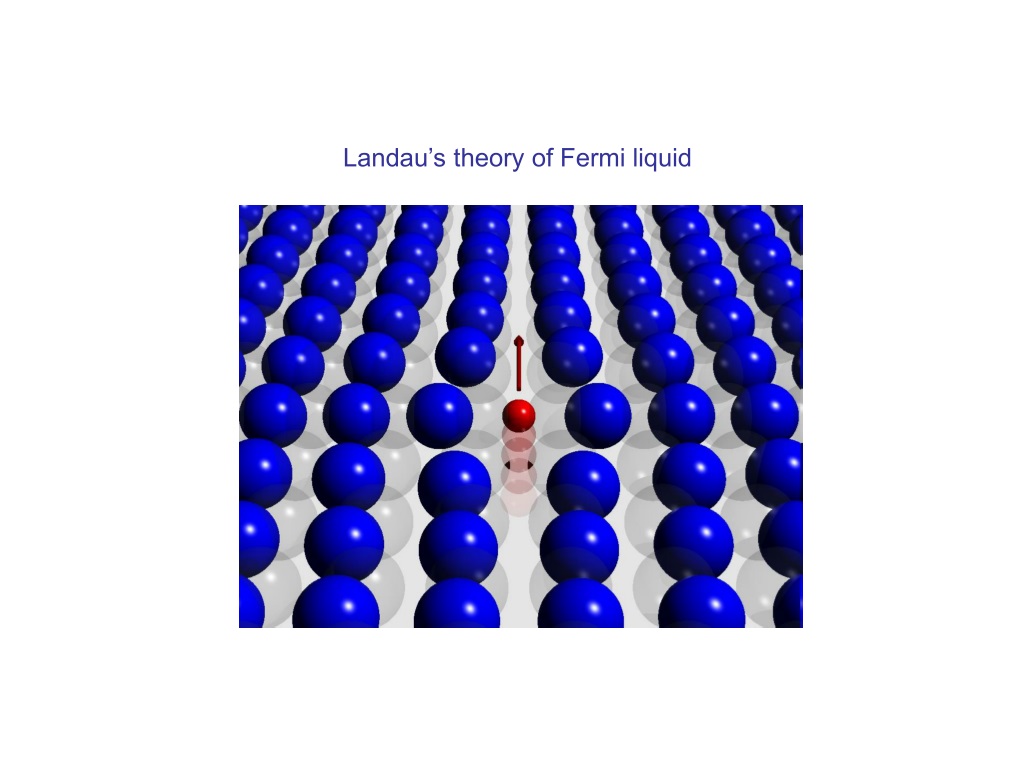
This "dressing" process modifies the particle's properties. For instance, the quasiparticle has an effective mass (), which is generally different from the bare electron mass ().
To get a more dynamic picture of this dressing, let's watch a segment from a lecture by Prof. Subir Sachdev.
PHYSICS 268R: Quantum Phases of Matter: 1. Fermi liquid theory
This video explains the physical origin of the quasiparticle picture, describing how an added electron creates a 'cloud' of particle-hole pairs and how this picture becomes more accurate closer to the Fermi surface.
Please watch from 29:54 to 35:48. Pay close attention to the description of the 'cloud of particle hole pairs' that forms the quasiparticle and the crucial concluding statement: the lifetime of these excitations goes to infinity as you approach the Fermi surface.
3. The Phenomenological Basis: Why Quasiparticles are Stable
The most critical part of the theory is understanding why this quasiparticle picture doesn't immediately fall apart. If interactions are strong, why doesn't a quasiparticle instantly scatter and lose its identity?
The answer lies in a combination of energy conservation and the Pauli exclusion principle. An excited quasiparticle with energy just above the Fermi energy can only decay by scattering off another particle. However, for the scattering to occur, the final states for both particles must be empty. At low temperatures, almost all states below are filled.
This "Pauli blocking" severely restricts the available phase space for scattering processes. A careful analysis shows that the scattering rate () for a quasiparticle depends quadratically on its energy relative to the Fermi level:
Since the typical excitation energy at a low temperature is , this implies the scattering rate scales as:

This is the cornerstone of Fermi liquid theory. As we consider excitations closer and closer to the Fermi surface () or at lower and lower temperatures (), the lifetime of a quasiparticle becomes infinitely long compared to its characteristic timescale of oscillation (). This makes the quasiparticle a well-defined entity, justifying the entire approach.
The following text provides a clear and concise physical argument for the long lifetime of quasiparticles based on this 'Pauli blocking' effect.
Please read Section 2 (pp. 2-3 to 2-5). The phase space argument presented here is the essential physical justification for why the quasiparticle concept is valid.
Test your understanding!
In our study of plasmons, we encountered Landau damping, where a collective mode can decay by creating an electron-hole pair. In Fermi liquid theory, we argue that single-particle excitations (quasiparticles) near the Fermi energy are long-lived. How can both be true?
Show answer
The key is the region of the plane being considered. Landau damping of plasmons occurs when the plasmon's dispersion curve enters the particle-hole continuum. This typically happens at finite and . The stability of Fermi liquid quasiparticles, on the other hand, is a statement about excitations at the edge of the particle-hole continuum. As you approach the boundary of this continuum (i.e., as the excitation energy for a given , or as for a particle-hole pair right at the Fermi surface), the available phase space for decay processes vanishes. So, a high-energy plasmon can decay into low-energy particle-hole pairs, but a low-energy quasiparticle has nowhere to decay to.
4. The Landau Energy Functional
Having established the physical basis, Landau constructed a phenomenological theory. He expressed the total energy of the system as a functional of the quasiparticle occupation numbers, . For small deviations from the T=0 ground state distribution , the change in energy is:
This expression introduces the two central quantities of the theory:
- The Quasiparticle Energy, : This is the energy cost of adding a single quasiparticle. For an isotropic system near the Fermi surface, it is parameterized by the effective mass :
- The Landau Interaction Function, : This function describes the residual, short-range interaction between two quasiparticles. It's the second derivative of the energy with respect to the occupation numbers.
These quantities ( and the parameters describing ) are the phenomenological parameters of the theory. They are not derived from FLT, but are used as inputs, typically determined by fitting to experimental data.
Fermi-liquid Theory: Introduction
The following notes by A.J. Leggett formalize this energy expansion and define the effective mass and Landau interaction function.
Please read from the paragraph starting 'Having settled the labelling...' on page 3 to the end of page 4. This section introduces the Taylor expansion of the energy and defines the key phenomenological parameters.
5. Experimental Signatures and When the Theory Fails
How do we see a Fermi liquid in an experiment? The theory predicts two key signatures that are observable in Angle-Resolved Photoemission Spectroscopy (ARPES), which measures the electron spectral function .
- A Discontinuity in : The momentum distribution is not a perfect step function as in a free gas. Interactions move some particles to states above . However, a sharp jump of size (the quasiparticle weight) remains at .
- Narrowing Spectral Peaks: The spectral function for a given is not a delta function. It's a peak with a finite width related to . As approaches , this peak becomes progressively sharper, reflecting the infinitely long lifetime of quasiparticles right at the Fermi surface.
The following video provides an excellent summary of these signatures and shows stunning experimental data confirming them. It also provides a wonderful analogy to help you understand what makes a Fermi liquid special by contrasting it with a system where the theory breaks down completely: a one-dimensional "Luttinger liquid".
1D physics and Luttinger liquids, lecture 1
This lecture clip provides a 'crash course' in Fermi liquid theory, focusing on its experimental signatures, and contrasts it with the very different physics of one-dimensional systems.
Please watch from 4:58 to 7:07 for a fantastic crowd analogy contrasting 2D/3D Fermi liquids with 1D systems. Then, watch from 22:24 to 35:33 for a review of the key theoretical predictions (the jump 'Z' and the narrowing spectral peaks) and a comparison with real ARPES data.
As the video's analogy suggests, dimensionality is key. In 1D, particles in a line cannot pass each other. Any excitation is necessarily collective, and the individual quasiparticle picture breaks down entirely, even for arbitrarily weak interactions. This fundamentally different state of matter is called a Luttinger liquid. Your experience with diverse condensed matter systems will help you appreciate that Fermi liquid theory, while powerful, is not universal.
Conclusion
Today we've laid the conceptual groundwork for one of the most important paradigms in many-body physics. Landau's Fermi Liquid theory provides a framework to understand how strong interactions can lead to behavior that is deceptively simple.
Key Takeaways:
- Adiabatic Continuity: The low-energy states of an interacting Fermi system are assumed to be in one-to-one correspondence with those of a free Fermi gas.
- Quasiparticles: The elementary excitations are "dressed" particles—an electron or hole plus its screening cloud—which have the same quantum numbers (charge, spin 1/2, momentum ) as the bare particles but a different effective mass .
- Stability: Quasiparticles are stable at low energies because Pauli blocking severely restricts the phase space for scattering, leading to a lifetime that diverges as ().
- Phenomenology: The theory is built around an energy functional parameterized by the quasiparticle energy (related to ) and the Landau interaction function .
Preview of the Next Lesson:
We now have the full conceptual framework of Fermi Liquid Theory. In the next lesson, we will put this machinery to work. We will use the phenomenological description to derive one of the most basic thermodynamic properties of a Fermi liquid: its low-temperature specific heat. This will demonstrate the predictive power of the theory and give a concrete physical meaning to the effective mass .