Recommended resources
The freely available resources this lesson will direct you to.
Hello! Welcome to our final lesson in this module on collective phenomena.
In our last lesson, we explored the Integer Quantum Hall Effect (IQHE), where the Hall conductance is quantized to perfect integer multiples of . We saw that this remarkable precision is protected by topology, with the integer identified as a Chern number. The entire picture, however, was built on a foundation of non-interacting electrons, with disorder playing the crucial role of creating the plateaus.
Today, we venture into even more exotic territory: the Fractional Quantum Hall Effect (FQHE). As the name suggests, this is what happens when the Hall conductance locks onto fractional values.
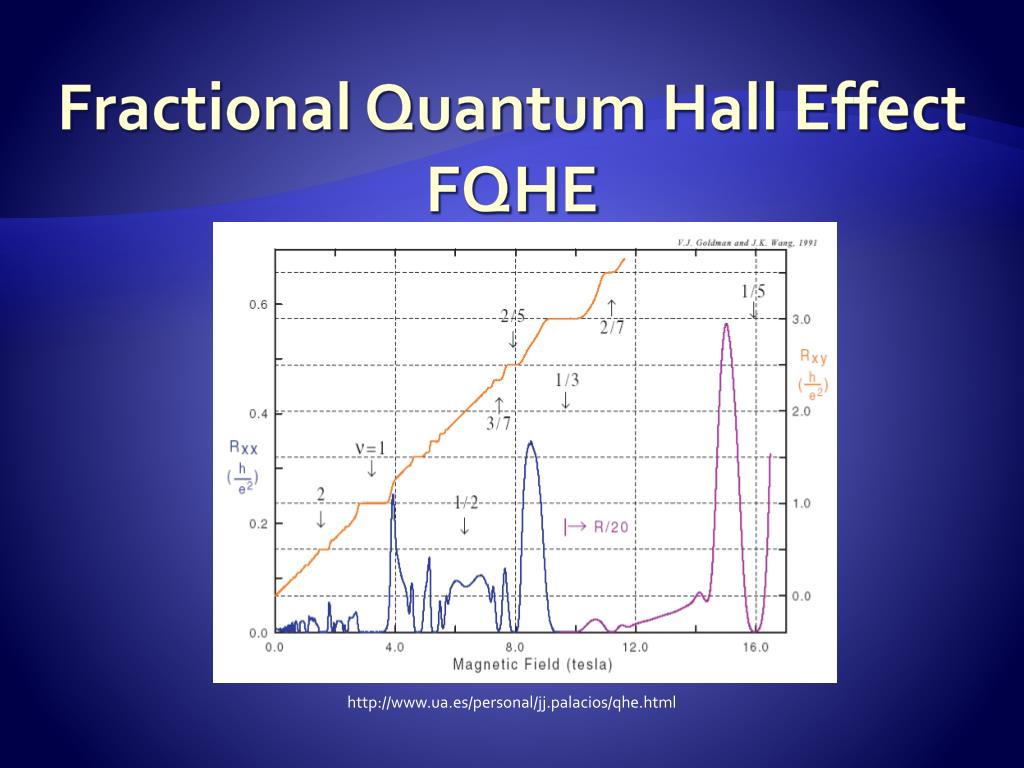
These fractional plateaus signal the emergence of a new kind of quantum liquid, one that cannot be described by independent electrons. The physics is now dominated by strong electron-electron interactions, leading to a highly correlated many-body ground state. Our goal for this lesson is to:
- Describe the Fractional Quantum Hall effect using the Laughlin wavefunction.
We will see how Robert Laughlin, in a stroke of genius, wrote down an ansatz for this correlated ground state, a wavefunction that not only explains the plateau but also predicts the existence of bizarre, fractionally charged excitations.
1. The Challenge of Interactions
When the lowest Landau level is only partially filled (e.g., ), there are a macroscopic number of ways to arrange the electrons among the available single-particle states. The kinetic energy is the same for all of them, so the ground state is determined by the configuration that minimizes the Coulomb repulsion energy.
However, trying to solve the Schrödinger equation by diagonalizing the Coulomb interaction for electrons is computationally impossible. This is a classic example of a strongly correlated many-body problem where brute-force methods fail.
3. The Fractional Quantum Hall Effect
To appreciate the difficulty of the problem Laughlin solved, let's start with this excerpt from David Tong's lecture notes. It sets the stage by explaining why interactions in a partially filled Landau level lead to a 'wildly, macroscopically degenerate' ground state, making standard perturbation theory useless.
Please read the introduction, up to the start of Section 3.1 (pages 74-75). Focus on understanding why a partially filled Landau level presents such a formidable theoretical challenge.
This is where physical intuition comes to the rescue. Laughlin's approach was not to solve the Hamiltonian, but to guess the answer based on fundamental principles.
2. The Laughlin Wavefunction
Laughlin's insight was to construct a many-body wavefunction that was built to minimize the Coulomb repulsion from the start. The key idea is to keep electrons as far away from each other as possible.
The resulting wavefunction for electrons at a filling fraction is remarkably simple. Working in the symmetric gauge where single-particle states in the lowest Landau level (LLL) take the form (with and the magnetic length), the Laughlin state is:
Let's break down this celebrated ansatz.
The FQHE: Laughlin wave function ...
The following text from A.J. Leggett's lecture notes provides a clear, step-by-step motivation for the structure of the Laughlin wavefunction. It builds the argument from the general form of a many-body state in the LLL and applies symmetry principles.
Please read section 1 of the notes. Pay attention to how the requirements of being in the LLL, Fermi statistics (antisymmetry), and rotational invariance lead almost uniquely to the Laughlin form. The final part of the section contains a crucial argument relating the power 'q' (which we call 'm') to the filling factor.
As explained in the notes, here are the key features:
- Lowest Landau Level: The exponential factor ensures that all single-particle states comprising the wavefunction belong to the LLL, which is a good approximation in the high-magnetic-field limit.
- Antisymmetry: Electrons are fermions, so the total wavefunction must be antisymmetric under the exchange of any two particles . The term changes sign upon exchange. Therefore, for the whole product to be antisymmetric, must be an odd integer. This naturally explains why plateaus at are prominent.
- Minimizing Repulsion: The term forces the wavefunction to vanish not just when two electrons are at the same point (as required by Pauli exclusion, ), but to vanish very quickly (as a zero of order ). This "pushing apart" of the electrons builds strong correlations into the state, effectively lowering the Coulomb repulsion energy.
- Filling Fraction: As shown in the reading, a careful analysis of the maximum angular momentum of a single particle in this state shows that this wavefunction describes a system with a density corresponding exactly to a filling fraction .
This wavefunction describes a new state of matter—an incompressible quantum fluid. It's a liquid, with uniform density on average, but it's incompressible because creating any excitation costs a finite amount of energy, opening a gap in the spectrum. This energy gap, just like in the IQHE, allows the system to be insensitive to small amounts of disorder, leading to the observed robust plateaus in Hall conductance.
3. Excitations with Fractional Charge
The Laughlin state is the ground state. What are its excitations? Laughlin proposed wavefunctions for localized excitations, which he called quasi-holes and quasi-particles.
The wavefunction for a quasi-hole located at position is:
This new factor introduces a vortex in the quantum fluid; it forces the electron density to zero at , creating a "hole".
The most stunning prediction relates to the charge of this excitation.
The FQHE: Laughlin wave function ...
The concept of fractional charge is one of the most profound consequences of the FQHE. Let's read A.J. Leggett's wonderfully intuitive argument for why these quasi-holes must carry a fraction of an electron's charge.
Please read the section on creating 'holes' and their effective charge. The core of the argument is that creating 'q' (or 'm') quasi-holes at the same point is equivalent to adding a new electron to the system. Follow this logic to see how one arrives at the charge e^* = e/m.
As the notes derive, the charge of these quasiparticles is not the elementary charge , but a fraction of it:
- Quasi-hole charge:
- Quasi-particle charge:
For the state, the fundamental excitations carry charge . This was a revolutionary idea. An elementary particle (the electron) entering this quantum fluid dissolves into three fractionally charged quasiparticles. This prediction has since been confirmed experimentally through shot noise measurements.
Test your understanding!
Imagine you use the Laughlin argument from the previous lesson (threading a flux quantum through a Corbino disk). For the Laughlin state, what charge is pumped from the inner to the outer edge? How does this relate to the measured Hall conductance?
Show answer
In the Laughlin state, inserting one flux quantum creates exactly one quasi-hole of charge . Therefore, a charge of is transferred across the sample.
The Hall conductance is defined as . The current is the charge transferred per unit time, . The voltage is related to the rate of change of flux, .
Putting it together:
This gives the correct quantized fractional Hall conductance.
4. A Deeper View: Composite Fermions and Fractional Statistics
The Laughlin state gives us the ground state wavefunction, but it's helpful to have a more intuitive physical picture of what the electrons are doing. A powerful and successful model is the composite fermion picture.
The idea is that in the presence of the strong correlations, it's no longer useful to think about "bare" electrons. Instead, the fundamental objects are "composite fermions"—an electron bound to an even number of magnetic flux quanta.
This might seem abstract, but it provides a beautiful unifying picture. The following video gives an excellent intuitive explanation of the FQHE, culminating in this composite fermion idea. It re-frames the Laughlin wavefunction in terms of this "flux attachment."
Integer and fractional quantum Hall effects: An Introduction
To tie all these ideas together, let's watch an excellent tutorial that explains the FQHE from an intuitive perspective. It culminates in the 'composite fermion' picture, a powerful way to conceptualize these strongly correlated states.
Please watch these segments from the lecture 'Integer and fractional quantum Hall effects: An Introduction': Introduction to FQHE (32:17 - 34:17): This introduces the experimental puzzle and the concept of fractionally charged quasiparticles. The Laughlin Wavefunction (35:16 - 43:51): This part re-derives the Laughlin wavefunction, explaining how the polynomial factor (z_i-z_j)^m can be thought of as 'attaching' m vortices or flux quanta to each electron. Composite Fermions (43:51 - 49:02): This is the conceptual climax. It explains how attaching an even number of flux quanta to each electron creates new 'composite' particles that experience a reduced effective magnetic field. It elegantly shows how the FQHE at ( u = 1/m) can be thought of as the IQHE of these composite fermions.
The composite fermion picture is incredibly powerful. For the state, each electron binds two flux quanta to become a composite fermion. These composite fermions then see a reduced magnetic field, and they proceed to fill their own lowest Landau level, giving an integer quantum Hall effect for composite fermions. The FQHE of electrons is simply the IQHE of composite fermions!
Furthermore, the quasiparticles of the Laughlin state are not just fractionally charged; they also obey fractional statistics. They are neither bosons nor fermions, but a new class of particle only possible in two dimensions called anyons. Exchanging two identical quasi-holes in a state multiplies the total wavefunction by a phase factor , rather than (bosons) or (fermions). This is one of the most profound features of topological phases of matter.
Conclusion
Today we've taken a significant step into the world of strongly correlated quantum systems. We've seen that the bizarre experimental data of the Fractional Quantum Hall Effect can be understood through the lens of a remarkably elegant theoretical construct.
Key Takeaways:
- The FQHE arises from strong electron-electron interactions in a partially filled Landau level, a quintessential many-body problem.
- The Laughlin wavefunction () is a brilliant ansatz for the ground state at filling fractions (with an odd integer). It minimizes Coulomb energy by building strong correlations that keep electrons apart.
- The Laughlin state describes an incompressible quantum fluid, which is responsible for the robust quantized plateaus.
- Its elementary excitations are quasiparticles which carry fractional charge () and obey fractional statistics (anyons).
- The composite fermion picture provides a powerful intuitive model, where the FQHE of electrons is mapped to the IQHE of electrons bound to an even number of flux quanta.
Preview of the Next Lesson:
We have now concluded our tour of some of the most fascinating collective phenomena in condensed matter physics. Our next module will pivot from theory to computation. We will begin building a practical toolkit for solving quantum problems that defy analytical solutions. In the first lesson, you will implement a finite difference method to find the bound-state energies of the 1D time-independent Schrödinger equation, applying your programming skills to a foundational quantum problem.