Recommended resources
The freely available resources this lesson will direct you to.
Hello! Welcome to our next lesson on collective phenomena in condensed matter.
In our previous lessons, we've explored how interactions in many-body systems can lead to emergent phenomena like superfluidity, described by a gas of quasiparticle excitations. Today, we turn our attention to a different kind of collective behavior, one that arises in a two-dimensional electron gas under a strong magnetic field. This phenomenon, the Integer Quantum Hall Effect (IQHE), is remarkable not just for its macroscopic quantum nature, but for its astonishing precision, which finds its roots in the deep mathematical concept of topology.
Our goal for this lesson is to:
- Analyze the Integer Quantum Hall effect and its connection to the Chern number as a topological invariant.
We will follow a path from experiment to theory:
- First, we'll examine the experimental discovery and key features of the IQHE.
- Next, we'll see how the simple single-particle picture of Landau levels explains some, but not all, of these features.
- We'll then explore the crucial role of disorder and introduce Laughlin's powerful gauge-invariance argument, which explains the incredible robustness of the effect.
- Finally, we will formalize this argument by introducing the concepts of Berry curvature and the Chern number, revealing the topological foundation of the quantized Hall conductance.
Given your background, the connection between a physical observable (conductivity) and a geometric/topological property (curvature) may remind you of concepts from general relativity or gauge theory. Here, we'll see it play out in a condensed matter system.
1. The Experimental Phenomenon and Landau Levels
The story begins with a surprising experimental observation. The classical Hall effect, where a magnetic field induces a transverse voltage, was well-understood. However, in 1980, Klaus von Klitzing discovered that in a two-dimensional electron gas at very low temperatures and high magnetic fields, the Hall resistance doesn't vary smoothly. Instead, it forms perfectly flat plateaus.
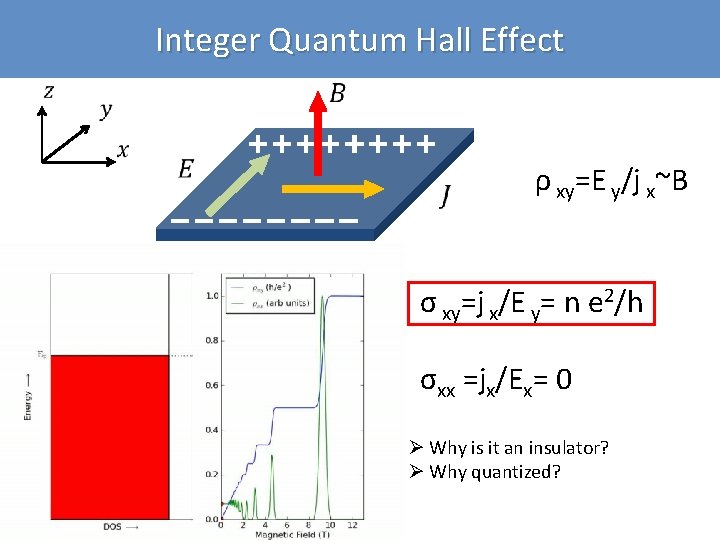
The values of the Hall conductance on these plateaus are quantized in exact integer multiples of a fundamental constant:
where is an integer. This quantization is universal and shockingly precise—accurate to one part in a billion—irrespective of the material's shape, size, or impurities. Simultaneously, the longitudinal resistance drops to zero on these plateaus, indicating dissipationless transport.
To get a feel for the experimental context and the initial theoretical picture, let's watch a segment of a lecture by Prof. Steven Simon.
TMS19 Steve Simon: Intro to integer and fractional QHE (I)
This video, titled "Intro to integer and fractional QHE (I)" by Steven Simon from the Topological Matter School, provides an excellent physicist's introduction to the topic. It starts from the basics and builds the concepts we need.
Please watch the following segments: Classical Hall Effect and 2D Systems (01:26 - 06:20): This sets the stage, explaining the classical effect and how experimentalists create the two-dimensional electron systems required to see the quantum version. The Quantum Hall Effect (06:58 - 15:18): This section describes von Klitzing's discovery, highlighting the quantized plateaus and the astonishing precision. The Landau Problem (15:33 - 28:16): This is the standard single-particle theory. It explains how a 2D electron in a magnetic field has its energy spectrum collapse into massively degenerate Landau levels. Pay close attention to the concepts of degeneracy and the filling factor ( u), which counts the number of filled Landau levels.
As the video explains, the quantization of energy into Landau levels provides a simple explanation for why the Hall conductance might be quantized. If exactly Landau levels are filled with electrons, and there's an energy gap to the next empty level, the system acts like an insulator. A simple calculation (which we'll see later in a reading) shows that this situation leads to a Hall conductivity of precisely .
However, this simple picture is incomplete. It predicts quantization only at the specific magnetic field values where the filling factor is exactly an integer. It cannot explain the wide, flat plateaus observed in experiments. What allows the quantization to persist over a range of magnetic fields?
2. The Role of Disorder and Laughlin's Argument
The surprising answer is that disorder, far from destroying the quantization, is essential for creating the plateaus. In any real sample, impurities create a random potential landscape.
Here's how it works:
- Weak disorder broadens the sharp Landau levels into bands of states.
- States at the center of the band remain extended, meaning their wavefunctions span the entire sample and can carry current.
- States in the "tails" of the band become localized, trapped around individual peaks or valleys of the random potential. These localized states do not contribute to transport.
Now, as you change the magnetic field, the Fermi level moves through the density of states. When it lies within the region of localized states, any added electrons simply fill these traps without changing the transport properties. The conductivity remains constant, forming a plateau. The value of the conductivity on the plateau is determined only by the number of filled bands of extended states below the Fermi level.
This explains the existence of plateaus, but it raises a new puzzle: why is the value on the plateau still perfectly quantized? It seems miraculous that the current carried by the remaining extended states conspires to produce the exact integer multiple of .
This is where Robert Laughlin's brilliant thought experiment comes in. He argued that the precise quantization is protected by a fundamental principle: gauge invariance.
The following resources explain the role of disorder and Laughlin's argument.
A Topological Look at the Quantum Hall Effect
The Physics Today article "A Topological Look at the Quantum Hall Effect" provides a superb conceptual overview of Laughlin's argument and the topological ideas behind it.
Please read the introduction and the section "Laughlin’s argument" (pages 38-40). Focus on the setup of the thought experiment (the quantum pump) and the conclusion that gauge invariance implies the transport of an integer number of electrons per cycle.
TMS19 Steve Simon: Intro to integer and fractional QHE (I)
Let's return to Steven Simon's lecture, where he gives a very clear and intuitive presentation of both the role of disorder and Laughlin's pumping argument.
Please watch these two final clips from the lecture: Disorder and Edge States (28:16 - 33:53): This part visualizes how disorder creates localized states and introduces the concept of chiral edge states, which carry current without dissipation. Laughlin's Pumping Argument (46:59 - 01:00:48): This is the core argument for quantization, based on threading a quantum of flux through a ring-shaped sample. It's a beautiful piece of physical reasoning.
Laughlin's argument is profound. By imagining the 2D electron gas on a ring and adiabatically threading a magnetic flux quantum through the hole, he creates a cyclic process. Gauge invariance demands that the system returns to its original state after this process. The only thing that can happen is the transfer of an integer number of electrons from the inner edge to the outer edge. This integer is precisely the in the Hall conductance formula. The argument is completely insensitive to the messy details of the sample, like disorder, because it relies only on the fundamental principle of gauge invariance and the existence of a gapped, incompressible state (provided by the localized states).
3. The Topological Invariant: Berry Curvature and the Chern Number
Laughlin's argument shows that the integer is a "topological invariant"—it's an integer that cannot change under small, smooth perturbations of the system (like adding a bit more disorder). To make this connection mathematically concrete, we introduce the language of Berry phase and Berry curvature.
When a quantum system's parameters are varied adiabatically in a closed loop, the wavefunction acquires a phase factor. Part of this is the familiar "dynamical" phase, but there is an additional component called the Berry phase, which depends only on the geometry of the path taken in parameter space.
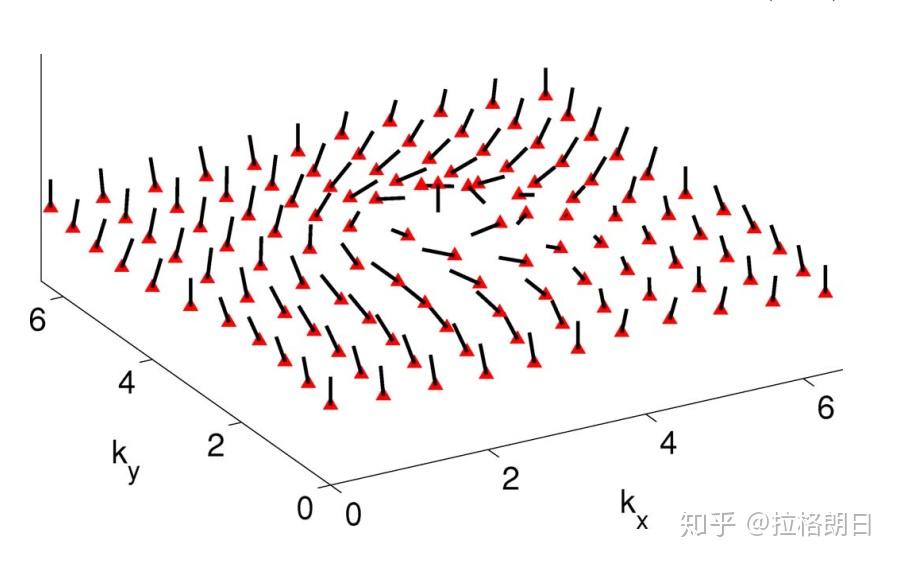
Just as the curl of a vector potential gives a magnetic field, we can define a Berry curvature in the parameter space (for us, the 2D momentum space, or Brillouin zone). This curvature measures the local "twisting" of the eigenstates.
For the Hall effect, the crucial insight, first derived by Thouless, Kohmoto, Nightingale, and den Nijs (TKNN), is that the Hall conductivity can be expressed directly in terms of this Berry curvature. The derivation starts from the Kubo formula, a general result from linear response theory that gives the conductivity in terms of matrix elements of current operators. The final result is stunningly simple.
The Hall conductivity for a filled band is given by:
where is the Chern number, defined as the integral of the Berry curvature over the entire Brillouin zone (which is a torus, a closed surface):
A deep mathematical result, a generalization of the Gauss-Bonnet theorem, guarantees that this integral, , must be an integer.
The following resources will guide you through this final, crucial connection.
Deriving Berry phase, Berry connection & Berry curvature
The video "Deriving Berry phase, Berry connection & Berry curvature" by Professor Nano provides an excellent visual and conceptual introduction to these ideas. It beautifully explains the analogy with electromagnetism.
Please watch these segments: Berry Curvature (21:29 - 27:49): This introduces the Berry curvature as the curl of the Berry connection, drawing an analogy to the magnetic field. It explains why the curvature is gauge-invariant and thus physically observable. Connection to Transport (27:49 - 29:58): This part makes the explicit connection we need: it explains how the integrated Berry curvature (the Chern number) is directly proportional to the quantized Hall conductivity.
Now, let's turn to a more formal derivation. The following reading from David Tong's lecture notes sketches out the proof of the TKNN formula.
2. The Integer Quantum Hall Effect
David Tong's lecture notes on the Quantum Hall Effect provide a concise but complete theoretical treatment. We'll focus on the sections that formalize the connection between conductivity and topology.
Please read the following sections: Section 2.2.4 The Role of Topology (pages 56-60): This section re-derives the Hall conductivity by considering the system on a torus with threaded fluxes (similar to Laughlin's setup). It shows how \sigma_{xy} can be written in terms of derivatives of the ground state wavefunction, which is precisely the Berry curvature. Section 2.3.1 TKNN Invariants (pages 61-64): This section provides the general formulation for a lattice system. It starts with the Kubo formula (eq. 2.12, which you can take as given) and shows how it can be rewritten as the integral of the Berry curvature (eq. 2.18, 2.19), leading to the famous TKNN formula (eq. 2.20).
The TKNN formula is the ultimate explanation for the IQHE. It shows that the Hall conductance is determined by a sum of integers, one for each filled electronic band. This integer, the Chern number, cannot change unless the system undergoes a quantum phase transition where the energy gap closes. This explains the perfect quantization and the robustness of the plateaus.
Test your understanding!
Why can't the Chern number of an energy band change by a small, continuous amount if you slightly change a parameter of the Hamiltonian (e.g., slightly alter the lattice spacing or the strength of a potential)?
Show answer
The Chern number is the integral of the Berry curvature over a closed manifold (the Brillouin zone). As a result of this integration over a closed space, the result is mathematically constrained to be an integer. An integer cannot change continuously. If a small, smooth change in the Hamiltonian causes a small, smooth change in the Berry curvature, the integral will also change smoothly. But since the result must be an integer, the only way it can change smoothly is not to change at all. It is "stuck" at its integer value. It can only jump to a different integer value if the underlying assumptions break down, which happens when the energy gap closes and the Berry curvature becomes ill-defined.
Conclusion
Today we have journeyed through one of the most beautiful topics in modern condensed matter physics. We saw how a macroscopic measurement—the Hall conductance—reveals a hidden topological property of the quantum wavefunctions of the electrons.
Key Takeaways:
- The Integer Quantum Hall Effect is characterized by perfectly quantized plateaus in the Hall conductance () and vanishing longitudinal resistance.
- The basic picture of Landau levels explains the origin of the quantization factor , but not the existence or robustness of the plateaus.
- Disorder is crucial, creating localized states that "pin" the Fermi level, giving rise to the plateaus.
- Laughlin's gauge invariance argument explains the extreme precision of the quantization, showing that the integer is a robust quantity that counts the number of electrons pumped in a cyclic process.
- This robustness is mathematically captured by topology. The Hall conductivity is proportional to the Chern number, a topological invariant which is the integral of the Berry curvature of the electron bands over the Brillouin zone.
Preview of the Next Lesson:
We've now completed our tour of several key collective phenomena. In our next module, we will shift gears and focus on the practical computational tools used to tackle quantum systems that cannot be solved analytically. We will begin by implementing a finite difference method to numerically find the bound-state energies of the 1D time-independent Schrödinger equation. This will be the first step in building your computational toolkit for quantum mechanics, leveraging your skills in Python and numerical analysis.