Recommended resources
The freely available resources this lesson will direct you to.
Hello! Welcome back to our study of topological matter.
In the previous lesson, we established a fundamental principle for time-reversal invariant systems: Kramers' theorem. We saw that for any system with time-reversal symmetry and half-integer spin (i.e., an odd number of fermions), every energy eigenstate is guaranteed to be at least two-fold degenerate. This protected degeneracy, embodied by Kramers pairs, is the bedrock upon which time-reversal invariant topological phases are built.
This lesson directly follows up on that insight. We know that the Chern number, which classifies the integer quantum Hall effect, is trivial (zero) in time-reversal symmetric systems. This begs the question: is there another topological invariant that can distinguish different types of insulators when time-reversal symmetry is preserved? The answer is yes, and it comes in the form of a binary invariant known as the topological invariant. Our learning outcome for today is to define this topological invariant for time-reversal invariant systems.
We will explore this concept in three stages: first, an intuitive argument for why the invariant is ; second, a formal definition of the invariant; and third, a powerful and practical method for calculating it in systems with inversion symmetry.
1. Why ? An Intuitive Argument
Let's start by revisiting the Chern number, , which is the integral of the Berry curvature over the entire Brillouin Zone (BZ):
A key property of the time-reversal operator is that it relates the Berry curvature at opposite momenta: . When you integrate over the entire BZ, which is symmetric around , the contributions from and exactly cancel out, forcing the total Chern number to be zero.
However, what if we integrate over only half of the BZ? Let's define an Effective Brillouin Zone (EBZ) that contains only one of each pair. The integral over the EBZ, , is not generally quantized because the EBZ is not a closed manifold—it has a boundary.
To make it a closed manifold, we can "cap" it, but the choice of cap is arbitrary. Moore and Balents presented a clever argument: while the value of the Chern number for the capped EBZ depends on the cap, time-reversal symmetry imposes a strong constraint. It ensures that changing the cap can only change the calculated Chern number by an even integer. This means that the Chern number modulo 2 is a robust quantity, independent of how we choose to close the manifold.
This gives us two distinct topological classes:
- Class 0: The Chern number over the capped EBZ is an even integer.
- Class 1: The Chern number over the capped EBZ is an odd integer.
This is the intuitive origin of the classification, which we denote by an invariant .
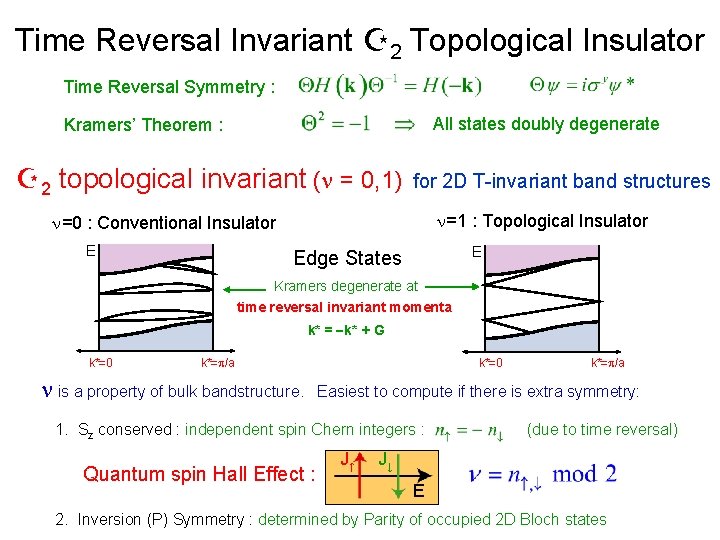
The physical consequence of this distinction is profound. As we will see, insulators with are guaranteed to host protected, metallic edge states that traverse the bulk band gap.

To get a better physical feel for these edge states, watch this short introductory clip from Charles Kane, one of the pioneers of this field.
Quantum spin Hall effect intro (by Charles Kane)
In this video, Charles Kane introduces the Quantum Spin Hall effect. He describes it as two copies of the integer quantum Hall effect, one for each spin, where time-reversal symmetry is restored. Pay close attention to his description of the 'helical' edge states and his realization that their crossing is protected by Kramers' theorem.
Watch from 0:34 to 3:51. Focus on the concepts of helical edge states (counter-propagating spin-polarized states) and how time-reversal symmetry protects the band crossing at the edge.
2. Formal Definition: The Kane-Mele Invariant
The modulo-2-Chern-number argument provides intuition, but a more direct and general definition was developed by Kane and Mele. The definition is elegant but requires some new mathematical machinery. The central object is a matrix that "sews" together the wavefunctions of a Kramers pair.
Let be the cell-periodic part of the Bloch wavefunction for band . A Kramers pair consists of and its time-reversed partner . We can construct a matrix whose elements are the overlaps between a state at and the time-reversed state at :
Here, and run over all occupied bands.
This "sewing matrix" has special properties at the Time-Reversal Invariant Momenta (TRIMs). These are the points in the BZ that are mapped onto themselves by time reversal, i.e., for some reciprocal lattice vector . In 2D, there are four such points (e.g., (0,0), , , and in units of ).
At a TRIM , the sewing matrix becomes antisymmetric. For any antisymmetric matrix , one can define its Pfaffian, , which is a polynomial in the matrix entries satisfying .
The invariant is defined by the product of signs derived from the Pfaffian of the sewing matrix at all the TRIMs. For each TRIM , we define a quantity :
Since the Pfaffian and the square root both square to the determinant, can only be . The subtlety lies in choosing a consistent branch for the square root across the BZ.
The invariant is then given by the product of all these signs:
- If the product is , the system is a trivial insulator ().
- If the product is , the system is a topological insulator ().
The following resources provide a more rigorous and detailed derivation of this formalism.
Lecture notes on topological insulators
These lecture notes by Prof. Ming-Che Chang offer a physicist-friendly introduction to the different ways of defining the Z₂ number.
Please read section B, 'Z2 topological number' (pages 2-4). It starts with the intuitive Chern number (mod 2) argument we just discussed, and then introduces the winding number approach and finally the alternative form using the sewing matrix, which we have focused on.
For a more mathematically in-depth treatment, you can refer to Section 3.2 ("Kane-Mele invariant") in the "Notes on topological insulators" from Purdue (LINK). It covers the same ground with greater formal detail, which may be of interest given your background.
3. A Practical Calculation: The Fu-Kane Formula
The Pfaffian definition is conceptually central but computationally abstract. Fortunately, for a vast class of materials—those that possess inversion symmetry—there is a remarkably simple way to calculate the invariant.
If a crystal has inversion symmetry, the Hamiltonian commutes with the parity operator . This means that at the TRIMs (which are also inversion-symmetric points), the Bloch eigenstates must also be eigenstates of parity, with eigenvalues .
In a seminal work, Fu and Kane showed that for such systems, the quantity is simply the product of the parity eigenvalues of all occupied bands at that TRIM:
(Note: For each Kramers pair, you only include the parity eigenvalue once in the product, as both states in the pair share the same parity.)
The full invariant is then determined by the product of these parity products over all TRIMs:
This formula is incredibly powerful. To determine if a centrosymmetric material is a topological insulator, you "only" need to:
- Calculate the band structure.
- Identify the parity eigenvalues of the occupied bands at the four TRIMs.
- Compute the product.
This also gives a clear picture of what drives a topological phase transition. A transition from to occurs when the value of flips from to . This happens if the parity product at an odd number of TRIMs changes sign. This is precisely what occurs during a band inversion, where two bands with opposite parity eigenvalues swap their energy ordering at a TRIM.
Let's look at the resource we used before to see this specific result.
Lecture notes on topological insulators
Let's revisit Prof. Chang's notes for this practical calculation method.
Please read subsection B.4, 'Lattice with inversion symmetry' on page 4. It directly presents the formula connecting the Z₂ index to the parity eigenvalues at the TRIMs.
Test your understanding!
Imagine a 2D insulator with inversion symmetry. It has two occupied bands (forming one Kramers pair each) below the Fermi level. At the four TRIMs , the parity eigenvalues of the two occupied bands are as follows:
| TRIM | Band 1 Parity | Band 2 Parity |
|---|---|---|
| +1 | -1 | |
| +1 | +1 | |
| +1 | +1 | |
| -1 | -1 |
Is this a trivial insulator () or a topological insulator ()?
Show answer
Let's calculate for each TRIM by taking the product of the parity eigenvalues for the occupied bands.
Now, we compute the final product to find :
Since , the topological invariant is . This is a topological insulator. The band inversion effectively happened at the point.
Conclusion
In this lesson, we have formally defined the topological invariant that governs time-reversal symmetric insulators. This moves us beyond the Chern number and into a new realm of topology in condensed matter.
Key Takeaways:
- Time-reversal invariant insulators are classified by a topological invariant, , which can be 0 (trivial) or 1 (topological).
- Intuitively, can be thought of as the Chern number of a capped half-Brillouin-zone, taken modulo 2.
- The formal definition of the invariant involves the Pfaffian of a "sewing matrix" constructed from wavefunction overlaps at the time-reversal invariant momenta (TRIMs).
- For systems with inversion symmetry, can be calculated simply by taking the product of the parity eigenvalues of all occupied bands at all TRIMs. A value of signals a non-trivial topological phase.
- A non-trivial invariant () guarantees the existence of topologically protected, gapless edge or surface states.
Preview of the Next Lesson
With the formal definition of the invariant in hand, we are ready to analyze a concrete physical system. In the next lesson, we will study the Kane-Mele model, a model of graphene that includes spin-orbit coupling. We will use the parity criterion to explicitly show how this interaction can drive a trivial insulator into a topological insulator—the first material predicted to host the Quantum Spin Hall effect.