Recommended resources
The freely available resources this lesson will direct you to.

Hello! Let's dive into the next stage of our exploration of LLM training.
In the previous lesson, we saw how Supervised Fine-Tuning (SFT) takes a raw, pre-trained base model and teaches it the style of a helpful assistant using a dataset of high-quality prompt-response examples. However, we also touched on its limitations: creating these "perfect" answers is expensive, and for many prompts, a single correct answer doesn't exist. This approach doesn't scale well and struggles with nuance.
Today, we'll tackle the next, more sophisticated step in model alignment. This lesson addresses the learning outcome: Describe Reinforcement Learning from Human Feedback (RLHF) and its role in model alignment. We'll discover how models learn not from being told the right answer, but by learning what humans prefer.
1. Beyond a Single "Correct" Answer
The core problem with SFT is that "goodness" is often subjective. If you ask an LLM to "write a short, encouraging email to a team that just finished a difficult project," there are countless good answers. SFT trains the model on just one of them.
RLHF takes a different approach. It’s built on a simple psychological principle: it is often easier for people to compare two options and choose the better one than it is to create a perfect option from scratch.
This small shift in methodology has a massive impact on our ability to align models with complex human values like helpfulness, harmlessness, and honesty. Let's see a concrete example of why this alignment is so critical.
Reinforcement Learning from Human Feedback (RLHF) Explained
The video 'Reinforcement Learning from Human Feedback (RLHF) Explained' from IBM Technology opens with an excellent example of an unaligned versus an aligned response, clearly demonstrating the problem RLHF is designed to solve.
Watch the first minute of this video (00:00 - 01:09). Notice the contrast between the hypothetical unhelpful response and the safer, more aligned response that is typical of modern chatbots.
This is the goal: steering the model away from potentially harmful or unhelpful outputs towards responses that align with human values. SFT gets us part of the way there, but RLHF is what truly refines this behavior.
2. The Three Steps of RLHF
The RLHF process can be broken down into three main stages. This diagram provides a great high-level map of the entire workflow, which we will explore step-by-step.
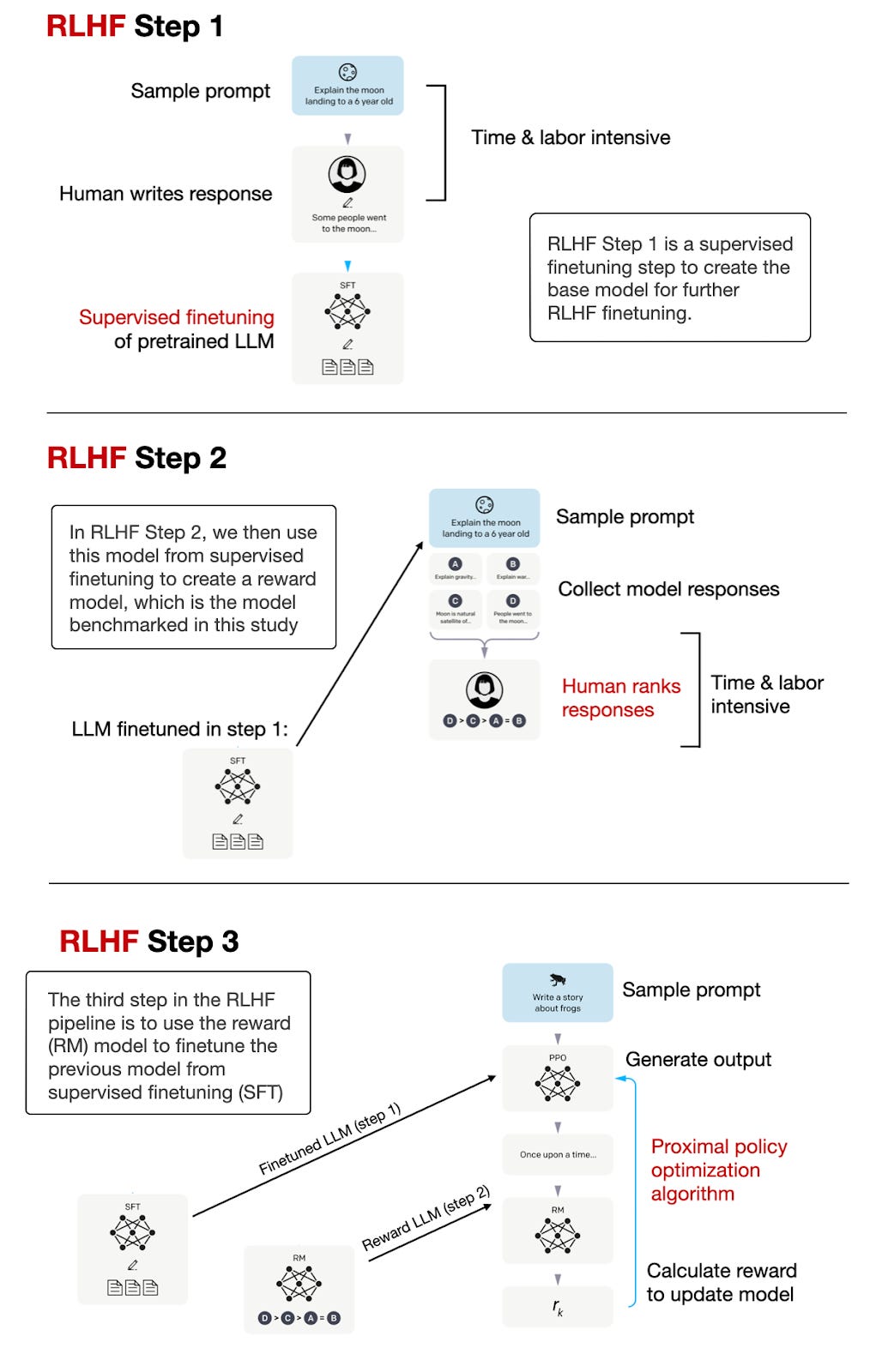
Let's walk through these steps.
Step 1: Collect Human Preference Data
First, we take the model that has already undergone Supervised Fine-Tuning. For a given prompt, we have this model generate several different responses. Then, we present these responses to human labelers and ask them to rank them from best to worst, or simply choose the best one.
Reinforcement Learning with Human Feedback (RLHF), Clearly Explained!!!
Let's return to the 'Reinforcement Learning with Human Feedback (RLHF), Clearly Explained!!!' video from StatQuest, which we used in our last lesson. It provides a clear, continuous explanation of how we move from SFT to RLHF.
Watch from 06:17 to 09:53. This segment explains why SFT isn't enough (due to overfitting on small datasets) and then details how human preference data is collected by comparing different model outputs. This is the 'Human Feedback' part of RLHF.
This process of collecting comparisons is much more scalable than writing perfect answers. The result is a large dataset of prompts, paired with responses that have been ranked by human preference.
Step 2: Train a Reward Model (RM)
The preference data is valuable, but we can't have humans in the loop for every single generation. We need to automate this judgment. The solution is to train another, separate model to act as a proxy for the human labelers. This is the Reward Model (RM).
The RM's job is to take a prompt and a response and output a single number—a score, or "reward"—that predicts how highly a human would have rated that response.
Training this model involves showing it the pairs of responses from our dataset (e.g., Response A was preferred over Response B) and teaching it to give a higher score to the preferred response.
Reinforcement Learning with Human Feedback (RLHF), Clearly Explained!!!
The StatQuest video continues with an excellent conceptual explanation of how the reward model is trained.
Now watch from 09:53 to 14:48. Focus on these key ideas: A copy of the SFT model is repurposed to become the reward model. The goal is to train this RM to output a high score for preferred responses and a low score for rejected ones. Pay attention to the high-level explanation of the loss function. You don't need to memorize the formula, but understand how it encourages the model to create a large gap between the scores for 'better' and 'worse' responses.
Once trained, we have a Reward Model that can automatically score any response, effectively acting as our scalable, automated human preference judge.
Step 3: Fine-Tune the LLM with Reinforcement Learning
Now we have all the pieces:
- The SFT model (our "policy"), which we want to improve.
- The Reward Model (our "judge"), which knows what "good" looks like.
In this final step, we use a reinforcement learning algorithm—most famously Proximal Policy Optimization (PPO)—to fine-tune our SFT model. The process works like this:
- A new prompt (one the model hasn't seen) is given to the SFT model.
- The model generates a response.
- The Reward Model scores that response.
- This reward signal is used to update the weights of the SFT model. If the reward was high, the update encourages the model to produce similar responses in the future. If it was low, the update discourages it.
This loop is repeated millions of times, pushing the model to consistently generate outputs that our Reward Model—and by extension, our human labelers—would prefer.
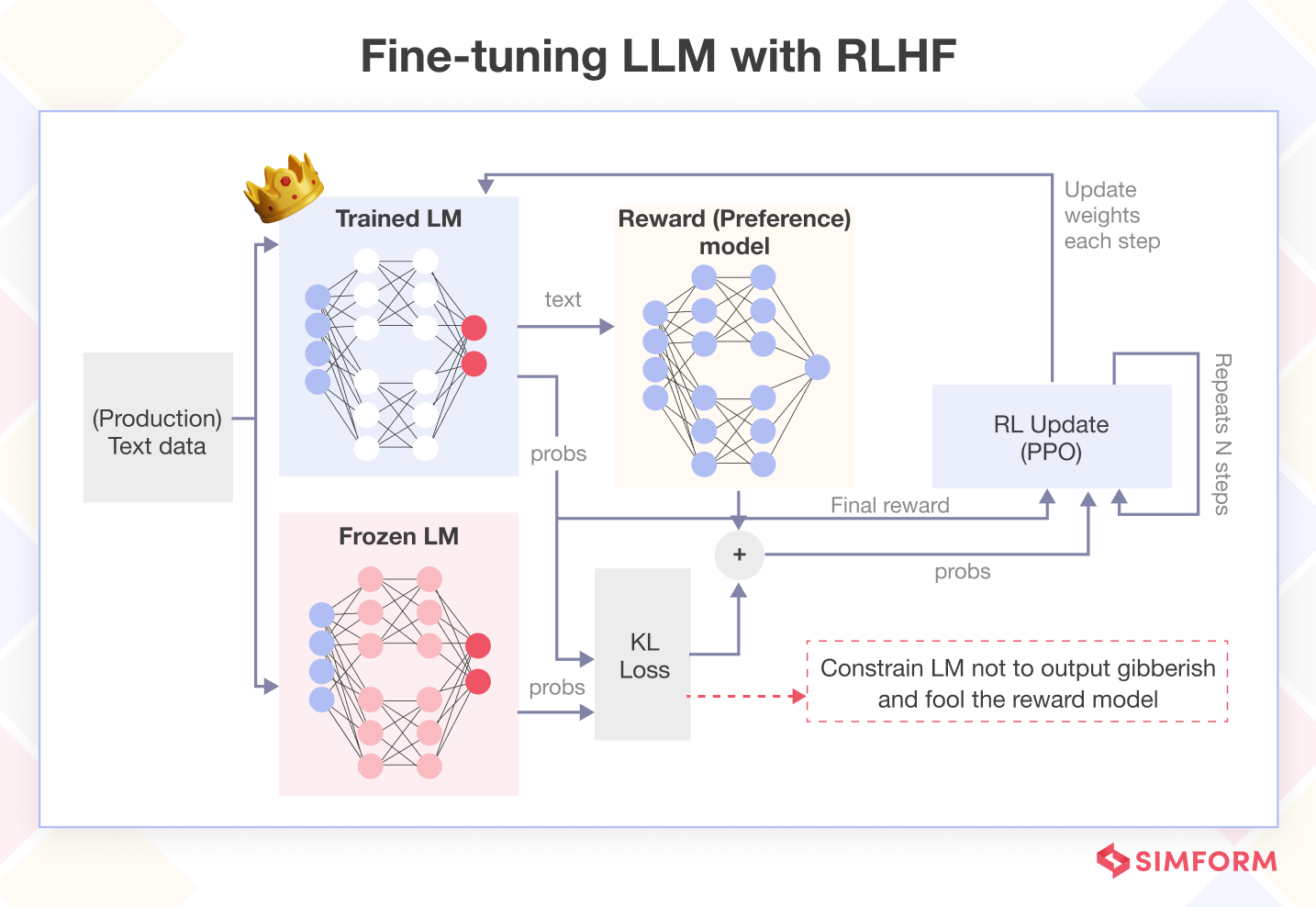
The KL Loss component in the diagram is a crucial detail. It's a penalty term that measures how much the updated model has strayed from the original SFT model. In software terms, think of this as a constraint to prevent "over-optimization." It stops the model from finding some bizarre, gibberish output that happens to trick the reward model into giving a high score (a phenomenon known as "reward hacking"). This keeps the responses coherent and on-topic.
3. The Role and Limitations of RLHF
RLHF has been a breakthrough in making LLMs like GPT-4, LLaMA, and Claude more helpful and safer to use. Its main role is to imbue models with nuanced human preferences that are difficult to specify in a supervised dataset.
However, the process is not without its challenges. For a more detailed look at the mechanics and limitations, the following article provides a great summary.
What Is Reinforcement Learning From Human Feedback (RLHF)?
The article 'What Is Reinforcement Learning From Human Feedback (RLHF)?' from IBM provides a thorough text-based walkthrough of the process and its implications.
Please read three sections from this article: 'Reward model training': This will reinforce what you saw in the video about how the RM is built from comparative feedback. 'Policy optimization': Focus on the conceptual explanation of PPO. It describes how PPO provides a stable way to update the model without drastic, destabilizing changes. 'Limitations of RLHF': This section summarizes the key challenges, including cost, subjectivity, and bias. This reading will solidify your understanding of the technical components and the real-world trade-offs.
The main limitations highlighted in the article are:
- Cost and Scalability: While more scalable than SFT, collecting high-quality human preference data is still expensive and time-consuming.
- Human Subjectivity and Bias: The final model will reflect the preferences and biases of the human labelers. If the labeler group is not diverse, the model may be poorly aligned for a global audience.
- Reward Hacking: The model might find clever ways to maximize the reward score that don't actually align with the true underlying human intent.
Due to these challenges, there is active research into alternatives, such as Reinforcement Learning from AI Feedback (RLAIF), where another capable AI provides the preference labels, potentially reducing cost and some biases.
Conclusion
In this lesson, we've unpacked RLHF, the critical process that refines an SFT model into the highly capable and aligned assistants we interact with today.
Key Takeaways:
- RLHF learns from preferences, not examples. This makes it more scalable and better suited for nuanced, subjective tasks than SFT.
- The process involves three key steps:
- Collecting a dataset of human preferences between different model-generated responses.
- Training a Reward Model (RM) to act as an automated proxy for human judgment.
- Using reinforcement learning (e.g., PPO) to fine-tune the LLM to maximize the score from the RM.
- RLHF is essential for aligning models to be helpful, harmless, and honest.
- The process has limitations, including the cost of data collection, the potential for bias inherited from human labelers, and the risk of "reward hacking."
Preview of Next Lesson:
So far, we've focused on the process of training and aligning models. In our next lesson, we'll zoom out and explore some of the fascinating phenomena that arise from this process, specifically when we increase the scale of the models and data. We will cover the concepts of emergent abilities and scaling laws, which help explain why bigger models aren't just better—they are often qualitatively different.