Recommended resources
The freely available resources this lesson will direct you to.
Hello! Welcome to the final lesson of our module on LLM Training and Alignment.
In our last session, we explored Reinforcement Learning from Human Feedback (RLHF), the process that fine-tunes a model to align with complex human preferences. We saw how this moves beyond simply teaching a model correct answers (SFT) to teaching it what "good" behavior looks like.
Today, we'll zoom out from the specific training steps to examine two fascinating, high-level phenomena that govern the entire field of large-scale AI development. This lesson will address the learning outcome: Explain the concepts of emergent abilities and scaling laws in LLMs.
Understanding these concepts is crucial because they explain why building bigger models often leads to surprising new capabilities and how research labs make billion-dollar decisions about allocating computational resources.
1. Scaling Laws: The Predictable Power of More
Let's begin with the more predictable of the two concepts. At its core, a scaling law in the context of LLMs is an empirical observation that a model's performance improves in a predictable way as you increase key resources. The three primary resources are:
- Model Size: The number of parameters in the neural network.
- Dataset Size: The amount of data the model is trained on.
- Compute: The total number of floating-point operations (FLOPs) used for training.
Researchers at labs like OpenAI and Google discovered that if you plot model performance (specifically, the cross-entropy loss on a test set) against any of these three resources on a log-log scale, you get a nearly straight line. This means performance follows a power law, making it possible to predict how much better a model will be if you train it with, say, 10x more compute.
AI can't cross this line and we don't know why.
The Welch Labs video 'AI can't cross this line and we don't know why.' provides a fantastic visual introduction to this topic, showing how these predictable trends were discovered and leveraged.
Watch the first 3 minutes and 30 seconds (00:00 - 03:30). Focus on: The concept of the 'compute optimal frontier' shown on the log-log plots. How these predictable power laws guided OpenAI's strategy in developing models like GPT-3. The three key factors that scale: compute, model size, and dataset size.
This predictability is incredibly powerful. It allows researchers to justify massive investments in building larger models by extrapolating from smaller experiments and forecasting the expected performance gains.
2. The Chinchilla Revolution: Scaling Smarter, Not Just Bigger
The existence of scaling laws raised a critical question: for a fixed compute budget, what is the optimal way to allocate it between model size (parameters) and data size (tokens)?
Initially, the prevailing wisdom, largely based on a 2020 paper from OpenAI (by Kaplan et al.), was that model size was the most important factor. The "Kaplan scaling law" suggested that as compute increases, model size should grow much faster than dataset size. This led to a race to build enormous models like GPT-3 (175B parameters), which were trained on a relatively small amount of data for their size.
However, in 2022, researchers at DeepMind published a landmark paper about their model, Chinchilla. They found that the Kaplan laws were suboptimal.
Emergent Abilities of Large Language Models
The DeepMind team conducted extensive experiments and arrived at a different, more efficient scaling law. The AssemblyAI article 'Emergent Abilities of Large Language Models' has a great section summarizing this pivotal shift.
Please read the section titled 'How much larger can we go?'. Focus on understanding the core difference between the OpenAI (Kaplan) scaling law and the DeepMind (Chinchilla) scaling law regarding the allocation of resources.
The key finding of the Chinchilla paper was revolutionary: for optimal performance, model size and dataset size should be scaled in roughly equal proportion. This led to a simple but powerful rule of thumb: a compute-optimal model should be trained on approximately 20 tokens for every 1 parameter.
This revealed that most prior LLMs, including GPT-3, were severely "undertrained." They were too large for the amount of data they had seen, meaning their compute budget could have been used more effectively by training a smaller model on more data.
The impact of this is best seen visually.
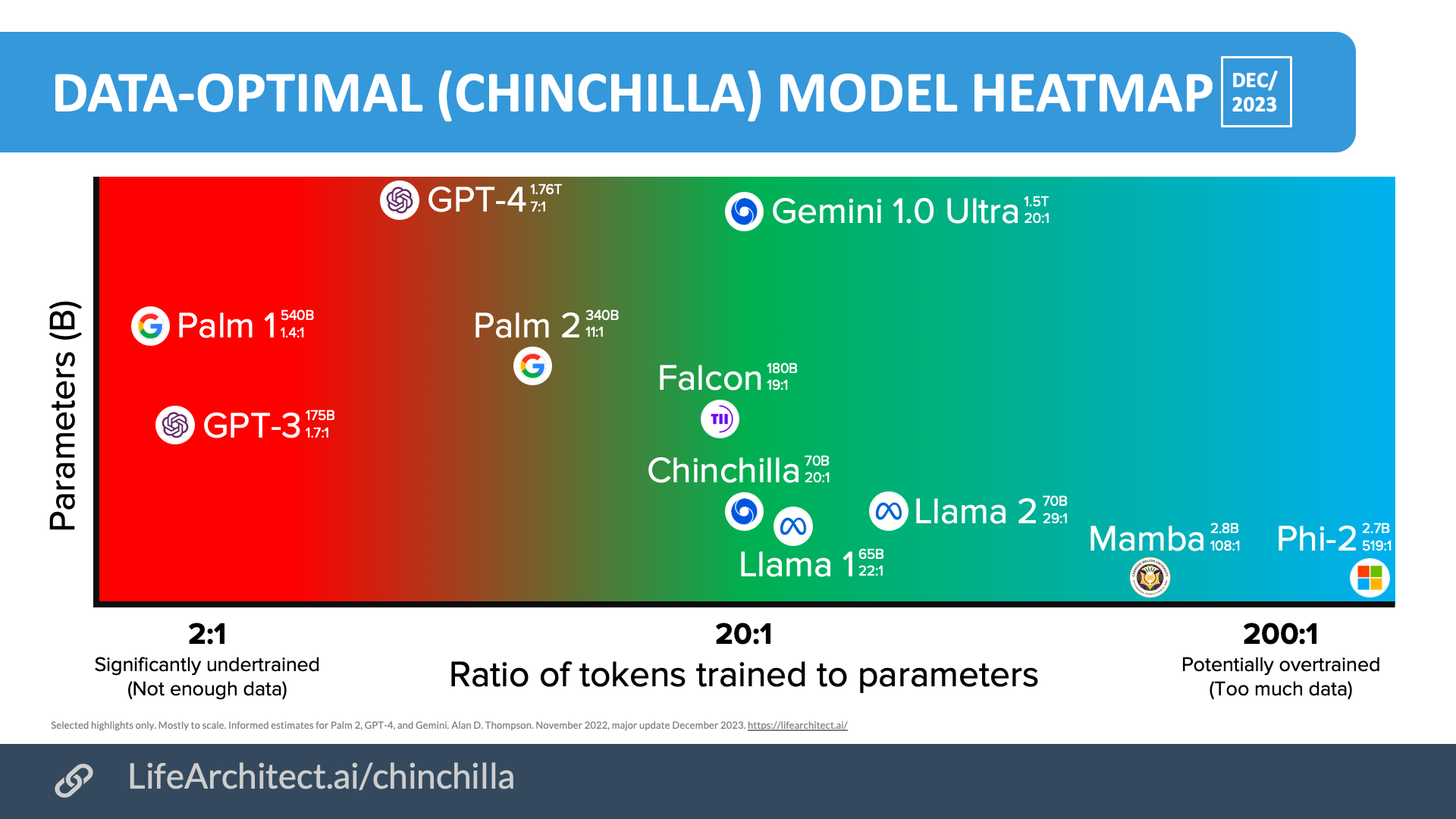
Chinchilla (70B parameters) was trained on 1.4 trillion tokens, outperforming the much larger Gopher (280B parameters) which was trained on only 300 billion tokens. This discovery has since guided the development of many subsequent models, like Meta's LLaMA series, leading to smaller, cheaper, yet highly capable models.
3. Emergent Abilities: The Unpredictable Magic
While scaling laws describe predictable, smooth improvements in a model's core objective (loss), scaling also produces something far less predictable: emergent abilities.
These are capabilities that are absent or random in smaller models but appear suddenly and robustly once a model crosses a certain threshold of scale. The model was never explicitly trained on these tasks; they simply "emerge" as a byproduct of being trained to predict the next token on a massive dataset.
The Emergent Abilities of LLMs - why LLMs are so useful
The concept of emergence is best understood through analogy and example. This video from AssemblyAI provides an excellent conceptual overview.
Watch these segments: 00:00 - 00:45: The introduction and the child-drawing analogy. 02:26 - 04:08: The analogy to phase transitions in physics. This provides a great mental model for the sudden shift in behavior. 04:27 - 05:49: The concrete 'Emoji Movie' example from the Big-Bench benchmark. Pay attention to how the performance graph suddenly shoots up.
Some well-known emergent abilities include:
- Multi-step arithmetic (e.g., solving
15 + 32 - 8). - Answering questions in a language the model has seen very little of.
- Identifying the intended meaning of a word in a sentence (word sense disambiguation).
- Chain-of-thought reasoning, where the model "thinks out loud" to solve a problem.
The unpredictability of which abilities will emerge and at what scale makes scaling LLMs a process of both engineering and discovery.
4. Are Emergent Abilities an Illusion?
This phenomenon is so striking that it begs the question: is this a true qualitative change in the model's capabilities, or is it an artifact of how we're measuring performance? There are two main arguments suggesting the latter.
-
Complexity of Tasks: Many "emergent" tasks require multiple steps of reasoning. A model might be getting smoothly better at each individual reasoning step as it scales. However, to solve the entire task, it needs to get all steps right. The probability of getting all N steps right can jump from near-zero to a high value with only a small, continuous improvement in the probability of getting a single step right.
-
Choice of Metrics: If we use a harsh, "all-or-nothing" metric like
exact string match, we might miss gradual improvements. For example, if the answer is "hydrogen" and a small model outputs "hyrdogen," it gets zero credit. A slightly larger model might output "Hydrogen," also getting zero credit. A much larger model finally outputs "hydrogen" and its score jumps from 0 to 100. If we had instead used a metric that measures the probability the model assigns to the correct answer, we likely would have seen a smooth, gradual improvement across all model sizes.
The Emergent Abilities of LLMs - why LLMs are so useful
The AssemblyAI video also explores this critical perspective.
Now watch from 06:07 to 07:54. This section explains the 'multi-step reasoning' hypothesis. Grasp the intuition that small, steady improvements in a fundamental skill can lead to a sudden perceived ability to complete a complex task.
Regardless of the explanation, the practical reality is that scaling models unlocks new and useful capabilities that we care about. Whether it's "true" emergence or a byproduct of our evaluation methods, the observation that larger models can do things smaller models can't remains a primary driver of AI research.
Conclusion
This lesson concludes our module on LLM training and alignment. We've journeyed from the foundational pre-training process to the fine-tuning steps of SFT and RLHF, and now we've examined the high-level phenomena that result from applying these techniques at an enormous scale.
Key Takeaways:
- Scaling Laws describe the predictable, power-law relationship between performance (loss) and resources (compute, parameters, data). They turn AI development from pure alchemy into a more empirical science.
- The Chinchilla scaling law refined our understanding, showing that optimally trained models require a balanced scaling of parameters and data (approx. 20 tokens per parameter), making many previous models "undertrained."
- Emergent Abilities are surprising capabilities that appear suddenly in large models without explicit training, such as multi-step reasoning.
- The reality of "emergence" is debated, and may be an artifact of task complexity or evaluation metrics. However, the practical effect—that bigger models can do qualitatively new things—is undeniable.
Preview of the Next Module:
We have now built a solid conceptual foundation of how LLMs are created and what makes them so powerful. Starting with the next lesson, we will pivot from theory to practice. In Module 3, "Interacting with LLMs: APIs and Prompting," you will start working with these models directly. Our first lesson will be hands-on: Use an LLM API (e.g., OpenAI) to send prompts and process responses programmatically. It's time to start building