Recommended resources
The freely available resources this lesson will direct you to.
- Formation of Latent Image & X-ray Film processing | Oral Radiology | Animated explanationwww.youtube.com
- ADVANCED EMULSION: Silver Halide Crystals, Imaging Couplers, Orange Masks and Processingwww.youtube.com
- Review of Latent Image Formation Mechanisms in Silver ...www.imaging.org
- Silver Halides in - Springerlink.springer.com
Hello. The last module ended at the image plane: a lens can deliver light with excellent contrast and geometry, but a camera also needs a way to retain what arrived. This module follows that transition from optical image to permanent photochemical record.
We will begin at the smallest useful scale: one silver-halide crystal. You will trace how absorbed light produces mobile electronic charge, how that charge helps assemble a few silver atoms at a particular site, and why that tiny cluster can later distinguish an exposed crystal from an unexposed one. Allow about 40 minutes, including the readings.
What must exposure leave behind?
A photographic emulsion contains many silver-halide microcrystals—often silver bromide or mixed halides—held in gelatin. The lens projects a spatially varying light field onto this layer. During exposure, however, the film does not acquire a visible, continuously shaded silver image. It acquires a spatial pattern of crystals that have become more likely to develop.
That distinction sets the physical problem. Absorbing a photon can create an electron, but a free electron is not a durable record: it may recombine with a positive charge carrier or become trapped somewhere unproductive. A useful exposure event must leave a sufficiently stable, localized chemical change. In the classical account, that change is a latent-image centre: a cluster containing only a few metallic silver atoms, associated with a sensitivity site in or on a crystal. Latent means that the exposure pattern exists but cannot yet be seen directly.
Read the opening mechanistic account in Silver Halides in Photography, an MRS Bulletin overview available through Springer. Its description gives the sequence we will examine, while its numerical estimates should be read as model-dependent rather than universal constants.
Read the MRS Bulletin overview for its physical account of charge generation, trapping, silver-ion motion, and cluster formation.
On the opening printed page, before the discussion of sensitizing agents on p. 13, find the paragraph beginning “The theory of the photographic process has its roots in the Gurney-Mott model.” Read the mechanism. Stop after the estimate of absorbed photons; the following paragraph moves on to development. Focus on which carriers move, what traps the electron, and why formation of one silver atom is not enough.
The crystal is the unit to keep in view. Photons may be absorbed at different positions within it, yet successful exposure events can contribute to a silver cluster at a particular site. The cluster is extraordinarily small compared with the amount of silver halide in the grain. Exposure therefore prepares a grain for a later chemical transformation; it does not perform that transformation in full.
From absorbed photon to separated charge
Silver halides are ionic solids with electronic energy bands. In the simplest, intrinsic route, a photon energetic enough to excite the crystal produces a mobile electron and a corresponding positive hole:
The hole represents a missing electron in an occupied state; it is not a mobile silver ion. Keeping those two positive-charge carriers distinct matters. The hole is the electronic counterpart of the photoelectron, whereas an interstitial silver ion, , is a silver ion able to move through the crystal lattice and supply silver to a growing cluster.
For silver bromide, the overview gives an indirect bandgap of about . Using , that energy corresponds roughly to a wavelength of . A lower-energy visible photon cannot generally drive that same intrinsic band-to-band excitation in pure AgBr. Yet practical photographic materials can respond well beyond the blue. Surface-bound spectral-sensitizing dyes provide another route: a dye absorbs the photon and can transfer an excited electron into the silver halide. The important shared result for our purposes is an electron available to participate in latent-image formation, not a requirement that every effective photon was absorbed by the halide lattice itself.
Once generated, an electron has competing fates. It may reach a useful trapping site; it may be lost through recombination with a hole; or it may otherwise fail to contribute to a stable cluster. This is why “one photon absorbed” and “one lasting increment of photographic record” are not equivalent statements.
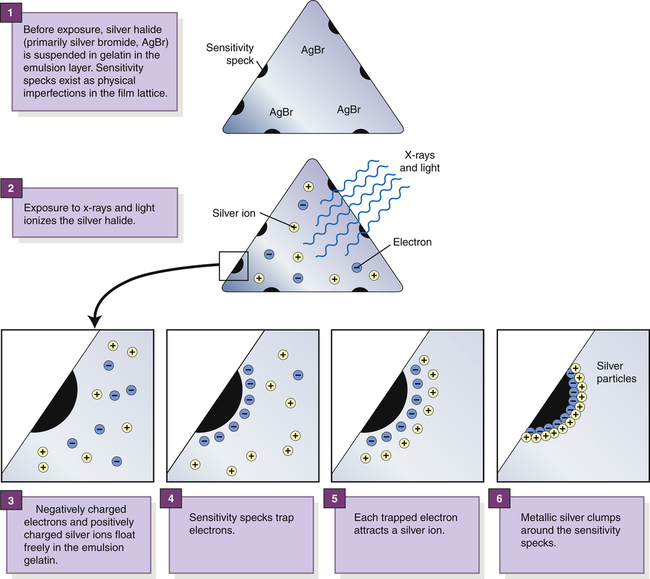
The image below is a useful schematic of the successful route. Read its labels as a sequence of roles, not as a literal map of freely floating charges in gelatin: the crucial electron trapping and silver-ion transport occur in or at the silver-halide grain. The diagram also groups light and X-ray exposure together; our account here concerns photographic light exposure.
A sensitivity site becomes a silver cluster
A sensitivity site is a location that favours productive electron trapping, commonly associated with chemical sensitization or a suitable crystal imperfection. An electron localized there can participate in the reduction of a mobile silver ion:
The superscript denotes a neutral silver atom. This compact equation identifies the essential chemical change: silver initially present as an ion becomes metallic silver. It does not imply that any electron anywhere in the emulsion will reliably produce a latent image. The electron and silver ion must meet at a site where the product can persist.
A single silver atom is generally too unstable to serve as a dependable development centre. Further successful exposure events can bring electrons to the site and permit additional silver ions to be reduced there. As the atoms aggregate, the cluster can become stable enough—and chemically effective enough—to make its host grain developable. Positive holes must meanwhile be kept from undoing productive charge separation through recombination.
The location of the sensitivity site is an engineering variable, not incidental dirt in a crystal. Read the sensitization discussion in the same overview to see how sulfur- and gold-containing agents affect electron trapping and cluster stability, and why dyes solve a different, spectral problem.
Continue the MRS Bulletin overview to separate chemical sensitization, which improves the usefulness of exposure-generated charge, from spectral sensitization, which extends the wavelengths that can generate that charge.
On printed p. 13, under “Silver Halides in Photography,” find the paragraph beginning “Intrinsic silver halide microcrystals would not attain the high light sensitivity.” From the following sentence, read the sensitization account. Stop at the end of the explanation of visible-spectrum response. Pay particular attention to the separate roles assigned to sulfur sites, gold, hole removal, and adsorbed dye molecules.
This separation is useful: chemical sensitization changes the odds that generated carriers leave a developable centre, while spectral sensitization changes which incoming wavelengths can generate useful carriers. Both alter sensitivity, but at different points in the physical mechanism.
How many events make a grain developable?
It is tempting to assign a universal number of photons to a latent image. That would hide two different questions: how many silver atoms constitute a suitable centre under specified conditions, and how many absorbed photons are needed in practice to make one. Electrons can be lost, intermediate clusters can fail to survive, and sensitization changes the possible pathways. The MRS Bulletin overview describes stable clusters of roughly three to five silver atoms and estimates more absorbed photons than atoms for the process it discusses.
A later review describes a particularly clear four-photon model. In its idealized sequence, four successful photoelectrons reduce four silver ions stepwise to an centre. It calls an centre a generally non-developable sublatent image and a developable one. Read that account as a model that makes the threshold for developability explicit—not as a rule that every emulsion needs exactly four incident photons.
Review of Latent Image Formation Mechanisms in Silver ...
Read this conference review to examine a concrete cluster-growth model and to distinguish an intermediate silver cluster from a developable latent-image centre.
In the “First Step: Exposure” subsection, read its opening account of photon absorption and then the microcluster explanation. Continue to “The Four-Photon Mechanism” on printed conference p. 4. Beginning with the sentence “These react stepwise with four silver ions,” read the stepwise model. Stop after its distinction between sublatent and developable centres; the subsequent subsections investigate alternative mechanisms.
In that model, “four photons” means four effective photon-generated electrons at the required steps. It is a best-case mechanistic construction, not the mean number of photons falling on a real grain. Nor is cluster atom count alone guaranteed to determine developability independently of cluster location and emulsion chemistry. The robust principle across these accounts is nucleation followed by growth: productive charge separation must create a small silver aggregate that survives and can initiate subsequent reduction.
At the image level, the light field changes the distribution of these successful centres across many grains. Brighter regions tend to yield more developable grains under otherwise comparable conditions. The exact relationship between exposure and the density of the processed image is a later topic; for now, the essential link is between a local photon history and the chemical state of individual crystals.
Why the record remains hidden—and can later appear
A few silver atoms at a sensitivity site contribute negligible visible darkness. Most of the exposed crystal is still silver halide. Nevertheless, the cluster changes how readily that crystal participates in a reducing developer. Developability is therefore a selective chemical property, not the same thing as already looking dark.
This is the amplification that made silver-halide photography practical: exposure need only establish microscopic centres; processing can then reduce far more silver halide in grains carrying suitable centres. Unexposed grains need not undergo the same reduction. Development and the subsequent preservation of the image are the subject of the next lesson.
The complete physical story can now be stated without treating exposure as a single magical reaction. A photon must produce useful electronic charge, directly in the halide or with help from a sensitizing dye. An electron must be trapped at a productive site rather than lost. Mobile silver ions must supply material for reduction there. Finally, the resulting silver atoms must form a cluster stable and effective enough to mark the grain for development. Each requirement helps explain why the construction of the crystal and its sensitivity sites matters as much as the arrival of light.
Conclusion
The latent image is a microscopic, developable change in exposed silver-halide grains, commonly understood in terms of small metallic-silver clusters. Photon absorption can generate an electron and a hole; electron trapping, silver-ion motion, and repeated reduction can turn that transient excitation into a persistent cluster. Not every absorbed photon succeeds, and no single cluster-size or photon-count threshold describes all photographic materials.
Next, we will follow what happens when the exposed emulsion enters developer and fixer: how those tiny centres become a visible image, and how processing conditions determine whether that image is preserved.