Recommended resources
The freely available resources this lesson will direct you to.
- Build 100% Self-Hosted AI Agents in 2026 (Surprisingly Easy)www.youtube.com
- How to Build a Personal Assistant AI Agent in n8n (Step-by-Step, No Code)www.youtube.com
- The personal AI platform: technical blueprint - Engineering Ideasengineeringideas.substack.com
- 12 MCP Server Examples Every AI Engineer Should Know - Airbyteairbyte.com
Introduction
In our previous lesson, we completed the design of our agent's cognitive architecture by creating an adaptive feedback loop. This allows the agent to interpret your responses, learn from them, and evolve its strategies over time. We have essentially designed the agent's "brain" and its capacity for learning.
Now, we shift from the conceptual to the physical. This lesson addresses the final piece of the Personal Agentic OS module, fulfilling the learning outcome: Map the data and API requirements for a self-hosted personal agent (e.g., email, calendar, notes, files). We will translate our design into a concrete technical blueprint, defining the infrastructure, data stores, and interfaces the agent needs to perceive and act upon its environment. This is a foundational skill for a solutions architect: moving from a requirements document to a system design.
1. The Self-Hosting Architecture: Control, Privacy, and Cost
A "self-hosted" agent runs on infrastructure you control, such as a home server or a Virtual Private Server (VPS), rather than on a third-party platform. This architectural choice is a deliberate trade-off, prioritizing control and privacy over the convenience of a managed service.
The primary reasons for self-hosting align with a skeptical, systems-thinking approach:
- Data Confidentiality: Your personal data (emails, notes, calendar events) is not shared with third-party service providers. The entire data plane resides within your trusted environment.
- Full Customization: You have complete control over the agent's components, from the underlying Large Language Model (LLM) to the specific tools and data sources it can access.
- Cost Efficiency: While there's an initial setup cost and a modest monthly fee for a VPS, you avoid per-API-call charges from LLM providers, which can become significant with active agents.
The following video provides a practical overview of building a self-hosted agent stack. It justifies the rationale for self-hosting and introduces the core components we will be mapping.
Build 100% Self-Hosted AI Agents in 2026 (Surprisingly Easy)
Watch this segment from 'Build 100% Self-Hosted AI Agents in 2026' by Yashica Jain to understand the motivation and high-level components of a self-hosted system.
Watch the introduction (00:00 - 02:04) to grasp the value proposition of self-hosting. Then, watch the section on VPS vs. local hosting (05:06 - 08:40) to understand the key architectural decision of using a VPS for 24/7 availability and accessibility.
Based on this, our blueprint will assume a VPS-based deployment, which provides the reliability and accessibility needed for a personal agent that must operate continuously.
2. A Layered Blueprint for the Personal OS
To structure our mapping, we can think of the self-hosted agent as a layered system. This is a classic architectural pattern that separates concerns and makes the system easier to understand, build, and maintain.
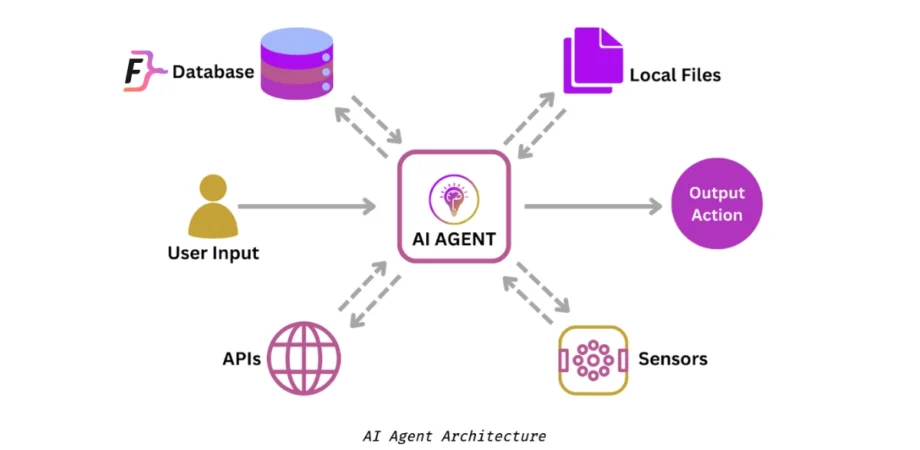
Here is a proposed three-layer architecture:
| Layer | Component | Description & Technology Examples |
|---|---|---|
| 1. Infrastructure | Hosting & Deployment | The physical or virtual environment. A VPS running Linux (Ubuntu) is a standard choice. Docker is used for containerization to isolate services, and a tool like Coolify can simplify deployment. |
| 2. Core Stack | Orchestration, Reasoning, & Memory | The agent's central nervous system. An orchestration engine like n8n manages workflows. The reasoning is provided by a locally-run LLM via Ollama. A database like PostgreSQL serves as the agent's persistent memory. |
| 3. Integration | Data Sources & Tools | The agent's senses and hands. These are the APIs and connectors that interface with your personal data in email, calendar, notes, and files. |
This layered model provides a clear structure for defining our requirements. While the video above gives a great practical stack, for a more advanced, forward-looking perspective, the article "The personal AI platform: technical blueprint" (LINK) outlines a sophisticated "personal AI data plane" using specialized tools like Pocketbase (for reactive data) and LanceDB (for vector search). This represents a more mature version of this architecture, and is an excellent reference for a solutions architect.
3. Mapping Data and API Requirements by Source
This is the core of our task. For each data source, we must define what data the agent needs and how it will access it.
The following video is an excellent practical demonstration. It uses n8n to build a personal assistant, connecting to several of the exact services we need. We will use it as a case study to extract concrete requirements.
How to Build a Personal Assistant AI Agent in n8n (Step-by-Step, No Code)
The video 'How to Build a Personal Assistant AI Agent in n8n' by Nate Herk provides a step-by-step guide to connecting an agent to external tools. It's a goldmine for understanding the practical API interactions required.
Watch the following three segments, focusing on the actions the agent is being configured to perform: Contact Database (Google Sheet): (06:16 - 08:27) - Notice how a simple sheet acts as a structured data source for contact information. Email Agent (Gmail): (10:37 - 22:45) - Pay close attention to the tools created: send_email and get_emails. Note the parameters required for each, like recipient, subject, and body for sending, and sender/limit for retrieving. Calendar Agent (Google Calendar): (26:52 - 39:47) - Observe the tools for create_event (with and without attendees) and get_events. Note the data fields being mapped: start/end times, title, and attendees.
By analyzing the video and applying architectural principles, we can formalize the requirements for each data source.
A. Email
- Data Requirements:
- Message: ID, Sender, Recipient(s), Subject, Body (plain text and HTML), Timestamp, Attachments (filename, content).
- Mailbox/Folder: Name, Unread Count.
- API Requirements (Functions the agent needs):
send_email(to, subject, body, [attachments]): Composes and sends an email.search_emails(query, [sender], [date_range], limit): Retrieves a list of emails matching criteria.get_email(id): Fetches the full content of a specific email by its ID.move_email(id, folder): Archives or categorizes an email.delete_email(id): Deletes an email.
B. Calendar
- Data Requirements:
- Event: ID, Title, Start Time, End Time, Location, Attendees (name, email, status), Description.
- API Requirements:
create_event(title, start_time, end_time, [attendees], [description]): Creates a new calendar event and sends invitations.get_events(start_date, end_date): Retrieves all events within a specified date range.update_event(id, ...): Modifies an existing event.delete_event(id): Cancels an event.
C. Notes & Files
This category is broader. For a self-hosted agent, this data likely resides in a local file system or a private note-taking application.
- Data Requirements:
- Note/File: Path, Filename, Content (text, markdown), Metadata (creation date, modification date, tags).
- API Requirements:
read_file(path): Retrieves the content of a file.write_file(path, content, [mode='overwrite'|'append']): Creates or updates a file.list_files(directory_path): Lists all files and subdirectories in a given directory.search_notes(query): Performs a full-text search across a directory of notes (often powered by a vector index for semantic search).
4. Standardizing Integration: The Model Context Protocol (MCP)
The approach in the n8n video, while practical, involves creating bespoke integrations for each tool. As a solutions architect, you should consider more scalable and standardized patterns. The Model Context Protocol (MCP) is an emerging standard for this.
An MCP server acts as a standardized gateway to a tool or data source. Instead of the agent having a custom-built connector for Gmail and another for Google Calendar, it communicates with a standardized "Email MCP Server" and "Calendar MCP Server."
12 MCP Server Examples Every AI Engineer Should Know
This article from Airbyte provides a clear, high-level overview of MCP servers and why they are a powerful architectural pattern for production agents.
Read the introduction 'What MCP Servers Do AI Agents Commonly Use in Production?' and review the summary table. Then, skim the descriptions for the Email, Calendar, and File System MCP servers. Finally, read the section 'Why Should You Use MCP Servers?' to understand the architectural benefits.
Adopting a standardized protocol like MCP for your Personal OS architecture provides:
- Scalability: Easily add new tools by deploying a new MCP-compliant server without changing the agent's core logic.
- Security: Authentication and authorization can be managed consistently at the server level.
- Interoperability: Any MCP-compliant agent can use any MCP-compliant tool server.
For your blueprint, specifying that tool integrations should be implemented via MCP servers is a forward-looking architectural decision that demonstrates a mature design approach.
Conclusion
We have now mapped the essential data and API requirements for a self-hosted Personal Agentic OS. This blueprint provides a clear path from a conceptual agent design to a tangible and technically sound implementation plan.
Key Takeaways:
- Self-hosting prioritizes control and privacy, with a VPS-based architecture offering the best balance of availability and management.
- A layered architecture (Infrastructure, Core Stack, Integration) provides a logical structure for the system design.
- Each data source (email, calendar, notes, files) has specific data requirements (the information needed) and API requirements (the actions the agent must perform).
- Practical tools like n8n can be used to implement these API connections, serving as a powerful orchestration layer.
- For a more robust and scalable architecture, using a standardized interface like the Model Context Protocol (MCP) is a superior long-term design choice.
Preview of the Next Lesson:
This lesson concludes our deep dive into the Personal Agentic OS. We have designed its core logic, learning capabilities, and now its physical architecture. In the next module, Frameworks and Implementation, we will broaden our scope to enterprise applications. The first lesson, "Establish criteria for selecting an agent framework," will equip you with a decision model to evaluate platforms like LangChain, CrewAI, and AutoGen for building complex, business-focused agentic systems.