Recommended resources
The freely available resources this lesson will direct you to.
- LangGraph Agents - Human-In-The-Loop - User Feedbackwww.youtube.com
- Build Self-Improving Agents: LangMem Procedural Memory Tutorialwww.youtube.com
- AI Agent Feedback Loops: How to Monitor and Validate Autonomous Agentsjduncan.io
- Advanced Reasoning: Self-Reflection, Error Recovery, and Adaptationwww.aplab.academy
Introduction
In our previous lesson, we engineered the logic for our Personal OS agent to move beyond simple reactivity. We designed a system of triggers based on performance analysis—velocity, streaks, and stagnation—enabling the agent to send proactive, context-aware interventions. The agent can now intelligently decide when to communicate and what to say.
However, this is only half of a true dialogue. This lesson addresses the critical next step, fulfilling the learning outcome: to design a feedback loop for the agent to interpret user responses and adapt its strategy. We will architect the mechanism that allows the agent to listen, understand, and learn from your replies, transforming it from a sophisticated announcer into a true learning partner.
This process of closing the loop is what enables an agent to evolve. When a user responds to a nudge, that response is valuable data. Is the user agreeing? Frustrated? Providing new context? A static agent would ignore this. An adaptive agent uses it to refine its model of the world and its approach to helping you.
Let's visualize this architecture. The diagram below shows a high-level operating system for an LLM agent, and the feedback loop is a core, explicit component.
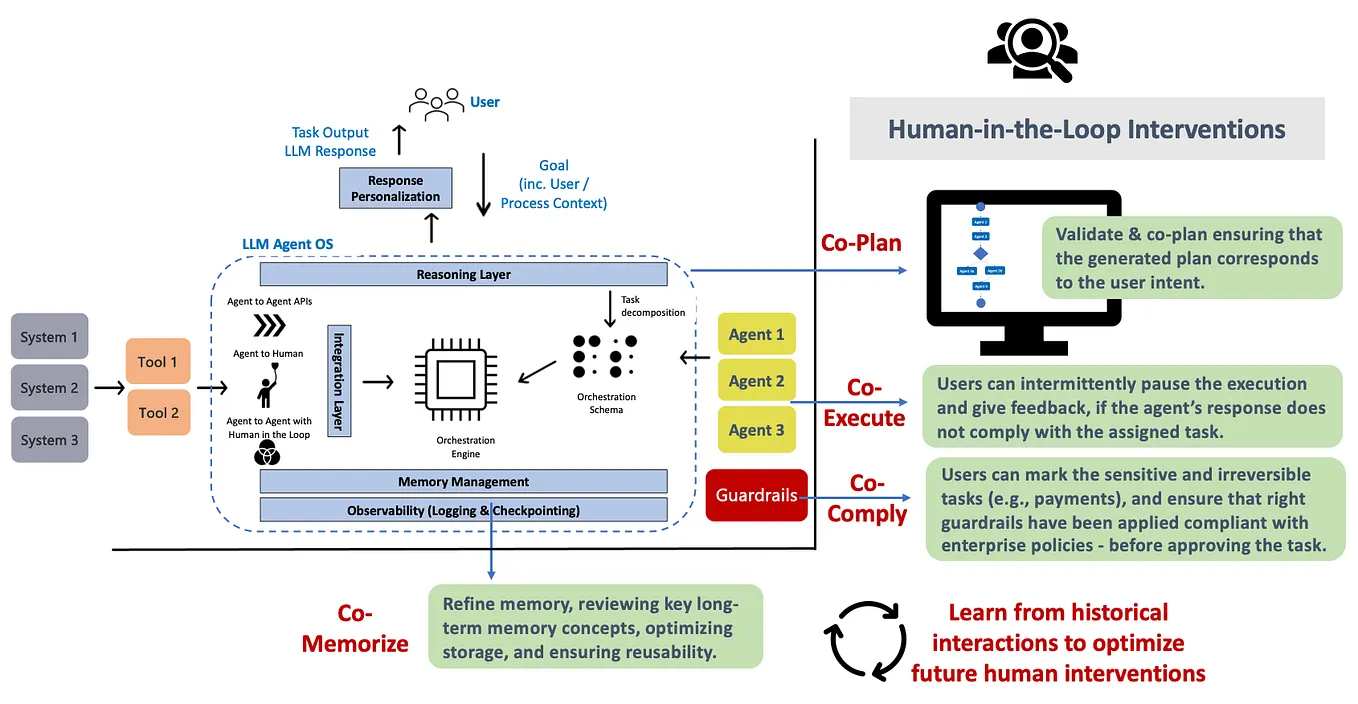
1. The Architecture of an Adaptive Feedback Loop
A robust feedback loop is not a single, monolithic function. It's a two-stage process built on a solid architectural foundation. The two key stages are:
- Interpretation: The agent must first make sense of the user's unstructured response. It needs to extract semantic meaning and intent.
- Adaptation: Based on the interpretation, the agent must modify its own internal state, configuration, or core instructions to alter its future behavior.
To build this, we need a systems-thinking approach. The following article provides a powerful analogy, framing agent feedback loops in the context of CI/CD pipelines from software engineering—a domain focused on rigorous, automated validation and iterative improvement.
AI Agent Feedback Loops: How to Monitor and Validate Autonomous Agents
The article 'AI Agent Feedback Loops' by J. Duncan provides a structured, engineering-centric view on how to monitor and evolve autonomous agents. It introduces concepts that are directly applicable to our design.
Read the sections 'The AI Agent Feedback Loop Architecture' and 'The Practical Takeaway'. Pay close attention to two core ideas: 'Context.md as the Source of Truth': This is the principle of maintaining the agent's core instructions and operating principles in an explicit, version-controlled format. 'Agent Configuration Evolution': This refers to the process of updating that source of truth based on feedback, so the agent's behavior evolves.
The key takeaway is that adaptation isn't arbitrary. It's a disciplined process of updating a central "source of truth" that governs the agent's behavior. When a user provides feedback, the goal is to distill that feedback into a lesson that can be codified in the agent's configuration.
2. Stage 1: Interpretation — Deriving Intent from a Response
Imagine our discipline-tracking agent sent this proactive message: "Just checking in. I noticed your progress on 'writing the business plan' has slowed this week. Is everything on track?"
The user's reply could vary significantly:
- Response A: "Thanks, got sidetracked. Back on it now."
- Response B: "I was traveling for work. Had no time. I'll make it up this weekend."
- Response C: "This is more complex than I thought. The goal might be too ambitious for the deadline."
- Response D: "This isn't helpful. Stop sending these messages."
Each response requires a different adaptation strategy. The first step is to convert the user's natural language into a structured format that the agent's logic can process. This is a perfect task for an LLM.
We can design a "sense-making" function that prompts an LLM to classify the user's response.
Example Sense-Making Prompt:
You are an interpretation module for a discipline-coaching AI agent. Your role is to analyze the user's response to a proactive nudge and extract structured data.

**Agent's Nudge:** {original_agent_message}
**User's Response:** {user_response_text}

Analyze the user's response and provide a JSON output with the following schema:
- "intent": Classify the user's primary intent. Options: ['ACKNOWLEDGEMENT', 'PROVIDING_CONTEXT', 'REQUEST_GOAL_MODIFICATION', 'NEGATIVE_FEEDBACK'].
- "sentiment": Classify the sentiment. Options: ['POSITIVE', 'NEUTRAL', 'NEGATIVE'].
- "new_context": (string, or null) Summarize any new information provided by the user that explains their performance (e.g., "User was traveling for work").
- "requested_action": (string, or null) Describe any explicit or implicit action the user wants the agent to take (e.g., "Revise goal deadline", "Reduce notification frequency").

Generate only the JSON object.
Output for Response B:
{
  "intent": "PROVIDING_CONTEXT",
  "sentiment": "NEUTRAL",
  "new_context": "User was traveling for work and had no time.",
  "requested_action": "Temporarily pause negative progress alerts and expect a catch-up period."
}
This structured JSON object is no longer ambiguous. It's a clear signal that can be processed by the agent's deterministic logic to trigger the correct adaptation.
3. Stage 2: Adaptation — Evolving Agent Strategy
Once the user's intent is clear, the agent must act on it. Adaptation can occur at multiple levels, from minor parameter tweaks to fundamental changes in the agent's core instructions.
The concept of procedural memory—an agent's knowledge of how it should act—is central here. When we adapt an agent, we are modifying this memory. The following video from LangChain demonstrates a practical and powerful way to implement this by using feedback to dynamically rewrite an agent's system prompt.
Build Self-Improving Agents: LangMem Procedural Memory Tutorial
This tutorial, 'Build Self-Improving Agents,' demonstrates how to implement procedural memory using the LangMem library. It shows a concrete example of an email agent learning from user feedback to change its default behavior.
Watch the introduction (00:00 - 00:53) to grasp the concept of procedural memory. Then, pay close attention to the main demonstration (01:37 - 03:32). Notice how the PromptOptimizer takes the conversation history and user feedback to infer a new set of instructions for the agent, effectively 'teaching' it a new procedure.
This is a direct implementation of the "Context as Code" principle. The agent's prompt is its configuration, and the feedback loop directly modifies it.
Let's apply this to our discipline tracker using the structured JSON from Stage 1:
- If
intentisPROVIDING_CONTEXT, the agent's logic might decide to temporarily suppressTRIGGER_NEGATIVE_VELOCITY_TRENDfor a few days. This is a simple parameter adjustment. - If
intentisREQUEST_GOAL_MODIFICATION, the agent could trigger a new workflow to guide the user through revising theirGoalorMetricobjects in the data model. - If
intentisNEGATIVE_FEEDBACK, the agent could use thePromptOptimizerapproach to add a new instruction to its core prompt: "The user has indicated a preference for fewer proactive messages. Only intervene if progress velocity drops below 50% of the required rate."
To add more conceptual rigor, we can classify these adaptations. The table below, adapted from the article "Advanced Reasoning: Self-Reflection, Error Recovery, and Adaptation" (LINK), outlines different levels of self-modification.
| Level | Scope | Example for Personal Agent |
|---|---|---|
| Parameter Tuning | Adjust existing parameters | Changing the threshold for a TRIGGER_STAGNATION alert from 3 days to 5 days. |
| Strategy Selection | Choose from predefined strategies | If "Nudge" interventions are met with negative feedback, switch to a less frequent "Weekly Summary" strategy. |
| Strategy Combination | Combine multiple approaches | After identifying a blocker, the agent could both suppress alerts and proactively suggest a relevant article on overcoming the specific issue. |
| Strategy Creation | Generate new strategies | (More advanced) After multiple failed attempts to re-engage a user, the agent proposes a completely new type of goal structure. |
For our Personal OS, most adaptations will fall within Parameter Tuning and Strategy Selection, which provides a powerful yet controllable way for the agent to evolve.
4. Explicit vs. Implicit Feedback Loops
The mechanism we've designed so far is an implicit feedback loop. It learns asynchronously from the natural flow of conversation. There is another, more direct type of feedback: explicit feedback, where an agent deliberately pauses its execution to request input. This is often called a "human-in-the-loop" (HITL) pattern.
It's crucial to distinguish between these two:
- Implicit Loop (Learning): Analyzes past interactions to improve future, general behavior. It's about long-term adaptation.
- Explicit Loop (Approval/Input): Pauses a current task to get required information or permission to proceed. It's about immediate task correctness.
The following video demonstrates how to build an explicit HITL workflow using LangGraph, a framework for building stateful, multi-agent applications.
LangGraph Agents - Human-In-The-Loop - User Feedback
This video, 'LangGraph Agents - Human-In-The-Loop,' explains how to create breakpoints in an agent's workflow, allowing it to pause, wait for user input, and then resume.
Watch the first six minutes to understand the core mechanism. Focus on: The motivation: why you'd want an agent to pause and ask for feedback. The role of 'checkpoints' and 'threads' in saving and resuming the agent's state. How the code sets a breakpoint, collects user input, and uses graph.update_state to inject that feedback before continuing.
In our Personal OS, an explicit loop might be used if the agent suggests a major goal revision: "Your progress suggests the current deadline is unrealistic. I've drafted a new plan with a revised deadline of [date]. Do you approve this change? [Y/N]" The agent would then pause until it receives that explicit approval.
Conclusion
In this lesson, we have designed the complete feedback architecture that enables a personal agent to learn and adapt. By separating the process into Interpretation and Adaptation, we created a robust and predictable system.
Key Takeaways:
- Feedback loops enable agent evolution. They are the mechanism by which an agent learns from its interactions and avoids repeating mistakes.
- Interpretation turns text into intent. Using an LLM to classify user responses into a structured format (like JSON) is the first step to making sense of feedback.
- Adaptation modifies the agent's "source of truth." Effective adaptation involves updating the agent's core instructions, parameters, or strategies, a concept powerfully implemented by dynamically modifying the agent's system prompt.
- There are different levels of adaptation, from simple parameter tuning to selecting entirely new strategies.
- Distinguish between implicit and explicit feedback. Implicit loops learn from conversational history to improve future behavior (long-term learning), while explicit loops pause a current task for immediate input or approval (task-specific correctness).
Preview of the Next Lesson:
We have now fully designed the "brain" of our Personal OS agent: its data model, its proactive logic, and its ability to learn from feedback. In the final lesson of this module, we will get practical and address the physical implementation: Map the data and API requirements for a self-hosted personal agent (e.g., email, calendar, notes, files). We'll translate our conceptual design into a concrete technical blueprint.