Recommended resources
The freely available resources this lesson will direct you to.
- Lower Stress With an End-of-Day Ritual | Dr. Cal Newport & Dr. Andrew Hubermanwww.youtube.com
- Unlock Better Sleep: 4 Powerful Routines to Beat Insomniawww.youtube.com
- Why writing worries at night improves sleep, according to ...www.monkleyfurniture.co.uk
- How to Reduce Mental Load & Support Emotional Well-beingwww.pureencapsulationspro.com
Hello! In our last lesson, we implemented a protocol to manage physiological arousal by using a warm bath or shower to trigger a sleep-promoting drop in core body temperature. We are now moving to the second, equally important, piece of the puzzle: managing cognitive arousal.
Tonight's lesson addresses the common problem of a racing mind at bedtime—the endless loop of worries, to-do lists, and work problems that keeps you from falling asleep. Your goal is to apply the cognitive offloading technique (e.g., 'worry dump' or next-day planning) to reduce pre-sleep rumination.
You will learn a structured, protocol-based approach to get these thoughts out of your head and onto paper, signaling to your brain that it's safe to power down for the night.
The Mechanism: Why Your Brain Won't Shut Down
If you've ever laid in bed exhausted, yet your mind is running a marathon, you've experienced the effects of an overloaded working memory. During the day, you're busy, distracted, and constantly juggling tasks. When you finally stop, your brain sees it as the first opportunity to process all the "open loops"—the unfinished tasks, unresolved worries, and pending decisions.
This is a well-documented phenomenon. Two key concepts explain why writing things down is so effective:
- Cognitive Offloading: This is the simple act of moving information from your brain to a reliable external system (like a notebook). As a clinical article from Pure Encapsulations Pro explains, this reduces the cognitive load of holding tasks on "constant standby," which in turn helps your nervous system downshift for sleep.
- The Zeigarnik Effect: This psychological principle states that our minds are biased to remember unfinished or interrupted tasks better than completed ones. By writing down a task and defining a next step, you are essentially telling your brain that the task has a plan, which provides a sense of closure and allows your mind to let go.
The Science Behind Worry Writing at Bedtime
To understand these mechanisms in more detail, let's turn to a concise article from Monkley Furniture that breaks down the science.
Read the section titled 'The Science Behind Worry Writing at Bedtime.' Focus on how the Zeigarnik effect and cognitive offloading work together to reduce mental load.
The Protocol: The 'Worry Dump' or 'Scheduled Worry'
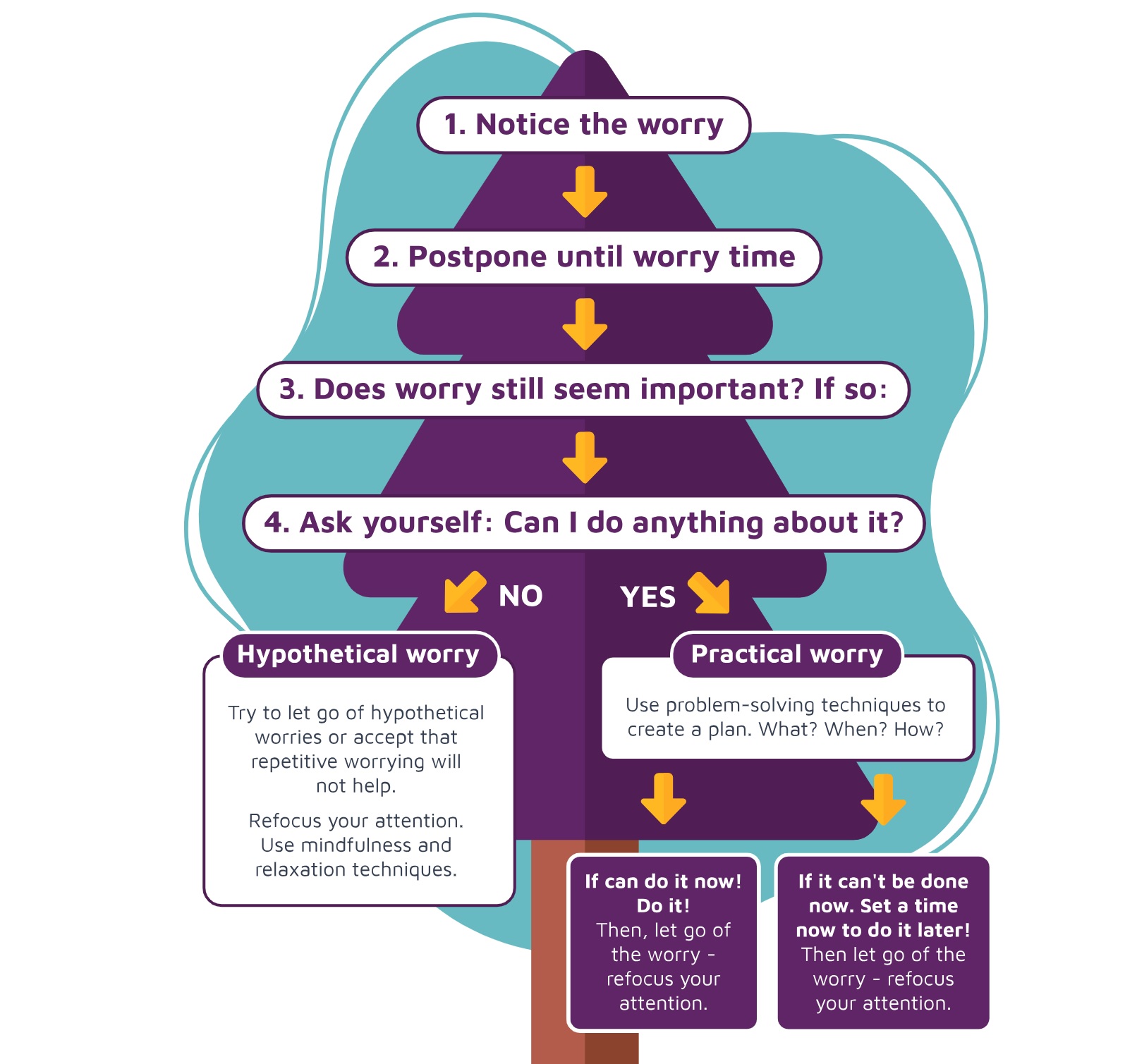
The most versatile technique for cognitive offloading is often called a "worry dump" or "scheduled worry." The idea is to set aside a specific, short period to proactively deal with these thoughts before they ambush you in bed.
This isn't about solving all your problems. It's about containing them.
Unlock Better Sleep: 4 Powerful Routines to Beat Insomnia
The 'Therapy in a Nutshell' channel provides a great explanation for why this works and how to implement it.
Watch from 04:42 to 06:31. Pay attention to the analogy of the brain as a computer forcing an update and the core steps of the 'scheduled worry' technique.
Building on that concept, here is a highly structured, five-step protocol you can implement. This turns the general idea of a "worry dump" into a repeatable system.
The 5-Step Cognitive Offloading Protocol:
This protocol is best done with pen and paper for 5-10 minutes during your wind-down routine.
- Capture: Create a bulleted list of every task, worry, or idea currently taking up space in your mind. Don't filter or judge; just get it all out.
- Clarify: Label each item. Is it an actionable task, a pending issue you're waiting on, or an abstract worry?
- Commit: For every actionable item, define the very next, tiny physical step. Not "finish project," but "email Bob for the report." This is the most crucial step for satisfying the Zeigarnik effect.
- Calendar: If an item cannot be acted on now, assign a specific time to revisit it (e.g., "Think about marketing plan: Friday, 10 AM").
- Close: Conclude with a clear sign-off statement, like "Parked until 9 AM" or "Shutdown complete." This acts as a firm psychological boundary.
An Alternative Protocol: The 'End-of-Day Shutdown'
For an entrepreneur, many pre-sleep ruminations are specifically work-related. Computer scientist and author Cal Newport developed a protocol specifically for this: the "End-of-Day Shutdown Ritual." It's a more focused version of cognitive offloading tailored to creating a hard stop between your work life and personal life.
Lower Stress With an End-of-Day Ritual | Dr. Cal Newport & Dr. Andrew Huberman
In this clip, Cal Newport explains his shutdown ritual to Dr. Andrew Huberman. This approach is highly systematic and effective for anyone whose work tends to follow them home.
Watch from 00:02 to 02:31. Focus on the three key components: reviewing open loops, capturing outstanding thoughts, and using a 'demonstrative anchor' to finalize the shutdown.
As Newport explains, the power of this ritual comes from the "demonstrative anchor" (e.g., saying "Schedule shutdown complete" or checking a box). When a work thought intrudes later, you don't engage with it. You simply remind yourself, "I completed the shutdown; this has been handled." It's a form of self-directed cognitive behavioral therapy that trains your brain to disengage.
Test your understanding!
It's 10 PM. As you start your wind-down routine, you realize you're mentally replaying a difficult conversation with a contractor, worrying about cash flow for next month, and remembering you need to book a flight. According to the 5-step Cognitive Offloading Protocol, what is the most effective action to take right now?
A) Spend the next 30 minutes creating a detailed financial forecast to solve the cash flow worry.
B) Write down: "1. Contractor convo, 2. Cash flow, 3. Book flight." Then close the notebook.
C) Write down: "1. Draft apology email to contractor tomorrow AM. 2. Review bank statements Friday 2 PM. 3. Book flight on lunch break tomorrow." Then write "Parked until tomorrow."
Show answer
The correct answer is C.
Reasoning:
- Option A violates the principle of containment. The goal is not to solve the problem now, but to offload it.
- Option B completes the "Capture" step but misses the critical "Commit" and "Calendar" steps. Your brain is less likely to let go because no concrete plan has been made.
- Option C correctly captures the worries, defines a specific and small next action for each, and uses a closing statement. This satisfies the brain's need for a plan and provides closure.
Conclusion
You now have two powerful, structured protocols to manage cognitive arousal before sleep. By systematically externalizing your thoughts, you are not avoiding your responsibilities; you are managing them effectively so your mind can get the rest it needs.
Key Takeaways:
- Pre-sleep rumination is often your brain trying to process "open loops" from the day.
- Cognitive offloading—writing thoughts down—moves them from your working memory to an external tool, reducing mental load.
- The 'Worry Dump' protocol is a 5-10 minute routine to Capture, Clarify, Commit, Calendar, and Close all mental loose ends.
- The 'End-of-Day Shutdown Ritual' is a work-specific version that uses a strong anchor phrase or action to create a hard mental stop.
In our previous lesson, we covered a protocol for the body (warming). In this lesson, we covered protocols for the mind (offloading). In our next and final lesson for this module, we will integrate these elements and more to help you design your own personalized, 60-minute wind-down routine.