Recommended resources
The freely available resources this lesson will direct you to.
- English Literary Movements: A Comprehensive Chronological Guide | UGC NET English Preparationwww.youtube.com
- Literary Theory for UGC NET 2026 | Complete Roadmap + PYQ Strategy | How to Score 40+ Marks Guarantewww.youtube.com
- Principles of Learning Derived From Cognitive Psychology Researchmcgraw.princeton.edu
- Memorization Strategies - UNC Learning Centerlearningcenter.unc.edu
Hello! Your two-phase schedule reserved time for recalling older material, but “review literary history” is still too broad to be a useful appointment. This lesson makes those blocks concrete. You will turn a cluster of writers, works, dates, movements, and critical concepts into a small structure you can reconstruct from memory, rather than a long list you can only recognize when it is in front of you.
The method will serve both examinations: it supports quick attribution and chronology decisions in UGC-NET preparation, while preserving connections you can use in GATE’s literary and interpretive questions. Allow about 40 minutes, including the short resource selections and time to sketch one structure of your own.
Organize for the question you may have to answer
Consider a note that reads: “Wordsworth, Coleridge, Shelley, Romanticism, Lyrical Ballads, 1798, Frankenstein, 1818.” Everything on the list may matter, but the list does not tell you which relationships to remember. It also invites a mistake: Frankenstein belongs to the Romantic period and draws on Gothic writing, but calling it simply a work by one of the poets associated with Lyrical Ballads would erase an important distinction.
A retrieval structure records relationships, not just items. For this cluster, useful questions include: Which authors contributed to Lyrical Ballads? Which Shelley wrote Frankenstein? Which work appeared earlier? What does “Romantic” identify in each case—an era, a set of concerns, or a narrower grouping of poets?
Princeton’s Principles of Learning Derived From Cognitive Psychology Research recommends organizing material with disciplinary categories and making compact graphical representations. Read the two short passages below for the distinction between giving information a structure and merely decorating a page of notes.
Principles of Learning Derived From Cognitive Psychology Research
Read the Princeton guide for its advice on organizing knowledge into categories and representing relationships visually.
Under “EIGHT EVIDENCED-BASED PRINCIPLES FOR EFFICIENT STUDYING,” find Principle 2. Read the organization advice, ending with the example of organizing knowledge by question type. Then find Principle 7, “Utilize ‘dual coding’ study methods and tools.” Read the mapping advice through its suggestion to use color and symbols. Focus on whether a diagram makes a relationship easier to recall; its appearance is secondary.
For literary study, four organizing axes are particularly reusable:
| Axis | What it lets you retrieve |
|---|---|
| Chronology | What came before or after a work, publication, or movement |
| Attribution | Which author wrote which text or proposed which concept |
| Classification | A period, movement, genre, or critical approach—and the difference between them |
| Connection and contrast | A shared concern, a formal difference, or an easily confused pairing |
You do not need four separate notebooks. A compact table or map can carry several axes, provided every entry has a clear purpose.
Build a cluster with boundaries, not an ever-growing list
Start with a manageable focus: two to five closely related items and one likely confusion. Here is a completed model using three publications:
| First publication | Work | Author | Retrieval cue |
|---|---|---|---|
| 1798 | Lyrical Ballads | William Wordsworth and Samuel Taylor Coleridge | A collaborative collection; an anchor for British Romantic literary history |
| 1818 | Frankenstein | Mary Shelley | A Gothic novel of the Romantic period; do not confuse Mary Shelley with Percy Bysshe Shelley |
| 1922 | The Waste Land | T. S. Eliot | A modernist poem; a much later chronological anchor |
The table is deliberately selective. It does not claim that Romanticism began in 1798 or that every work from an era has one defining style. It gives you three reliable publication anchors and preserves a distinction between period, genre, and movement. Always label what a date means: first publication, composition, revised edition, or an author’s lifetime are not interchangeable.
Now imagine the table covered. The structure should let you recover information in several directions: “1798” cues Lyrical Ballads; “Mary Shelley” cues Frankenstein and 1818; “The Waste Land” cues Eliot, modernism, and its position after the other two works. Reconstructing the relationships without looking is the study action. Copying the table neatly is only preparation for it.
The video English Literary Movements: A Comprehensive Chronological Guide, from UGC NET ENGLISH, provides a brief sequence of movement labels and representative writers. Watch only these contrasting points; use them to notice how a chronology can supply a backbone without becoming a substitute for work-level knowledge.
English Literary Movements: A Comprehensive Chronological Guide | UGC NET English Preparation
Watch selections from “English Literary Movements: A Comprehensive Chronological Guide” (UGC NET ENGLISH) to see how movement labels and writers can act as retrieval cues.
Watch metaphysical poets for a compact writer–style grouping. Then watch Romantic groupings, including the narrower Lake Poets label. Finally watch modernism. Focus on the difference between a broad movement and a subgroup. Treat the video as a source of candidate connections to verify and refine, not as an exhaustive or rigid chronology.
Why not simply make one enormous timeline from that video? Because a timeline answers when more readily than whose work, what kind of work, or why two labels differ. Keep the timeline as a backbone, then add only the cross-links that help you answer a likely question. For example, “Wordsworth—Coleridge—Lyrical Ballads” is more useful than adding another unconnected author name to the margin.
Give concepts the same treatment as works
Critical theory produces a different sort of confusion. You may recognize several names in a question but hesitate over which essay or concept belongs to each. A concept cluster therefore needs a distinguishing cue, not just a theorist–term pair.
Here is a compact model. The last column says what to retrieve when two nearby entries appear together in an option set.
| Writer | Text | Distinguishing cue |
|---|---|---|
| Roland Barthes | “The Death of the Author” | Challenges the author’s intention as the final authority over a text’s meaning |
| Michel Foucault | “What Is an Author?” | Asks how the “author” functions in classifying and circulating discourse |
The titles sound related, which makes the pairing easy to confuse. Rather than memorizing “Barthes = author” and “Foucault = author,” retain the contrast between their questions. These brief cues are for attribution and differentiation; later lessons will examine the arguments themselves more closely.
A short segment of Literary Theory for UGC NET 2026, from English Winglish by Pooja Singh, surveys theorists, texts, and concepts. Watch it as a demonstration of material that needs organizing, not as an invitation to memorize every name at once.
Literary Theory for UGC NET 2026 | Complete Roadmap + PYQ Strategy | How to Score 40+ Marks Guarante
Watch the theorist survey in “Literary Theory for UGC NET 2026” (English Winglish by Pooja Singh) and notice the different kinds of links it presents.
In the theorist survey, listen for names, works, and concepts. Distinguish those three categories in your notes rather than treating them as one list. The quick associations are starting cues; study the arguments behind them when the course reaches those theories.
This gives you a rule for deciding what belongs in a retrieval structure: include an item if it is an anchor or if it resolves a probable confusion. Leave out a detail you cannot yet explain or verify, and add it when you study that topic properly. A small, accurate structure is more useful than a dense map containing uncertain links.
Turn the structure into retrieval practice
A table becomes a study tool only when you use it with the answers hidden. UNC Learning Center’s Memorization Strategies makes this distinction between the familiarity produced by rereading and the more informative test of actively recalling material. It also discusses grouping related information and returning to it after a delay.
Memorization Strategies - UNC Learning Center
Read the UNC Learning Center’s guidance on understanding, self-testing, spaced study, and meaningful groups.
In “Simple memory tips and tricks,” begin with the paragraph under “Try to understand the information first.” Read through spaced practice, ending with the “Use distributed practice” paragraph. Then, farther down the same section under “Create meaningful groups,” read the grouping example. Notice that a mnemonic can help recover items, but you still need to know what connects them.
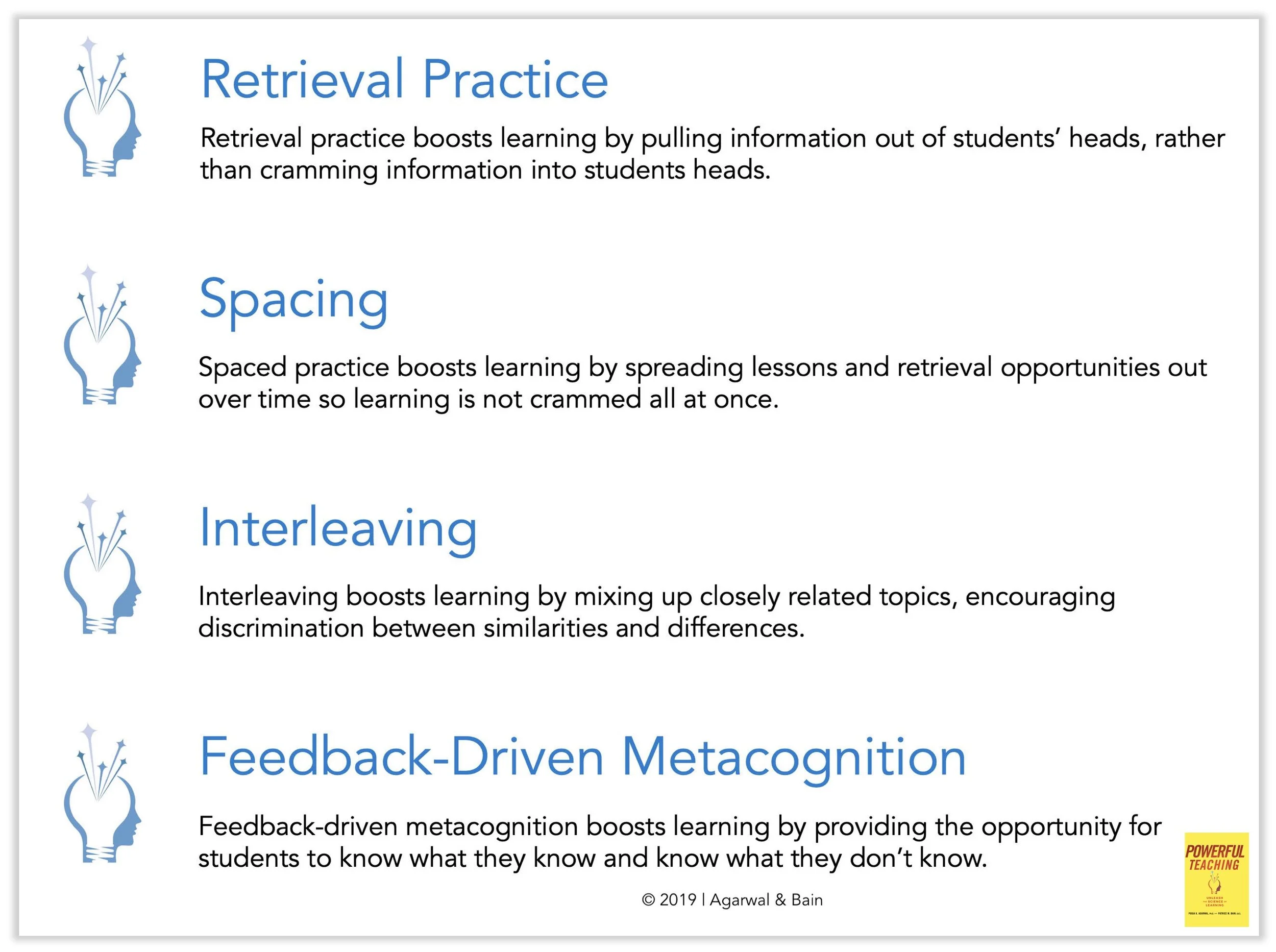
The image below brings together four useful habits. For this lesson, the decisive pair is retrieval—recalling before you look—and feedback—checking exactly what you missed. Spacing and interleaving determine when, and alongside what, you repeat that process.
A workable cycle for one cluster is short:
- Choose the cue. Cover the table and start from a year, work, author, or concept—not always from the leftmost column.
- Rebuild what you can. Say or write the linked entries from memory, including the distinguishing detail. If “1818” brings back Frankenstein but not Mary Shelley, that missing link is visible.
- Check and repair. Compare with a reliable source or your checked notes. Correct the precise link you missed rather than rereading everything.
- Return after a gap. Put the cluster into an older-material block in your schedule. A successful answer immediately after studying is less informative than one recovered later.
Varying the cue matters. If every card asks “Who wrote Frankenstein?”, you may learn that single direction while remaining unable to identify Mary Shelley’s work in a matching question or place it in a chronology. You need not make a card for every possible combination; alternate a few reverse and comparative cues. One might ask for an author from a title; another might require you to distinguish the two essays on authorship.
As clusters accumulate, occasionally mix closely related ones: Romantic and modernist works, for example, or Barthes and Foucault. Mixing is useful when it makes you choose between plausible alternatives. Randomly combining unrelated facts before you understand either one usually adds noise rather than a helpful distinction.
Keep the finished product small enough to test in your scheduled recall block: a labelled table, a timeline with a few cross-links, or a handful of two-way prompts. When a practice question exposes an error, revise the affected link. The next lesson’s elimination strategies will then have something dependable to work with: not merely names you have seen, but relationships you can retrieve.
Key takeaways
Cluster by relationship and question type, not by page count. Use chronology for ordering, attribution for author–work links, and contrast for easily confused movements, genres, or concepts. Label dates precisely, keep uncertain details out until checked, and test the structure with its answers hidden. Spaced returns and feedback make it a revision tool rather than a one-time summary.
Next, you will use those retrieved anchors to eliminate options in chronology, matching, assertion–reason, and multiple-statement questions.