Recommended resources
The freely available resources this lesson will direct you to.
Hello! Welcome back to our exploration of advanced topics in critical phenomena.
In our last lesson, we established the Mermin-Wagner theorem, a powerful result showing that continuous symmetries cannot be spontaneously broken in two dimensions at any finite temperature. We saw this through the lens of the 2D XY model, where long-wavelength spin-wave fluctuations are so prevalent that they destroy any possibility of true long-range order. This led to the prediction of "quasi-long-range order," where correlations decay algebraically with distance, as .
This presents a puzzle. The spin-wave theory predicts this critical-like behavior for any low temperature, but we know that at very high temperatures, thermal disorder must lead to conventional short-range order with exponential correlation decay. A transition between these two regimes must occur. Today's learning goal is to explore this very transition: to describe the Kosterlitz-Thouless (KT) transition in the 2D XY model as a topological phase transition without long-range order. We will discover that the key lies not in spin waves, but in a different kind of excitation entirely: topological defects called vortices.
1. Beyond Spin Waves: The Role of Vortices
The spin-wave approximation we discussed previously is based on the assumption that the spin angles vary smoothly and slowly across the lattice. This approximation linearizes the Hamiltonian to . While this captures the physics of Goldstone modes, it misses a crucial class of excitations allowed by the full cosine potential.
Because the physics is invariant under , the spin field must be single-valued, but the angle field itself does not have to be. This allows for configurations where the angle winds by an integer multiple of around a closed path. These are vortices.
A vortex is characterized by an integer charge , its winding number, defined by the line integral around a path enclosing the vortex core:
For , this configuration cannot be smoothly "unwound" to the uniform state (). The integer charge is a topological invariant, meaning it can't be changed by local, continuous deformations. This makes vortices fundamentally different from spin waves.
To build a solid understanding of these defects and their energetics, let's turn to a detailed resource.
Advanced Statistical Physics: 2. Phase Transitions
The following text from the course 'Advanced Statistical Physics' by Leticia Cugliandolo provides an excellent introduction to vortices. It explains why they are not captured by the spin-wave approximation, defines them mathematically, and calculates the energy of an isolated vortex.
Please read section 2.4.3, 'The 2d XY model: vortices and the Kosterlitz-Thouless transition'. Focus on: The definition of a vortex and its charge (Eq. 2.52). Why these are called 'topological defects'. The calculation of the energy of a single vortex (Eq. 2.64), which shows a logarithmic divergence with system size L. The crucial free-energy argument (Eq. 2.65) that weighs this energy cost against the entropy gain. The figures in this section are particularly helpful for visualization.
2. The Free Energy Argument and the Unbinding Transition
As you saw in the reading, the energy of a single vortex with charge in a system of linear size is approximately:
where is a short-distance cutoff (the lattice spacing). This logarithmic divergence suggests that creating an isolated vortex is infinitely costly in the thermodynamic limit (), so they should never appear.
However, Kosterlitz and Thouless made the brilliant observation that we must consider the entropy. A vortex can be placed anywhere on the sites of the lattice, giving it a configurational entropy of .
The competition between energy and entropy is captured by the Helmholtz free energy:
This simple equation holds the key to the transition:
- At low temperatures, where , the prefactor is positive. The free energy diverges to as , meaning isolated vortices are suppressed.
- At high temperatures, where , the prefactor becomes negative. The system can now lower its free energy by creating free vortices.
This argument predicts a transition at (for vortices, which are lowest in energy) where free vortices proliferate and destroy the ordered state.
3. The True Mechanism: Vortex-Antivortex Pair Unbinding
The argument above, while insightful, is a slight oversimplification. The real mechanism is not the spontaneous creation of single vortices but the unbinding of vortex-antivortex pairs.
At any non-zero temperature, thermal fluctuations can create pairs of vortices with opposite charge ( and ), such that the total topological charge is zero. The interaction energy for a pair separated by distance is finite and attractive, growing logarithmically with separation:
This logarithmic potential acts like a "spring" holding the pair together. The KT transition can then be understood through the behavior of these pairs.
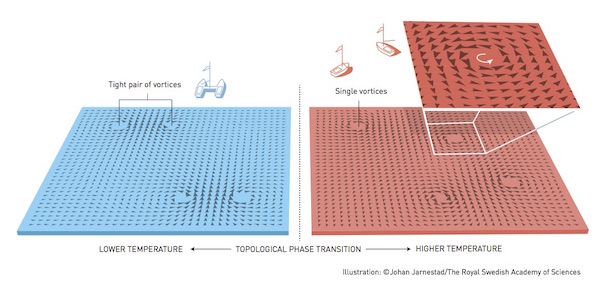
-
Low-Temperature Phase (): The system contains a dilute gas of bound vortex-antivortex pairs. Because they are paired, their influence is localized, and they do not disrupt the long-distance quasi-long-range order established by the spin waves. The correlation function decays algebraically: .
-
High-Temperature Phase (): At a critical temperature , the thermal energy becomes sufficient to overcome the logarithmic attraction. The pairs "unbind" and dissociate into a gas of free-roaming vortices and antivortices. These free charges screen interactions effectively, destroying the quasi-long-range order. The correlation function now decays exponentially: .
This unbinding mechanism is explained concisely in the next section of the resource you just read.
Advanced Statistical Physics: 2. Phase Transitions
Let's refine our understanding by focusing on vortex-antivortex pairs. This short section explains their logarithmic interaction energy and frames the KT transition as a pair unbinding phenomenon.
Please read the section beginning 'The estimate of TKT just given...' until the end of section 2.4.3. This part introduces the logarithmic confining potential for pairs (Eq. 2.68) and identifies the transition with the breakup of these pairs.
Test your understanding!
The interaction energy between a vortex-antivortex pair is . Compare this to the 3D Coulomb interaction between an electron and a positron, . Which pair is "easier" to separate? How does this relate to why a similar topological transition doesn't occur in the 3D XY model?
Show answer
The logarithmic potential $\ln(R)$ increases with separation $R$ much more slowly than the $1/R$ potential falls off. This means the vortex-antivortex pair is much more weakly bound than an electron-positron pair. It is "easier" to separate the vortices.In the 3D XY model, the equivalent topological defects are vortex loops. The interaction between these loops falls off with distance, rather than increasing. As a result, they don't form tightly bound pairs whose unbinding can drive a phase transition. Instead, the 3D XY model undergoes a conventional second-order phase transition with spontaneous symmetry breaking, as allowed by the Mermin-Wagner theorem.
4. Phenomenology of the KT Transition
The KT transition is unlike any we have studied so far. It is not characterized by the onset of an order parameter, nor is it a first-order or conventional second-order transition. It belongs to a new class, sometimes called a transition of "infinite order".
Let's summarize its key features.
[PDF] The Kosterlitz-Thouless Transition
This resource from MIT provides a concise summary of the phenomenology of the KT transition, highlighting its most unusual and important characteristics.
Please read section 4.2, 'The KT transition'. Pay close attention to: The behavior of the spin wave stiffness ( ho_s^R), which is finite below T_{KT} and drops to zero above it. The concept of the universal jump (Eq. 37), a landmark prediction of the theory that we will explore more in the next lesson. The very unusual exponential divergence of the correlation length \xi(T) as T_{KT} is approached from above (Eq. 38). Contrast this with the power-law divergence seen in conventional critical phenomena.
This transition, driven by the collective behavior of topological defects, neatly resolves the puzzle posed by the Mermin-Wagner theorem. It allows for a phase transition in a 2D system with continuous symmetry, but one that avoids spontaneous symmetry breaking and the formation of a traditional order parameter.
Conclusion
In this lesson, we have delved into one of the most elegant concepts in modern statistical physics. We've seen how the 2D XY model can host a phase transition despite the Mermin-Wagner theorem's prohibition on long-range order.
Key Takeaways:
- The KT transition is a topological phase transition that occurs in the 2D XY model and related systems.
- It is driven by the unbinding of vortex-antivortex pairs, which are topological defects characterized by an integer winding number.
- The transition separates two distinct phases:
- A low-temperature phase () with quasi-long-range order, a gas of bound vortex pairs, and algebraic decay of correlations.
- A high-temperature phase () which is disordered, with a "plasma" of free vortices and exponential decay of correlations.
- It is a phase transition without a local order parameter and without spontaneous symmetry breaking. It exhibits unique phenomenology, such as an exponential divergence of the correlation length above .
Preview of the Next Lesson:
We have qualitatively described the unbinding mechanism based on an energy-entropy argument. But how does this unbinding happen as a collective effect? To answer this, Kosterlitz developed a renormalization group (RG) approach that is perfectly suited to this problem. In the next lesson, we will explore this RG analysis to understand how the interactions between vortices change at different length scales, leading to the unbinding transition and the famous "universal jump" in the spin-wave stiffness.