Recommended resources
The freely available resources this lesson will direct you to.
Hello! Welcome back to our study of many-body mean-field methods.
In our previous lesson, we undertook the mathematical derivation of the Hartree-Fock (HF) equations. We started with the Slater determinant as our variational ansatz for the many-electron wavefunction and, by minimizing the energy, arrived at a set of effective single-particle equations:
We identified the Fock operator, , as an effective Hamiltonian containing not just the kinetic and nuclear attraction terms (), but also a mean-field potential from the other electrons. This potential was composed of two distinct parts: the Coulomb (or direct) operator, , and the exchange operator, .
Today's lesson directly addresses the learning outcome: Interpret the physical significance of the direct (Hartree) and exchange (Fock) terms. We will move beyond the formalism to build a solid physical intuition for what these terms represent, why they are different, and what profound physical consequences they have, particularly in the context of condensed matter systems.
1. The Direct (Hartree) Term: A Classical Mean-Field
Let's begin with the more intuitive of the two terms. The contribution of the direct interaction between orbitals and to the total energy is given by the Coulomb integral, :
We can regroup the terms to make its meaning transparent:
This expression has a straightforward classical interpretation. It is nothing more than the total electrostatic repulsion energy between a charge distribution given by and a second charge distribution .
The corresponding Coulomb operator, , which acts on an orbital , represents the potential energy felt by the electron in orbital due to the average charge cloud of the electron in orbital .
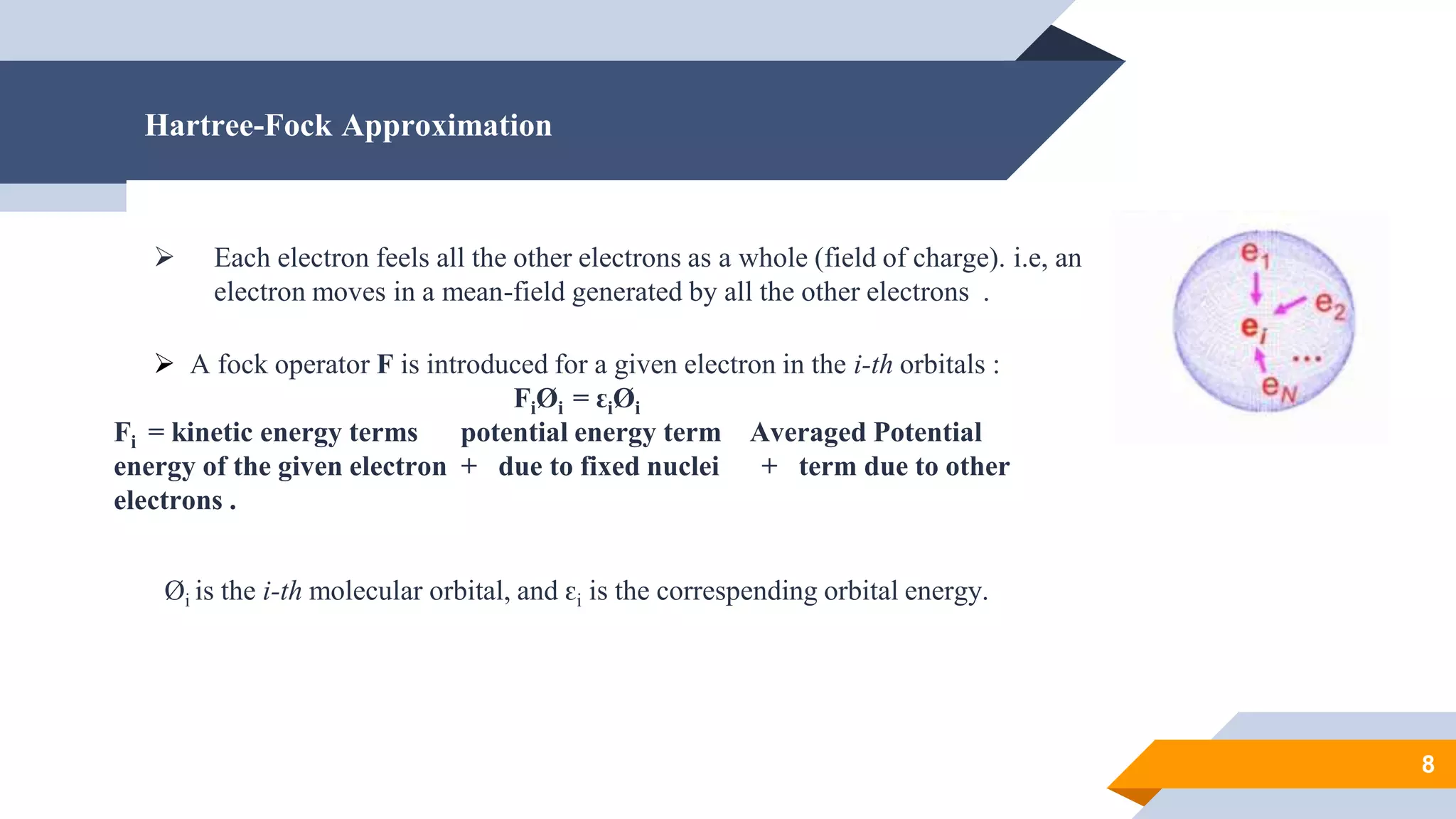
The full Hartree potential, , is the total repulsive potential at position created by the average charge density of all other electrons in the system. This is the essence of the "mean-field" approximation: replacing the complex, instantaneous pairwise interactions with an average, static field.
The following video provides a clear explanation of this classical interpretation.
The first part of this video from the Zientziateka channel explains the Hartree contribution, emphasizing its classical interpretation as the interaction between electron charge densities.
Please watch from 03:24 to 05:03. The speaker walks through the mathematics to show how the direct term corresponds to the classical potential energy of a charge distribution.
If we were to completely ignore the fact that electrons are indistinguishable fermions and use a simple Hartree product wavefunction, this would be the only interaction term we would find. This is precisely what the original Hartree theory did. The inclusion of antisymmetry via the Slater determinant brings in a crucial new piece.
2. The Exchange (Fock) Term: A Purely Quantum Correction
The second interaction term is the exchange integral, :
Notice the difference: the arguments of the orbitals and are swapped on the right-hand side of the operator. This term has no classical analogue. It cannot be interpreted as an interaction between two charge densities. Instead, it is a direct mathematical consequence of enforcing the Pauli exclusion principle through the antisymmetry of the Slater determinant.
The exchange operator, , is a non-local integral operator:
To evaluate its effect on at point , we must integrate over all space, and the result depends on the function everywhere.
So, what is its physical meaning?
- It arises from indistinguishability: This term appears because the expression includes cross-terms where electrons 1 and 2 in the 'bra' are exchanged in the 'ket'.
- It acts only between electrons of the same spin: If and have opposite spins, the spin part of the integral for vanishes due to orthogonality (e.g., ). This is a fundamental point: the Pauli principle, which forbids two fermions from occupying the same quantum state, has its most direct energetic consequence on electrons with parallel spins.
- It lowers the total energy: The exchange term enters the total energy expression with a minus sign (). This means the exchange interaction is attractive. It reduces the overall repulsion between electrons.
The following video uses the simple case of an excited Helium atom to build a powerful intuition for the exchange interaction and its energy-lowering effect for parallel spins.
In this video, Nicola Spaldin provides an excellent qualitative and quantitative explanation of the exchange interaction.
Please watch from the beginning to 03:16 to understand the motivation. Then, watch from 07:36 to the end (31:59). The video will guide you through constructing symmetric and anti-symmetric spatial wavefunctions corresponding to anti-parallel and parallel spins, respectively. Pay close attention to how the total energy expression naturally splits into a direct integral (K) and an exchange integral (J), and how the sign of the J term depends on the spin configuration. The final part provides a clear physical interpretation of K as a classical term and J as a purely quantum mechanical one.
The lowering of energy for parallel spin configurations is the basis for Hund's first rule in atoms and is the fundamental mechanism behind ferromagnetism in solids.
3. The Fermi Hole and Exchange Hole
We can gain an even deeper physical insight by considering how the exchange interaction affects the spatial distribution of electrons. The Pauli principle dictates that two electrons with the same spin cannot be at the same place at the same time. The exchange term is the energetic manifestation of this correlation.
We can define a pair-correlation function that describes the probability of finding an electron at given that another electron is at . Within the Hartree-Fock approximation, the density of same-spin electrons around a given electron is not uniform. The exchange interaction creates a depletion region around each electron, a so-called exchange hole or Fermi hole.
This means that an electron effectively repels other electrons of the same spin from its immediate vicinity, more so than would be expected from classical Coulomb repulsion alone. The "hole" is not a physical void but a statistical depletion of charge density. The total charge integrated over this hole is exactly , corresponding to the "missing" electron.
To understand this concept more rigorously, let's turn to a more advanced text.
Electronic Hamiltonians - Part II
The following sections from a UBC lecture note by Mona Berciu provide a clear, first-quantization derivation of the Hartree-Fock equations and an excellent physical interpretation of the exchange hole.
First, read the section 'A different approach for a generic Hamiltonian: 1st quantization' (pages 12-14). This re-derives the HF equations in a way that makes the physical meaning of the Hartree potential (VH) and the Exchange potential (VE) very clear. Then, read section 2.1 'Pair correlations and the “Fermi hole”' (pages 19-20). This is the crucial part. It shows how the exchange term leads to a reduction in the electron density (the 'hole') in the vicinity of an electron and explains how the energetic stability comes from the attraction of the electron to this effective positive charge it carries with it.
The key physical picture is that an electron, by "digging" an exchange hole around itself, lowers its interaction energy. It is no longer repelled by a uniform density of other electrons; instead, it is attracted to the net positive background charge within its own exchange hole. This self-interaction is the origin of the negative exchange energy. The electron plus its exchange hole can be thought of as a single composite object—a quasiparticle.
Test your understanding!
A colleague is running a Hartree-Fock calculation on a simple diatomic molecule. They are surprised to find that the exchange energy between an electron in a bonding orbital and an electron in the orthogonal bonding orbital is zero. Why is this expected? What if both electrons were in different orbitals?
Show answer
The exchange interaction, , is non-zero only if the orbitals and have a region of overlap in space. If the orbitals are orthogonal due to symmetry (like a and a orbital in a linear molecule), their product is zero everywhere when integrated, causing the exchange integral to vanish. The Pauli principle keeps same-spin electrons apart, but if they are already spatially segregated by the symmetry of their wavefunctions, there is no additional energy lowering from the exchange effect.
If both electrons were in different orbitals (e.g., and ), these orbitals would occupy the same region of space and would not be orthogonal by symmetry. If the electrons have the same spin, there would be a non-zero overlap and thus a finite, energy-lowering exchange interaction between them.
4. Application: Cohesion in the Jellium Model
Your interest in condensed matter physics makes the jellium model a perfect case study. In this model, we consider a uniform gas of electrons moving in a uniform, fixed positive background charge (the "jelly"). This is a simple model for alkali metals.
Let's analyze the potentials:
- External Potential (): The attraction of an electron to the uniform positive background.
- Hartree Potential (): The repulsion of an electron from the uniform average density of all other electrons.
Since the electron gas density is uniform and the background is uniform, these two potentials are equal in magnitude and opposite in sign. They exactly cancel each other out!
This means that in the Hartree approximation (direct term only), the electron gas has no cohesion. The kinetic energy would cause it to fly apart.
It is the exchange term that provides the stability. The attraction of each electron to its own exchange hole provides a negative potential energy that binds the system together. The total energy per electron in the Hartree-Fock approximation for jellium is:
The first term is the positive kinetic energy, and the second is the negative exchange energy (where is a dimensionless parameter related to the electron density). The exchange term is solely responsible for the energy minimum that corresponds to a stable, bound system. This is a powerful demonstration of the physical importance of this purely quantum mechanical effect.
Conclusion
In this lesson, we have built a physical picture for the two interaction terms that appear in Hartree-Fock theory.
Key Takeaways:
- The direct (Hartree) term is a classical mean-field electrostatic repulsion. It represents the interaction of an electron with the average charge cloud of all other electrons.
- The exchange (Fock) term is a purely quantum mechanical effect with no classical analogue. It arises from the antisymmetry requirement of the wavefunction for identical fermions (Pauli exclusion principle).
- The exchange interaction is energy-lowering and acts only between electrons of the same spin.
- Physically, the exchange term accounts for the exchange hole (or Fermi hole), a region of reduced same-spin electron density around each electron. The attraction of an electron to its own exchange hole is the source of the exchange energy.
- In the jellium model, this exchange energy is the sole source of cohesion, demonstrating its critical role in the stability of metals.
Preview of the Next Lesson:
Now that we have derived the HF equations and understood their physical content, the next logical step is to solve them. As we noted previously, the Fock operator depends on its own solutions, requiring a special approach. In the next lesson, we will outline the Self-Consistent Field (SCF) procedure, the iterative algorithm used to numerically solve the Hartree-Fock equations. We will also formally define the correlation energy, which is precisely the energy that the Hartree-Fock approximation, by its single-determinant nature, fails to capture.