Recommended resources
The freely available resources this lesson will direct you to.
Hello! Welcome to the first lesson in our new module on Strongly Correlated Electron Systems.
In our last lesson, we delved into the Kondo effect, a beautiful example of how a single magnetic impurity can have a profound, non-perturbative impact on the entire sea of conduction electrons. We saw the emergence of a new energy scale, the Kondo temperature , below which the impurity and its surrounding electrons form a complex, many-body singlet state. This was our first real taste of "strong correlation" physics.
Today, we will take the conceptual leap from a single impurity to an entire lattice of interacting electrons. This is the situation in a vast class of real materials, like transition metal oxides, where the standard band theory we studied earlier often fails dramatically. Our goal is to derive the most fundamental model used to describe such systems: the single-band Hubbard model. We will construct its Hamiltonian by starting with the familiar tight-binding framework and adding the simplest, yet most crucial, form of electron-electron interaction: the repulsion between two electrons on the same lattice site.
1. The Language of Interacting Systems: Second Quantization
To describe electrons hopping around a lattice and interacting with each other, it's cumbersome to keep track of the wavefunction of every single electron. A much more powerful and natural language is second quantization. Given your background in QFT, you're already familiar with creation and annihilation operators. Here, we'll use a version of this formalism adapted to a discrete lattice.
Instead of creating particles in momentum states, we define operators that create or destroy an electron at a specific lattice site.
- : Creates an electron with spin (where can be or ) at lattice site .
- : Annihilates an electron with spin at lattice site .
Since electrons are fermions, these operators obey anti-commutation relations:
The second line ensures the Pauli exclusion principle: trying to create two electrons in the same state (same site, same spin) gives zero.
From these, we can construct the number operator, which counts the electrons at a site:
The eigenvalue of this operator is 1 if site is occupied by a spin- electron, and 0 otherwise.
To see how these operators are used to build a Hamiltonian, please watch the following video.
Introduction to Correlated Materials. Lecture 4: The Hubbard Hamiltonian
This video from Prof. Nicola Spaldin provides a very clear, step-by-step construction of the Hubbard Hamiltonian. It begins with a review of the second quantization operators and then uses them to build the kinetic and interaction terms.
Please watch the segment from 1:16 to 19:53. The video is divided into four logical parts: Introduction to Second Quantization (1:16 - 8:38): This part introduces the creation, annihilation, and number operators, which are the building blocks of our Hamiltonian. The Tight-Binding Term (8:38 - 13:50): Here, the tight-binding model for electron hopping is expressed in the new notation. The Interaction Term (13:50 - 17:10): This is the key step where the on-site Coulomb repulsion (the 'U' term) is formulated. The Full Hubbard Hamiltonian (17:10 - 19:53): Finally, the kinetic and interaction terms are combined.
2. Assembling the Hubbard Model
As you saw in the video, the Hubbard model consists of two competing terms.
The Kinetic Term: Hopping
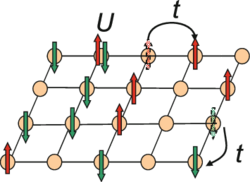
The first part of the Hamiltonian describes the ability of electrons to move between adjacent lattice sites. This is exactly the physics of the tight-binding model you've already studied. A term like describes the process of annihilating an electron at site and creating it at site —in other words, the electron "hops" from to . The strength of this hopping is given by the hopping integral, conventionally denoted as .
To ensure the Hamiltonian is Hermitian, we must include the reverse process as well. The full kinetic term is a sum over all pairs of nearest-neighbor sites, denoted by :
This term describes the delocalization of electrons across the lattice, which lowers their kinetic energy.
The Potential Term: On-Site Repulsion
The second part introduces the electron-electron interaction in its most simplified, local form. It assumes that the Coulomb repulsion is only significant when two electrons are on the exact same site. This is a reasonable approximation for well-separated atoms where the atomic orbitals are strongly localized.
We assign an energy cost, , for this "double occupancy". Using the number operators, we can write this elegantly. An energy penalty is applied if, and only if, a site is occupied by a spin-up electron () and a spin-down electron (). The term that captures this is . The total interaction energy is the sum over all lattice sites:
The Full Hamiltonian
Combining these two parts gives the celebrated single-band Hubbard model:
(Here, stands for the Hermitian conjugate, which is ).
Test your understanding!
Consider a simple two-site Hubbard model () with just one electron. Let the initial state be , where is the vacuum state (empty lattice). What is the state ? What does this tell you about the role of ?
Show answer
Let's apply the Hamiltonian term by term to .
-
The interaction term :
.
The state has one spin-up electron at site 1 and nothing at site 2. So, , but , , and .
Therefore, . The term gives zero. This makes physical sense: there is no double occupancy, so there is no repulsion energy. -
The kinetic term :
.
Let's look at the two parts:- . Using the anti-commutator , we have . So, . This is a state with the electron at site 2.
- , since . This term annihilates nothing at site 2, giving zero.
Combining the results, we get:
where is the state with the electron hopped to site 2.
For a single electron, only the kinetic term is active, and the Hamiltonian acts to move the electron to the neighboring site. The interaction term only plays a role when there are at least two electrons.
3. A More Formal Derivation
The intuitive construction above is powerful, but your preference for formal derivations warrants a look at how the Hubbard model emerges from a more fundamental starting point. It is, in fact, an effective model derived from the full many-electron Hamiltonian under a specific set of approximations. The following reading outlines this process.
This text from a graduate-level course provides a rigorous derivation of the Hubbard model. It starts from the general Hamiltonian for interacting electrons in a periodic potential and systematically applies approximations to arrive at the familiar form.
Please read sections 8.7.1 ('Hubbard model', pages 357-362). Pages 357-359: Follow the setup starting from the general second-quantized Hamiltonian. Pay attention to the transformation into the Wannier basis, which moves from field operators \psi(r) to site-based operators c_{i\sigma}. Pages 359-361: This section introduces the crucial approximations. Notice how the 'generalized Hubbard model' (Eq. 8.561) includes many types of interactions (inter-site repulsion V, exchange J, etc.). Pages 361-362: See how this generalized model is simplified to the standard Hubbard model (Eq. 8.574) by arguing that for many materials, the on-site repulsion U and nearest-neighbor hopping t are the dominant energy scales.
This more rigorous path highlights what we are neglecting:
- Interactions between different bands: We assume a single, isolated band near the Fermi level (the single-band approximation).
- Long-range Coulomb interactions: We neglect the repulsion between electrons on different sites (), on different bonds (), and other more complex terms.
- Hopping beyond nearest neighbors: We assume is zero for sites that aren't directly adjacent.
The Hubbard model's power lies in its simplicity. It isolates the most essential competition in many correlated materials: the battle between the electrons' desire to delocalize (driven by ) and their desire to stay apart to avoid Coulomb repulsion (driven by ).
4. The Central Conflict: Delocalization vs. Localization
The behavior of the Hubbard model is entirely governed by the ratio of the two parameters: .
-
When : The kinetic energy term dominates. The cost of double occupancy is small, so electrons hop relatively freely. The system behaves much like a normal metal, correctly described by band theory. The electrons are delocalized in Bloch waves that extend across the entire crystal.
-
When : The interaction term dominates. The energy cost for two electrons to meet on the same site is huge. To avoid this penalty, electrons will forgo hopping and become "stuck" on their own lattice sites, one per site. The system becomes an electrical insulator, not because of a filled band as in band theory, but because the strong repulsion prevents charge from moving. The electrons are localized.
This competition between kinetic energy and potential energy is the central drama of the Hubbard model and the key to understanding a vast range of phenomena, from magnetism to unconventional superconductivity.
Conclusion
In this lesson, we have formally derived the single-band Hubbard model, the canonical starting point for the study of strongly correlated electrons.
Key Takeaways:
- The Hubbard model is built in the language of second quantization, using creation and annihilation operators for electrons on lattice sites.
- It contains two terms: a kinetic hopping term with strength that delocalizes electrons, and a potential energy term with strength that penalizes on-site double occupancy.
- The model is an approximation of the full many-body Hamiltonian, valid when a single band dominates and interactions are primarily local.
- The physics is governed by the competition between and , represented by the ratio , which determines whether the electrons are delocalized (metallic) or localized (insulating).
Preview of the Next Lesson
We have set the stage by deriving the model and identifying its key conflict. In the next lesson, we will begin to solve it. We will analyze the Hubbard model in the extreme "atomic limit" where hopping is zero (). This will allow us to see precisely how strong Coulomb repulsion leads to an insulating state, even with a partially filled band—a state of matter known as a Mott insulator.