Recommended resources
The freely available resources this lesson will direct you to.
Hello! Welcome to your next lesson.
Introduction
In our last lesson, we explored how the Mexican state sponsored the Muralist movement to construct a new national identity after its revolution. This was a powerful example of art being used as a constructive, nation-building tool.
Today, we shift our focus to a radically different and darker model of state control over culture. We will examine the cultural policies of Nazi Germany, where the regime sought not only to promote a singular, rigid artistic vision but also to systematically vilify, confiscate, and destroy any art that contradicted its ideology.
This lesson directly addresses the learning outcome: Analyze Nazi cultural policy by contrasting state-endorsed propagandistic art with the condemnation of 'Degenerate Art'.
We will dissect the ideological foundations of this policy and then compare the two major exhibitions staged in Munich in 1937, which served as the centerpiece of this cultural war. Your background in design will be particularly relevant as we analyze how the Nazis intentionally curated the experience of viewing art to manipulate public opinion.
Our lesson will be structured as follows:
- The Ideological War on Modern Art: We'll explore why the Nazi regime saw modern art as a profound threat.
- A Tale of Two Exhibitions: We'll compare the state-sanctioned Great German Art Exhibition with the infamous Degenerate Art Exhibition.
- A Framework for Contrast: We'll build a comparative framework to analyze the key differences in style, subject, and purpose between these two categories of art.
1. The Ideological War on Modern Art
Before 1933, Germany, particularly during the Weimar Republic, was a global epicenter of the artistic avant-garde. Movements like Expressionism, Dada, and the Bauhaus school championed experimentation, subjectivity, and social critique. For the Nazis, this vibrant, diverse cultural landscape was a symbol of moral and racial decay.
The Nazi regime's assault on modernism was driven by a combination of factors: Adolf Hitler's personal resentment as a failed academic artist, a racial ideology that equated modernism with "un-German" influences, and a totalitarian need to control all forms of expression. Art that was abstract, critical, or emotionally complex was seen as dangerous because it encouraged individual interpretation—something an authoritarian state cannot tolerate.
To understand the context and the specific reasons behind this cultural purge, please watch the following segments from the documentary "Degenerate Art Show."
This video provides a detailed account of the Nazi campaign against modern art. These initial clips explain the cultural background, Hitler's motivations, and the regime's definition of 'degenerate' art.
Please watch the following four segments: Nazi Objectives and the Power of Art (2:25 - 3:33): Focus on the key questions the video poses about why the regime targeted art. Cultural Golden Age and the Rise of the Third Reich (3:47 - 8:34): Pay attention to the description of Weimar culture and the political climate that allowed the Nazis to rise to power. Why the Nazis Targeted Modern Art (11:44 - 15:25): This section is crucial. Note Hitler's personal history and his objection to art that requires interpretation. Defining Degenerate Art (15:25 - 18:48): Understand the specific criteria the Nazis used to label art as 'degenerate,' linking it to ideas of cultural decline and racial impurity.
As the video explains, the Nazis established the Reichskulturkammer (Reich Chamber of Culture) under Joseph Goebbels to enforce their ideology. This body systematically purged Jewish and modernist artists, professors, and museum directors. They confiscated thousands of artworks from public collections, creating a cultural vacuum they would fill with their own state-approved art.
2. A Tale of Two Exhibitions: Munich, 1937
The climax of this cultural war occurred in Munich in the summer of 1937 with two simultaneous, dueling exhibitions. This was a masterstroke of propaganda, designed to present the public with a clear, binary choice between "good" German art and "bad" degenerate art.
For a concise overview of this strategy, please read the following article from Smarthistory.
This article, 'Art in Nazi Germany,' clearly outlines the strategy behind the two exhibitions and highlights the internal confusion and contradictions within the Nazi party regarding artistic taste.
Please read the sections 'Nazi art policy,' 'A simple decision,' and 'What was actually on display in the two exhibitions?'. Focus on: The manipulative presentation of the Degenerate Art exhibition. The fact that even top Nazis like Goebbels initially favored modern art, revealing Hitler's personal taste as the ultimate arbiter. The stylistic contrast between the art in the two shows.
Now, let's look closer at each exhibition.
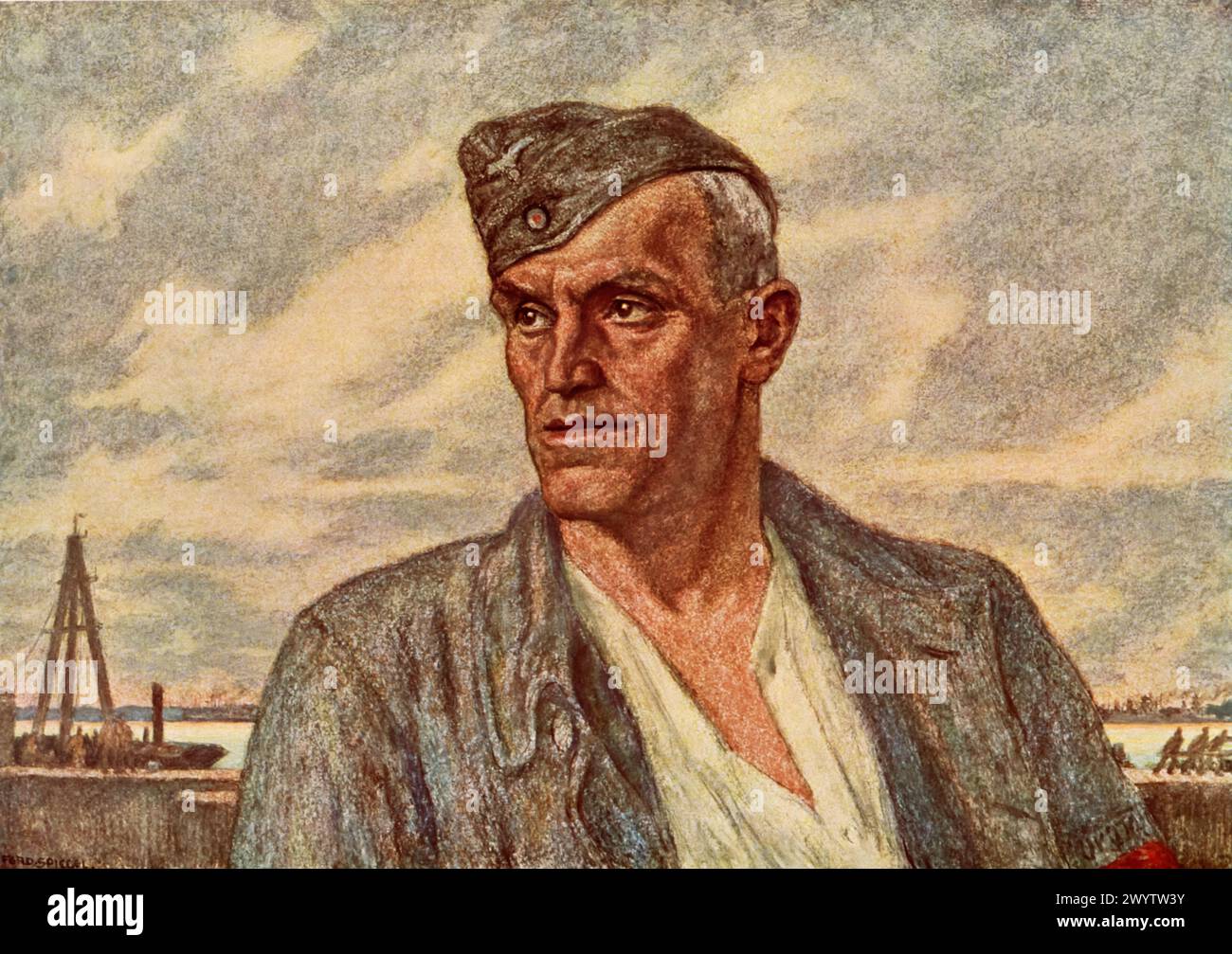
The Great German Art Exhibition
This exhibition was held in the newly constructed Haus der Deutschen Kunst (House of German Art), a monumental, neoclassical building designed to evoke power and permanence. The art inside was meant to embody the Nazi ideal.
- Style: Strictly academic, realistic, and easily legible. It drew heavily on classical Greek and Roman aesthetics.
- Subjects: Heroic soldiers, idealized "Aryan" families, bountiful peasant life, and serene, idyllic landscapes. The human form was depicted as strong, healthy, and racially pure.
The Entartete Kunst (Degenerate Art) Exhibition
Just down the street, the Nazis staged a counter-exhibition. Its purpose was not just to display rejected art, but to actively humiliate it.
From your background in user experience design, you can appreciate that this was a masterclass in malicious design. The exhibition was deliberately staged in a dark, cramped building. Artworks were unframed, hung chaotically, and surrounded by derogatory slogans painted on the walls, such as "Madness becomes method" or "Nature as seen by sick minds." The entire experience was engineered to make the visitor feel uncomfortable and to associate that discomfort with the art itself.
- Style: Encompassed all of modernism—Expressionism, Cubism, Surrealism, Dada. It was art that prioritized emotional expression, abstraction, and critical thinking over realistic depiction.
- Subjects: The horrors of war, the complexities of urban life, psychological portraits, and abstract forms. Artists like Otto Dix, who depicted the brutal reality of World War I, were especially condemned for challenging the Nazi myth of heroic warfare.

To see how these exhibitions were orchestrated and received, let's return to the "Degenerate Art Show" video.
These segments detail the design and content of the two exhibitions, highlighting the stark contrast in their presentation and purpose.
Please watch the following two segments: The Degenerate Art Show: Organization and Presentation (26:25 - 33:55): Note the specific techniques used to discredit the art, from the venue choice to the wall text. The Great German Art Exhibition (36:08 - 39:42): Observe the characteristics of the approved art—its classical style, heroic subjects, and idealized forms.
3. A Framework for Contrast
To fulfill the learning outcome, let's synthesize this information into a clear comparative framework. This structure helps to systematically analyze the opposing values embedded in each category of art.
| Feature | State-Endorsed "Aryan" Art | Condemned "Degenerate" Art |
|---|---|---|
| Purpose | Propaganda: To promote Nazi ideology, inspire conformity, and project an image of a powerful, eternal Reich. | Vilification: To serve as a negative example, ridicule modernism, and define what German culture was not. |
| Aesthetic Style | Academic Realism & Neoclassicism: Clear, legible, and idealized. Based on classical traditions. | Modernism: Expressionist, abstract, subjective, and experimental. Challenged traditional forms. |
| Core Values | Order, obedience, racial purity, militarism, health, community (Volksgemeinschaft). | Individuality, emotion, intellectualism, critique, internationalism, psychological depth. |
| Subject Matter | Heroic soldiers, idealized nudes, perfect "Aryan" families, idyllic landscapes, "Blood and Soil" themes. | The trauma of war, social inequality, urban alienation, religious angst, abstract forms, subjective portraits. |
| Role of the Artist | A skilled craftsperson in service of the state; a promoter of official ideology. | An individual visionary or social critic; a "degenerate" threat to cultural purity. |
| Intended Viewer Experience | To feel awe, national pride, and a sense of belonging to a powerful, ordered collective. | To feel confusion, disgust, and ridicule; to reinforce the viewer's "healthy" German sensibilities. |
Conclusion
Nazi cultural policy was a totalitarian project aimed at achieving absolute control over the hearts and minds of the German people. It was a dual strategy of promotion and eradication. By staging the Great German Art Exhibition and the Degenerate Art Exhibition side-by-side, the regime created a powerful, albeit false, dichotomy between a "healthy," heroic, and racially pure art and a "diseased," chaotic, and "un-German" modernism.
- Key Takeaways:
- Nazi cultural policy was rooted in a racial ideology that condemned modern art as "degenerate"—a product of supposed moral, mental, and racial impurity.
- The regime contrasted state-endorsed art, characterized by heroic realism and classical ideals, with "degenerate" art, which included all forms of the modernist avant-garde.
- The 1937 exhibitions in Munich were a calculated propaganda event designed to manipulate public opinion by glorifying one form of art while viciously ridiculing the other.
- The criteria for "good" and "bad" art were ultimately determined by Hitler's personal taste and the regime's totalitarian need to eliminate ambiguity and individual interpretation.
Ironically, the Degenerate Art exhibition attracted millions more visitors than its "great" counterpart, and the art it sought to destroy has become the celebrated canon of 20th-century modernism. The Nazi-approved art, by contrast, is now remembered almost exclusively as a historical artifact of a brutal regime.
Preview of the Next Lesson
The end of World War II did not end the use of art as a political tool. In our next lesson, we will explore how the ideological battleground shifted to the Cold War. We will analyze the political undertones of American Abstract Expressionism, a movement that, despite its lack of overt political content, was championed by some as a symbol of American freedom and individualism in the cultural struggle against the Soviet Union.