Recommended resources
The freely available resources this lesson will direct you to.
Hello! Welcome to your next lesson.
In our previous modules, we've traced the relationship between art and power through ancient empires, the Renaissance, and the age of revolutions. We've seen how patronage, ideology, and critique have shaped artistic production. Now, we enter the 20th century's great ideological battleground: the Cold War.
This lesson addresses the learning outcome: Analyze the political undertones of American Abstract Expressionism in the context of the Cold War.
We will investigate a fascinating paradox: how a radically new, seemingly apolitical style of painting, created by artists who were often outsiders and critics of the establishment, was co-opted and promoted internationally as a potent symbol of American freedom. We will uncover the network of institutions, individuals, and covert operations that turned abstract art into a weapon in a global contest for "hearts and minds."
1. What is Abstract Expressionism?
First, let's establish a visual understanding of the art form itself. The movement, which emerged in New York in the 1940s, was America's first major contribution to the international avant-garde.
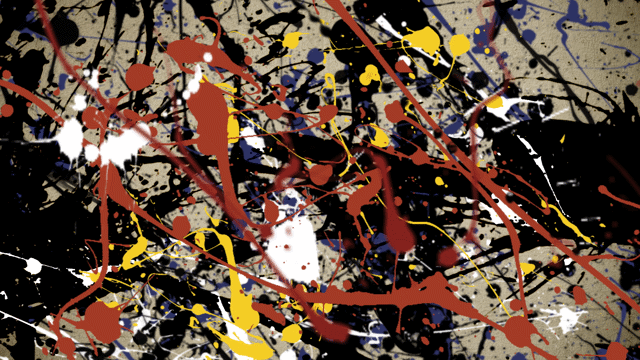
Abstract Expressionism is not one single style, but it is generally characterized by:
- Large-scale canvases: The paintings are often monumental, intended to envelop the viewer.
- Non-representational forms: The art does not depict recognizable objects or scenes.
- Emphasis on process: The physical act of painting—splashing, dripping, gestural brushstrokes—is central to the work's meaning.
- Individualism and emotion: The art was seen as a direct expression of the artist's inner world, their subconscious, and their personal struggles.
Artists like Jackson Pollock, Willem de Kooning, and Mark Rothko were at the forefront of this movement. They were forging a new artistic language, breaking free from European traditions and declaring a new, self-confident American cultural identity.
2. The Cultural Cold War
To understand the political significance of this art, we must understand the context in which it flourished. The Cold War (c. 1947–1991) was primarily an ideological struggle between two superpowers:
- The United States: Championing capitalism, liberal democracy, and individualism.
- The Soviet Union: Promoting communism, state control, and collectivism.
This was not just a military and economic rivalry; it was also a cultural war. Each side sought to prove the superiority of its system by showcasing its cultural achievements.
On the Soviet side, the official artistic doctrine was Socialist Realism. This style was figurative, easily understandable, and its purpose was to glorify the state, the worker, and the communist project. It was, by definition, propaganda.
The United States needed a cultural counterpoint. It needed an art form that could represent everything Soviet art was not: free, individualistic, innovative, and not subject to state control. The radical, non-figurative, and intensely personal nature of Abstract Expressionism made it a perfect, if unlikely, candidate.
3. The Unlikely Weapon: MoMA, the Rockefellers, and the CIA
The idea that the U.S. government would promote this art was initially absurd. Many of the artists had past associations with leftist and communist-leaning groups. In the McCarthy era of the 1950s, they were viewed with suspicion. President Truman famously dismissed modern art as "the vaporings of half-baked lazy people."
So, how did this art become a tool of foreign policy? The answer lies in a powerful and uniquely American structure: the alliance between private wealth, cultural institutions, and government intelligence agencies.
The following reading from Eva Cockcroft's seminal 1974 article in Artforum was one of the first to meticulously document these connections. It reveals how the promotion of Abstract Expressionism was not a coincidence but a "consciously forged" strategy.
Abstract Expressionism, Weapon of the Cold War
Please read the following sections from Eva Cockcroft's article, 'Abstract Expressionism, Weapon of the Cold War.' This text provides the critical evidence for how and why this art movement was deployed in the Cold War. It details the key institutions and individuals involved.
As you read, focus on the answers to these questions: What was the unique role of private museums like MoMA in the U.S. art world? (Find the section starting with 'Museums, for their part, enlarged their role...') Who were the key figures and families behind MoMA, and what were their connections to U.S. foreign policy? (Find the section starting with 'Links between cultural cold war politics...') Why was Abstract Expressionism considered the 'ideal style' for propaganda? (Find the section starting with 'In the world of art, Abstract Expressionism constituted the ideal style...') How did MoMA step in when the U.S. government was unable to promote art abroad due to political pressure? (Find the section starting with 'The U.S. Government simply could not handle the needs...') What is the author's final conclusion about the relationship between art and politics in this context? (Find the final section of the article, starting with 'The alleged separation of art from politics...')
4. Deconstructing the Power Structure
Cockcroft's article reveals a complex system of influence that operated outside of official government channels. Let's break down the key components you just read about, which align with your interests in structure and power.
- The Institution: The Museum of Modern Art (MoMA) was the central hub. Unlike state-funded European museums, it was a private institution governed by a board of trustees composed of America's corporate and financial elite.
- The Patrons: The Rockefeller family, whose fortune came from Standard Oil, were the primary founders and funders of MoMA. Nelson Rockefeller, who served as MoMA's president, was also a key figure in U.S. foreign policy, particularly in Latin America where his family had significant business interests.
- The Strategists: Figures like Alfred H. Barr Jr., MoMA's influential director, masterfully shaped the narrative. He argued that abstract art was the art of free societies, while realistic art was the domain of totalitarian regimes like Nazi Germany and the Soviet Union.
- The Covert Connection: The Central Intelligence Agency (CIA) recognized the propaganda value of cultural freedom. Figures like Tom Braden, who went from being MoMA's executive secretary to supervising the CIA's cultural activities, helped facilitate covert funding for international art exhibitions. This was necessary to bypass a Congress suspicious of modern art and artists with leftist histories.
In essence, MoMA functioned as a quasi-state agency for cultural diplomacy. When right-wing political pressure forced the official U.S. Information Agency (USIA) to cancel exhibitions, MoMA—backed by Rockefeller money and with a quiet nod from the CIA—stepped in to organize and fund landmark international tours of Abstract Expressionist art, such as "The New American Painting."
The genius of this strategy was that the art's lack of overt political content was its greatest political strength. It didn't need to depict freedom; it was presented as the embodiment of it. The artist, working with complete individual autonomy, became a symbol of the "free world," in stark contrast to the state-controlled artist of the communist bloc. The artists themselves were largely unaware of this political deployment; their personal quests for expression were simply a valuable resource to be leveraged.
Conclusion
This lesson reveals a sophisticated and subtle instance of art's entanglement with power. It moves beyond simple patronage to a complex system of institutional and covert influence.
Key Takeaways:
- Abstract Expressionism was promoted internationally as a symbol of American freedom, creativity, and individualism during the Cold War.
- This promotion was not accidental but was a deliberate strategy orchestrated by a network of powerful figures at the intersection of private wealth (the Rockefellers), cultural institutions (MoMA), and intelligence agencies (the CIA).
- The movement's "apolitical" and individualistic character was its primary political asset, providing a stark contrast to the state-mandated "Socialist Realism" of the Soviet Union.
- This case study demonstrates how even the most abstract and personal art can acquire profound political undertones when viewed within a specific historical and ideological context.
Preview of the Next Lesson:
While Abstract Expressionism was used to project an image of American freedom abroad, our next lesson will look at an art movement that turned its critical eye inward. We will explore how Pop Art, particularly the work of Andy Warhol, critiqued the post-war consumer culture and mass media that were central to the "American way of life."