Recommended resources
The freely available resources this lesson will direct you to.
Hello! Welcome to the eighth and final lesson of our first module, where we've been exploring the core architectural patterns of security products.
In our previous lesson, we designed a sophisticated security event processing pipeline. We architected it to normalize, enrich, and route vast streams of telemetry. However, we designed it from the perspective of a single organization. A crucial question for building any commercially viable SaaS security product remains: how do you build this to securely and efficiently serve hundreds or thousands of customers on shared infrastructure?
This brings us to today's learning outcome: Analyze multi-tenant isolation trade-offs in security products across data, configuration, and performance dimensions.
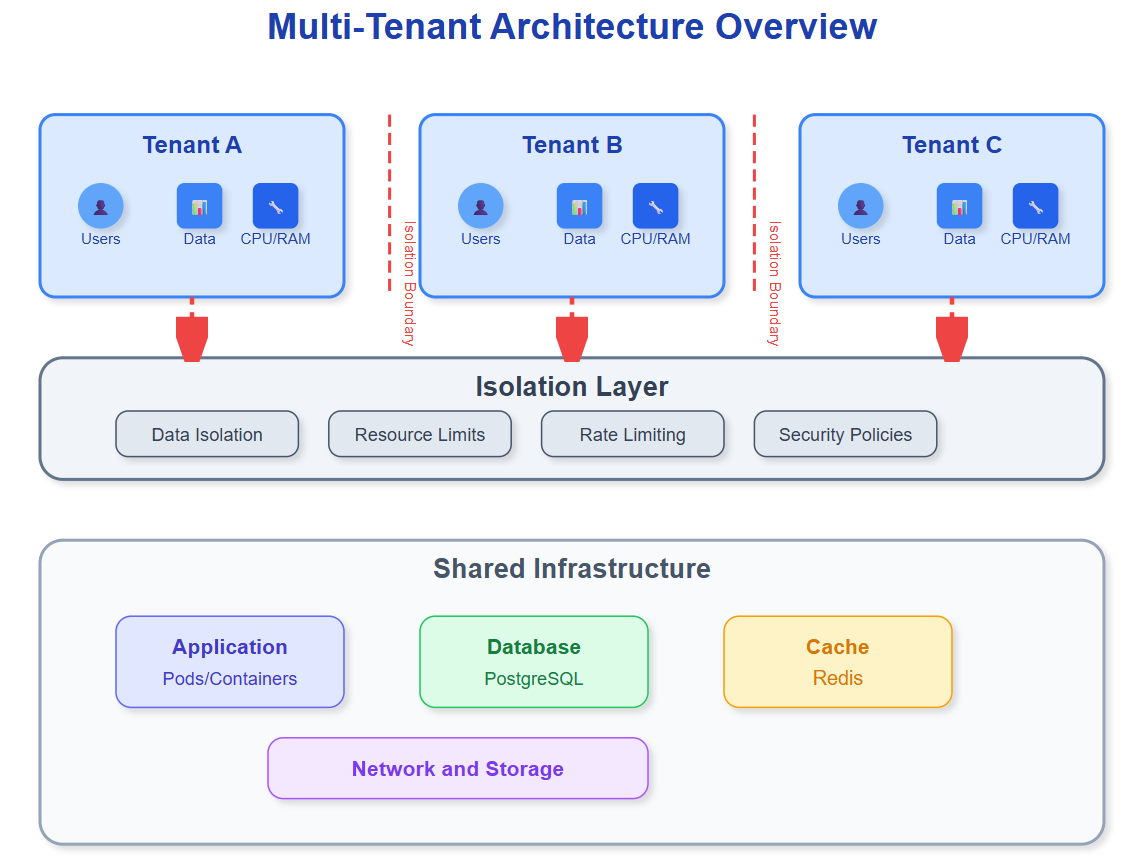
Multi-tenancy is a fundamental architectural consideration for any SaaS product. It presents a core tension: the drive for cost-efficiency and operational simplicity by sharing resources versus the absolute need for security, data privacy, and performance guarantees for each customer (tenant). Today, we'll dissect this challenge from first principles, examining the architectural patterns and trade-offs you must navigate when designing a multi-tenant security service.
1. The Core Multi-Tenancy Models: Silo vs. Pool
At the highest level, multi-tenant architecture is a spectrum between two opposing philosophies: the Silo model and the Pool model.
- Silo Model: Each tenant is given a completely separate, dedicated stack of resources (e.g., their own virtual machines, databases, VPCs). This offers maximum isolation but comes at a high cost and operational overhead.
- Pool Model: Multiple tenants share the same infrastructure components. This is highly cost-effective and scalable but introduces significant complexity in ensuring strict isolation between tenants.
To begin, let's get a foundational understanding of what tenant isolation is and the fundamental differences between the silo and pool approaches.
AWS re:Invent 2019: SaaS tenant isolation patterns (ARC372-P)
The video 'SaaS tenant isolation patterns' from AWS Events provides an excellent, in-depth exploration of this topic. We'll start with the sections that introduce the concept and the core models.
Please watch the following two segments: What is Tenant Isolation? (00:00 - 02:40): This introduces the concept of tenant isolation and why it is a non-negotiable, foundational principle for any SaaS business. Silo vs. Pool Models (08:45 - 10:25): This section clearly contrasts the 'silo' approach (isolated resources) with the 'pool' approach (shared resources), setting the stage for our entire discussion.
Now, let's dive into the three critical dimensions of isolation: data, performance, and configuration.
2. Dimension 1: Data Isolation
Data isolation is arguably the most critical dimension. A failure here, where Tenant A can see Tenant B's data, is an existential threat to a SaaS business. The choice of database architecture is the primary control for data isolation. There are three common patterns, which represent a spectrum from the silo to the pool model.
[PDF] Multi-Tenant SaaS Architectures: Design Principles and Security ...
This paper, 'Multi-Tenant SaaS Architectures', provides a clear and structured breakdown of database partitioning strategies. It's an excellent resource for understanding the trade-offs in data isolation.
Please read Section II, 'DATABASE PARTITIONING STRATEGIES' (starting on page 30). Pay close attention to the descriptions and trade-offs of the three main models: Dedicated Database per Tenant Shared Database, Schema-per-Tenant Shared Database, Table-per-Tenant (This is often implemented with a tenant_id column in a shared table, as discussed in other resources). Focus on the table comparing single and multi-tenant DBs and the analysis of each model's implications for scalability, security, and cost.
Let's summarize the trade-offs from the reading:
| Model | Data Isolation | Cost & Efficiency | Complexity | Use Case |
|---|---|---|---|---|
| Database-per-Tenant (Silo) | High. Strongest physical and logical separation. | Low. Highest infrastructure cost and resource overhead. | High. Requires automation for provisioning, migration, and backups for each tenant. | Regulated industries (healthcare, finance), government clients, premium enterprise tiers. |
| Schema-per-Tenant (Hybrid) | Medium. Strong logical separation, but shares DB instance resources (CPU, memory). | Medium. Good balance of resource sharing and isolation. | Medium. Migrations must be applied to all schemas. Risk of cross-schema queries if not careful. | General purpose enterprise SaaS applications. |
Shared Table with tenant_id (Pool) |
Low. Relies entirely on application logic and database policies to enforce separation. | High. Most cost-effective and resource-efficient model. | Low (at first). Easy to start, but security becomes a major challenge. Risk of coding errors leading to data leaks. | B2C apps, startups, and services with many small tenants. |
Fine-Grained Data Isolation
In the pooled models, you can't rely just on developers always remembering to add WHERE tenant_id = ? to every query. You need architectural enforcement.
- Row-Level Security (RLS): Many modern databases (like PostgreSQL) support RLS. This is a database feature that applies a security policy to every query automatically, ensuring a user from Tenant A can only see rows that match their tenant identity, even if a query is written incorrectly. The AWS video you watched earlier touches on this with Aurora Postgres (from 38:00).
- Cryptographic Isolation: For the highest level of security in a shared data store, you can encrypt each tenant's data with a unique, tenant-specific key. Even if a breach allows an attacker to dump the entire database, they cannot decrypt data without compromising every single tenant's key.

3. Dimension 2: Performance Isolation
Performance isolation addresses the "noisy neighbor" problem: a situation where one tenant's heavy usage consumes a disproportionate amount of shared resources (CPU, I/O, network), degrading the service for all other tenants.
This is a classic distributed systems challenge. A fantastic real-world example comes from Cloudflare, who detailed their journey in providing performance isolation for their multi-tenant database environment.
Performance isolation in a multi-tenant database environment
The Cloudflare blog post 'Performance isolation in a multi-tenant database environment' is a superb case study. It moves from a theoretical problem to concrete engineering solutions.
Please read the entire blog post. It's a journey through increasingly sophisticated solutions: Problem: Understand how throughput and latency are affected in a shared environment. Previous Solution: Note the drawbacks of their initial manual, reactive approach. New & Future Solutions: This is the core. Focus on the architectural patterns they propose for solving the problem proactively: Gateway Throttling (at the proxy layer) Congestion Avoidance (an adaptive algorithm based on latency) Tenant Resource Quotas (allocating a 'slice' of resources) Gateway Query Queuing (prioritizing requests)
The key takeaway from Cloudflare's experience is that effective performance isolation is often achieved at a gateway or proxy layer that sits in front of the shared resource. This layer can inspect requests, monitor tenant-specific resource consumption, and then apply controls like:
- Rate Limiting: Limiting the number of requests a tenant can make per second.
- Concurrency Throttling: Limiting the number of concurrent connections or in-flight requests for a tenant.
- Queuing & Prioritization: Placing a noisy tenant's requests in a lower-priority queue during periods of high load.
- Adaptive Throttling: Dynamically adjusting a tenant's limits based on real-time system health metrics, like the congestion avoidance algorithm described in the blog.
4. Dimension 3: Configuration Isolation
While data and performance isolation focus on shared infrastructure, configuration isolation is about ensuring that each tenant's unique settings—their WAF rules, their access policies, their user roles—are kept separate and only apply within their own context.
A failure in configuration isolation could mean Tenant A's firewall rules accidentally get applied to Tenant B's traffic, or an administrator from one company could create users in another.
The principles for achieving configuration isolation are similar to data isolation:
- Tenant-Aware Data Model: Configuration settings are stored in your database (whether siloed or pooled) and are always associated with a
tenant_id. - Tenant-Scoped APIs: The management APIs used to create, read, update, and delete configurations must be strictly sandboxed. An authenticated API call from a user must have its tenant identity validated, and all subsequent database operations must be scoped to that tenant.
- Tenant-Aware Policy Engine: Any service that uses the configuration (like a WAF applying rules or a ZTNA service evaluating access) must first fetch the configuration for the specific tenant it is processing a request for. It must never load a global or cross-tenant set of rules. The AWS video discusses this concept as dynamically generating and applying tenant-specific IAM policies at runtime (from 18:21).
5. Bringing It All Together: Choosing Your Strategy
There is no single "best" multi-tenancy architecture. The right choice is a series of trade-offs driven by business, technical, and compliance requirements.
AWS re:Invent 2019: SaaS tenant isolation patterns (ARC372-P)
Let's return to the AWS video to see how these factors influence the final architectural decision and to get a summary of the trade-offs.
Please watch these final segments: Influencing Factors (05:33 - 08:45): This section covers the business drivers that dictate your isolation strategy, such as service tiers, compliance needs (e.g., HIPAA, GDPR), and performance requirements. Summary of Trade-offs (44:32 - 47:01): This is a concise summary of the pros and cons of the silo vs. policy-based (pool) approaches. The Importance of Testing (47:01 - 48:24): A crucial final point. You must have an automated way to continuously test that your isolation boundaries are actually working.
In practice, many large-scale SaaS products use a hybrid model. They might offer a pooled architecture as their standard, cost-effective tier, while providing a premium, high-security siloed architecture for large enterprise customers with strict compliance needs who are willing to pay for it.
Conclusion
In this lesson, we've deconstructed the complex challenge of designing multi-tenant systems. We've seen that it's not a single decision but a series of trade-offs across data, performance, and configuration.
Key Takeaways:
- Multi-tenancy balances cost-efficiency (pool model) against maximum isolation (silo model).
- Data Isolation is paramount and primarily driven by database architecture: database-per-tenant, schema-per-tenant, or shared-table with a
tenant_id. Advanced techniques like RLS and cryptographic isolation are critical for pooled models. - Performance Isolation aims to solve the "noisy neighbor" problem using techniques like rate limiting, concurrency throttling, and resource quotas, often implemented at a gateway or proxy layer.
- Configuration Isolation ensures that one tenant's settings (e.g., policies, rules) do not affect another, enforced through a tenant-aware data model and strict API scoping.
- The optimal strategy is often a hybrid approach, dictated by factors like cost, target customer, performance guarantees, and regulatory compliance.
This lesson concludes our first module on the core architectural patterns in security products. You now have a solid foundation in proxies, policy engines, analysis modes, data collection, and multi-tenancy.
Preview of the Next Module
With these foundational patterns in our toolkit, we are now ready to apply them to build specific security products. In our next module, we will begin with one of the most common and critical security services: the Web Application Firewall (WAF). Our first lesson will be: Architect the data flow and component placement for reverse proxy, transparent bridge, and cloud-hosted WAF deployment modes.