Recommended resources
The freely available resources this lesson will direct you to.
- The lost art of accomplishment without burnout | Cal Newport for Big Think +www.youtube.com
- AMA #11: Improve Task Switching & Productivity and Reduce Brain Fogwww.youtube.com
- Maximizing Focus: Sophie Leroy's Attention Residue Researchwww.unpluggedpsych.com
- Principles of cognitive control over task focus and task switching - PMCpmc.ncbi.nlm.nih.gov
Introduction
Welcome to the sixth lesson in our course on attention management. In our last session, we fortified your workspace against external, stimulus-driven distractions by designing your physical and digital environments for focus. You learned to be an architect of your attention, making focus the path of least resistance.
However, even in a perfectly quiet room with all notifications disabled, a significant source of distraction remains: the one we generate internally. This is especially relevant given your daily challenge of navigating 2-3 major context shifts.
Today, we will address the learning outcome: to explain the concept of attention residue and its impact on performance when switching between major contexts. We will explore the cognitive cost of moving your attention from one complex task to another, a phenomenon that leaves a mental "fog" that degrades your performance. This is the hidden tax on multitasking and rapid context switching.
1. Defining Attention Residue
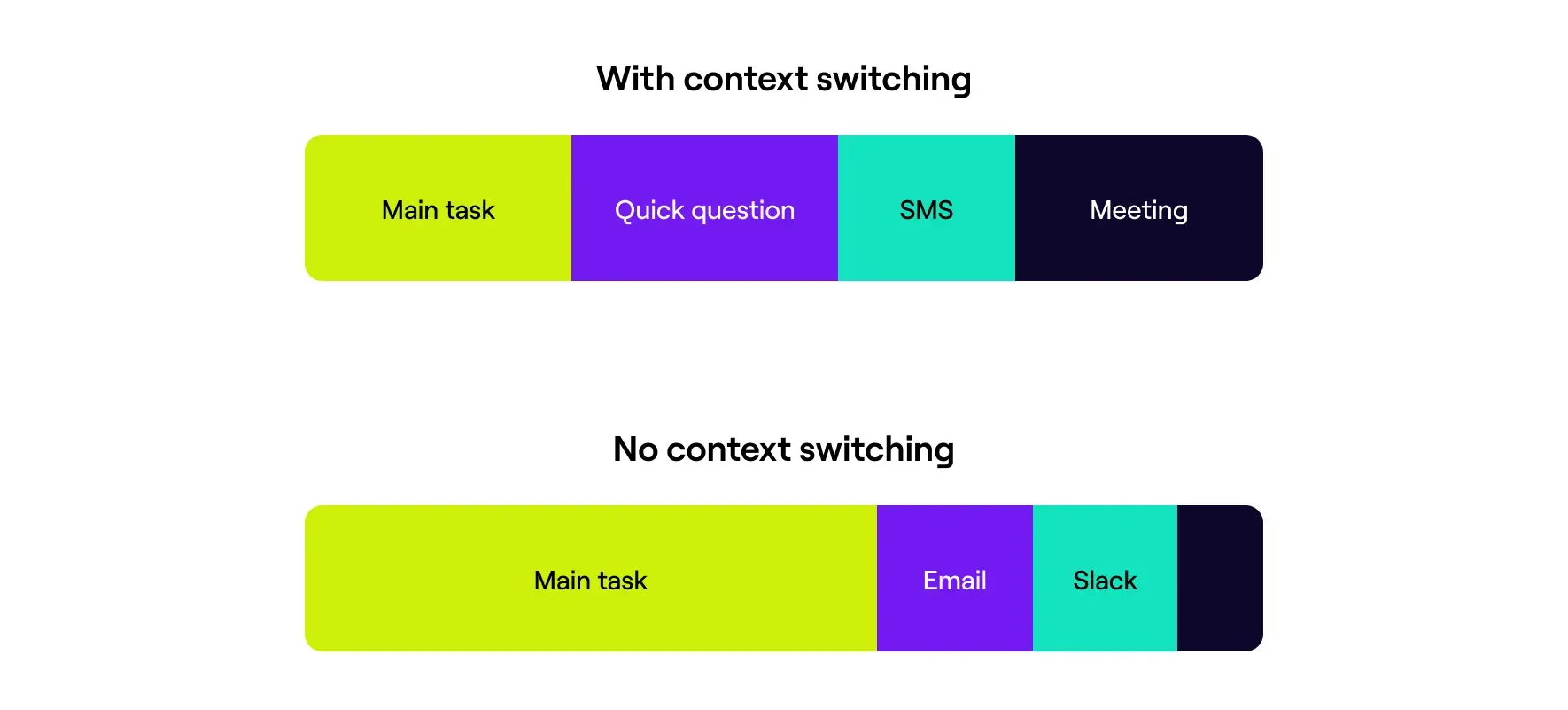
The term "attention residue" was coined by researcher Sophie Leroy to describe what happens when you switch from Task A to Task B: part of your attention stays stuck on Task A. Your brain doesn't just cleanly switch off one process and boot up another. Instead, thoughts about the previous task linger, occupying valuable cognitive resources.
To get a clear understanding of this concept and its originator, the following resource provides an excellent summary.
Maximizing Focus: Sophie Leroy's Attention Residue Research
This article from Unplugged Psychology provides a concise introduction to attention residue, its impact on productivity, and the foundational research by Sophie Leroy.
Please read the first three sections of the article: At the beginning of the text, read the introductory section that defines attention residue. Next, read about productivity impacts in the section 'The Impact of Attention Residue on Productivity'. Below that, review the study findings in 'Sophie Leroy’s Research on Attention Residue'. Focus on understanding the core definition and how it leads to decreased performance and efficiency.
Cal Newport, a computer scientist you may be familiar with, also provides a succinct explanation of this phenomenon from a productivity standpoint.
The lost art of accomplishment without burnout | Cal Newport for Big Think +
In this short clip, Cal Newport frames attention residue as a direct consequence of violating a key principle of effective knowledge work: doing fewer things at once.
About two minutes in, watch the segment on doing fewer things. Pay close attention to how he describes attention residue as a 'self-imposed reduction of cognitive capacity' that is both exhausting and detrimental to the quality of your work.
In short, attention residue is the cognitive cost of task switching. It means that when you are working on Task B, you are doing so with a partially-occupied mind, leading to slower work, more errors, and a subjective feeling of frustration.
2. The Quantifiable Impact of Switching
One of the most compelling aspects of Leroy's research is that it moves the concept of attention residue from a vague feeling to a measurable drag on performance. For someone like you who frequently switches between major contexts, understanding the numbers can be revealing.
Let's return to the Unplugged Psychology article and look at the data.
Maximizing Focus: Sophie Leroy's Attention Residue Research
This section of the article contains a table that summarizes the key quantitative findings from research on attention residue.
Please read the section 'The Role of Task Switching in Attention Residue'. Focus specifically on the table provided just before the explanatory text. Note the metrics for 'Task Performance Decrease' and 'Time to Regain Full Focus'.
The findings are stark:
- Performance can drop by 20-40% following a switch.
- It can take up to 15 minutes to fully disengage from the previous task and regain full focus.
Consider your workday with 2-3 major context shifts. If each switch incurs even a conservative 20% performance hit for the next 15-20 minutes, the cumulative loss of productive capacity over a day, week, or year is substantial. This isn't about a lack of discipline; it's a fundamental cognitive bottleneck.
3. The Neuroscience of Task Switching
Your preference for understanding the "why" is crucial here. The performance cost of attention residue is not an abstract economic idea; it's a direct consequence of the brain's underlying architecture.
The Brain's Reconfiguration Time
Switching tasks isn't like flipping a light switch. It's more like turning an aircraft carrier. It requires disengaging one complex set of neural circuits and engaging another. Neuroscientist Andrew Huberman provides an accessible explanation of this biological reality.
AMA #11: Improve Task Switching & Productivity and Reduce Brain Fog
In this clip from a Q&A session, Dr. Huberman explains the neural mechanics of task switching, emphasizing the 'push-pull' nature of brain activity and why immediate focus on a new task is biologically unrealistic.
Please watch two consecutive clips: Engaging/Disengaging Circuits: Focus on the idea that your brain must both engage new circuits and disengage or inhibit old ones, and that this process takes time. The 5-10 Minute Transition: Note his argument that expecting immediate focus is an 'unfair burden' to place on your neural circuits and that a transition period is a biological necessity.
This gives us a foundational principle: task switching has a non-zero time cost because neural networks must physically reconfigure. Attention residue is the subjective experience of this reconfiguration process.
A Deeper Dive: Cognitive Stability vs. Flexibility
Given your background in neuroscience and computer science, we can explore a more formal model from cognitive psychology. Traditionally, focus (stability) and the ability to switch (flexibility) were seen as two ends of a single spectrum—a trade-off where being more focused made you less flexible, and vice versa. More recent research suggests this is not the case, and this distinction is key to truly understanding attention residue.
Principles of cognitive control over task focus and task switching - PMC
This research paper, 'Principles of cognitive control over task focus and task switching,' offers a sophisticated model. It argues that the ability to focus and the ability to switch are independent mechanisms. This provides a powerful explanation for why residue from a previous task can persist.
Please read the following three parts of the paper. This is a dense academic text, so focus on the conceptual takeaways: Introduction: Grasp the core definitions of cognitive stability (the ability to focus on a task) and cognitive flexibility (the ability to switch focus). In the section 'Adaptation of stability and flexibility', read the paragraph describing the switch cost: the measurable performance drop when changing tasks. This is the formal term for the impact we are studying. Finally, and most importantly, read the section 'Independent mechanisms of stability and flexibility'. The central argument here is that stability and flexibility are not an obligatory trade-off but are regulated by independent processes. Focus on understanding why the author argues against the one-dimensional view.
Here is the crucial insight this paper provides for explaining attention residue:
- Focus on Task A is managed by your brain's "cognitive stability" system.
- Switching to Task B is managed by your "cognitive flexibility" system.
Because these systems are independent, activating your flexibility system to initiate a switch does not automatically shut down the stability system that was maintaining focus on Task A. Attention residue is the lingering activation of the Task A stability system, which continues to consume resources and interfere with the new task set for Task B.
This model explains why even a willed, deliberate switch to a high-priority task is still plagued by thoughts of the previous one. It is a feature of your cognitive architecture.
Conclusion
In this lesson, we have dissected the internal challenge of context switching. You now have a multi-layered understanding of attention residue, from its practical definition to its neurological and cognitive underpinnings.
Key Takeaways:
- Attention Residue is the lingering of thoughts about a previous task after you have switched to a new one, creating a "brain drain" that impairs performance.
- The Impact is Quantifiable, with research showing performance drops of 20-40% and recovery times of up to 15 minutes after a single switch.
- The Neuroscientific "Why" is that the brain requires time to disengage neural circuits related to the old task and engage those for the new one.
- A Formal Cognitive Model explains this by positing that cognitive stability (focus) and cognitive flexibility (switching) are independent processes. Attention residue is the persistence of the old stability state after a switch has occurred.
Preview of the Next Lesson:
We have thoroughly diagnosed the problem. Now, we turn to the solution. Knowing that attention residue is a natural consequence of your cognitive architecture, how can we work with that architecture, not against it? In our next lesson, you will learn to develop 'shutdown' and 'startup' rituals to minimize attention residue during context switches, providing you with a practical tool to manage this challenge.