Recommended resources
The freely available resources this lesson will direct you to.
Hello! Welcome back to our course.
In our last lesson, we built the foundation of your personal learning system by choosing and setting up a note-taking tool—Obsidian for networked thought or Notion for structured notes. You now have a system designed to capture and process new information effectively. However, capturing knowledge is only half the battle. To truly "debug your learning process," we need to ensure that what you learn actually sticks.
This brings us to today's lesson, where we'll focus on the crucial act of review. Our learning outcome is to select appropriate review methods (e.g., flashcards, free recall, practice problems) for different types of knowledge. You'll learn that effective review isn't about passively re-reading your notes; it's an active process of pulling information out of your memory. Just as different design problems require different research methods, different types of knowledge demand different review strategies.
1. A Framework for Knowledge: Declarative vs. Procedural
Before we can choose the right tool for the job, we need to understand the material we're working with. In learning, knowledge can be broadly categorized into two types: declarative and procedural. Understanding this distinction is the key to selecting the right review method.

Let's break this down with examples relevant to your goals:
-
Declarative Knowledge ("Knowing What"): This is knowledge of facts, concepts, and ideas. It's the information you can state or "declare."
- UX Example: Recalling Jakob Nielsen's 10 Usability Heuristics.
- Coding Example: Knowing the definition and syntax for a CSS
grid-template-areasproperty. - Data Analysis Example: Defining what a p-value represents in a statistical test.
-
Procedural Knowledge ("Knowing How"): This is the knowledge of how to perform a skill or task. It's applied, action-oriented knowledge.
- UX Example: Conducting a heuristic evaluation of a user interface.
- Coding Example: Building a responsive two-column layout using CSS Grid.
- Data Analysis Example: Running an A/B test and interpreting the results to inform a design change.
As you can see, mastering a field like UX or data analysis requires building both types of knowledge. You need the facts (declarative) to inform your actions (procedural). Our review strategy must therefore address both.
2. Reviewing Declarative Knowledge: Consolidating the "What"
To build a strong foundation of factual and conceptual knowledge, you need review methods that force you to actively retrieve definitions, facts, and connections. Here are three powerful techniques.
A. Smart Flashcards: For Facts and Definitions
Flashcards are often used inefficiently, leading to the memorization of isolated, decontextualized facts. To make them truly effective, they should be used strategically for specific pieces of declarative knowledge.
Let's watch a short clip that critiques the common pitfalls of flashcard apps and highlights what effective retrieval practice should entail.
What Study Gurus Get Wrong About Learning
In this video, 'What Study Gurus Get Wrong About Learning,' Dr. Benjamin Keep explains why simple flashcard systems can be a weak form of learning and points toward more effective retrieval techniques.
Please watch from 04:02 to 05:12 to understand the limitations of basic flashcards. Then, watch from 08:08 to 09:53 to see what makes retrieval practice truly effective—moving beyond isolated facts to synthesis and application.
As the video argues, the goal isn't just to remember facts in isolation but to understand and apply them. Therefore, use flashcards for the building blocks of knowledge, but don't stop there.
- When to use them: For vocabulary (e.g., "What is a 'user journey map'?"), syntax (e.g., "What is the correct syntax for a Python f-string?"), or key facts (e.g., "What are the four principles of WCAG?").
- How to use them:
- One question per card: Keep it simple and specific.
- Test yourself actively: Always try to recall the answer before flipping the card.
- Combine with Spaced Repetition: Use an app like Anki or the built-in features of Quizlet to schedule reviews automatically. We'll cover this scheduling in our next lesson.
B. Free Recall: For Assessing Understanding
How do you check what you really know about a topic, beyond just recognizing familiar terms? The answer is free recall—a technique where you write down everything you can remember about a topic on a blank sheet of paper.
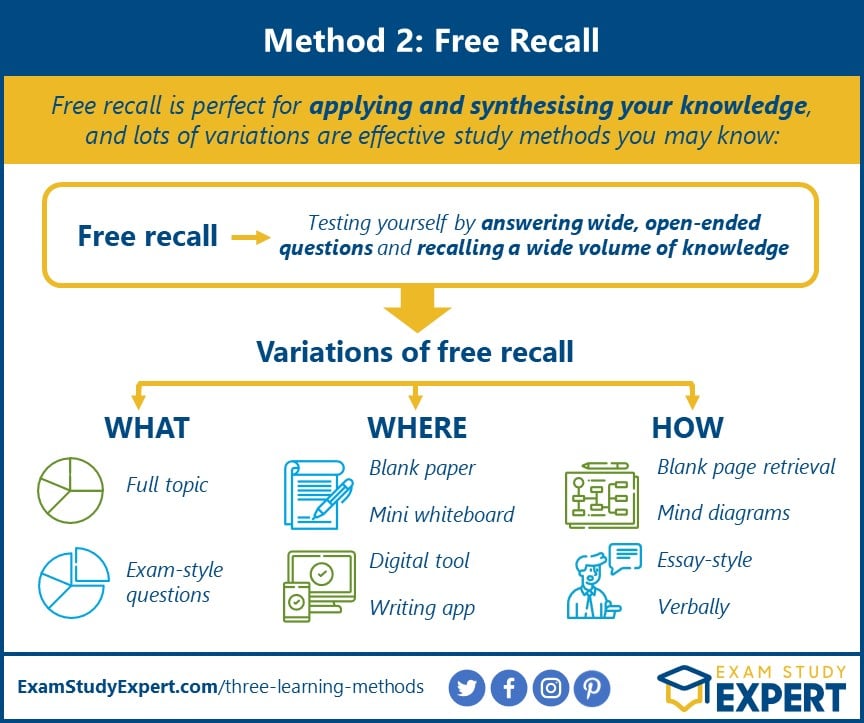
This method is incredibly effective because it bypasses the "illusion of competence" that comes from passively re-reading. You can't fool a blank page.
- When to use it: After reading a chapter, watching a lecture, or at the end of a study week to consolidate everything you've learned about a concept.
- How to use it:
- Take a blank piece of paper or open a new document.
- Write the topic at the top (e.g., "The Zettelkasten Method").
- Set a timer for 5-10 minutes and write down everything you can remember. Use bullet points, mind maps, or full sentences.
- When done, compare your output to your source material (e.g., your notes in Obsidian).
- Identify what you missed, what you got wrong, and what connections you failed to make. This gives you a precise map of where to focus your next review session.
C. The Feynman Technique: For Deepening Understanding
If you can't explain something simply, you don't understand it well enough. This is the core principle behind the Feynman Technique, a powerful method for solidifying your grasp of a concept by teaching it.
10 Active Study Techniques to Boost Your HSC Memory Retention
This article, '10 Active Study Techniques,' provides a great summary of several methods. We'll focus on its explanation of the Feynman Technique.
Read section 5, 'The Feynman Technique (Explain It Simply).' Pay close attention to the four-step process and the examples provided.
- When to use it: When you encounter a complex or abstract concept that you struggle to grasp, like a statistical model in data analysis or a complex design principle.
- How to use it:
- Choose a concept: Write the name of the concept at the top of a page.
- Teach it: Explain the concept in your own words, as if you were teaching it to a 12-year-old. Use simple language and analogies.
- Identify gaps: When you get stuck, use jargon, or your explanation feels shaky, you've found a gap in your understanding.
- Go back and review: Return to your source material to fill that gap. Then, repeat the teaching process until your explanation is clear and simple.
3. Reviewing Procedural Knowledge: Mastering the "How"
Procedural skills aren't learned by reading; they are learned by doing. Your review methods must reflect this. The goal is to simulate the real-world application of the skill as closely as possible.
To explore a wide range of practical methods, let's turn to a fast-paced video that lists twelve different ways to use active recall.
12 ways to Active Recall in 12 minutes
This video, '12 ways to Active Recall in 12 minutes,' offers a fantastic menu of techniques. We'll focus on those best suited for procedural knowledge.
Please watch the sections on 'Practice Problems' (09:34 - 10:45) and 'Practice Tests' (10:45 - 11:37). These are the cornerstone of procedural skill review.
A. Practice Problems
For skills in domains like coding or math, practice problems are the most direct way to review. They force you to retrieve and apply rules, syntax, and problem-solving patterns.
- When to use them: When learning a new coding concept (e.g., JavaScript arrays), a specific software function (e.g., Figma's auto-layout constraints), or a data analysis technique.
- How to use them:
- Work through exercises from textbooks, online courses (e.g., freeCodeCamp, Codewars), or create your own.
- Crucially, check your solution. As the video notes, understand why the correct answer is right and why your answer (if different) was wrong.
- Don't just solve it once. Revisit challenging problems after a few days to ensure the procedure has stuck.
B. Application Projects
While practice problems isolate specific skills, application projects require you to synthesize multiple skills to build something tangible. This is the ultimate test of procedural knowledge.
- When to use them: When you want to bridge the gap between isolated exercises and real-world competency.
- How to use them:
- Define a small, concrete project. Instead of "learn React," try "build a simple to-do list app in React."
- For UX: "Conduct a quick heuristic evaluation on your favorite app," or "Create a set of wireframes for a new feature idea."
- For coding: "Build a personal portfolio page using the HTML and CSS you've learned."
- This approach directly combats the "application" pain point you mentioned in your goals.
Test your understanding!
You are learning about Accessibility (WCAG) guidelines. Match the learning goal on the left with the most appropriate review method on the right.
| Learning Goal | Review Method |
|---|---|
| 1. Memorizing the four core principles of WCAG (Perceivable, Operable, Understandable, Robust). | A. Application Project |
| 2. Being able to explain the concept of "color contrast" and why it matters to a project manager. | B. Practice Problems |
3. Getting better at writing semantic HTML (e.g., using <nav>, <main>, <article>) correctly. |
C. Flashcards |
| 4. Auditing a website to identify and document accessibility issues. | D. Feynman Technique |
Show answer
- C. Flashcards: This is a perfect use case for memorizing a small set of specific, factual items. The acronym mnemonic "POUR" would also work well here.
- D. Feynman Technique: This requires you to simplify a technical concept for a non-technical audience, proving deep understanding.
- B. Practice Problems: Writing code is a skill. The best way to review and improve is through targeted practice exercises that force you to apply the rules.
- A. Application Project: An audit is a complex task that synthesizes knowledge (what the guidelines are) and skills (how to use auditing tools, how to document findings). This is a procedural, application-focused goal.
Conclusion
Today we've armed you with a strategic toolkit for reviewing information. By moving beyond passive re-reading and embracing active retrieval, you can dramatically improve your retention and ability to apply what you learn.
Key Takeaways:
- The most effective review method depends on the type of knowledge: declarative ("what") vs. procedural ("how").
- To review declarative knowledge, use active retrieval methods like smart flashcards for facts, free recall for overall comprehension, and the Feynman technique for deep understanding.
- To master procedural knowledge, you must "practice what you play." Use practice problems to hone specific skills and application projects to synthesize them in a realistic context.
What's Next?
Now that we've answered the question of how to review, the next logical step is to determine when and how often to do it. In our next lesson, we will address the learning outcome: "Define a scheduling policy for reviewing learned material based on the principles of spaced repetition." You'll learn how to leverage the "forgetting curve" to your advantage and build a sustainable schedule for long-term retention.