Recommended resources
The freely available resources this lesson will direct you to.
Hello! Welcome to the first lesson of our tenth module, "Designing Your Personal Learning System."
In the last module, we focused on the tactical level: how to plan, execute, and de-risk a single learning project. Now, we're zooming out to the strategic level. The goal of this module is to design the durable, overarching infrastructure that will support all your future learning—your personal learning system.
A cornerstone of any such system is how you capture, process, and connect ideas. This brings us to today's learning outcome: to select a primary note-taking method (e.g., Zettelkasten, Cornell Notes) that aligns with principles of retrieval and elaboration.
We'll move beyond the idea of notes as simple records and reframe them as tools for thinking. You will learn to evaluate different methods based on how well they support the learning principles we've covered, enabling you to choose an approach that helps you not just remember information, but truly understand and apply it.
1. The Mindset Shift: Notes for Thinking, Not Just Storing
Many of us were taught to take notes by passively transcribing what we hear or read. This often leads to the "illusion of competence" we've discussed before—you feel like you're learning, but the information isn't sticking because your brain isn't actively engaged.
Effective note-taking is an active process. It’s not about how much you write down, but how much you think about what you’re writing.
To set the stage, let's watch a short video that introduces this crucial distinction.
How To Take Smart Notes (3 methods no one's talking about)
In her video 'How To Take Smart Notes', Vicky Zhao explains why traditional, passive note-taking fails us and introduces the concept of 'smart notes' as an active, more effective alternative.
Watch the first 1 minute and 20 seconds. Pay close attention to her explanation of the 'illusion of competence' and how it relates to passive highlighting and underlining.
The key takeaway is that the process of note-taking is more important than the notes themselves. An effective process forces you to engage with the material, and the best methods have core learning principles baked right into their design. The two most important principles for our purpose are:
- Elaboration: Connecting new information to what you already know, explaining it in your own words, and exploring its relationship with other ideas.
- Retrieval Practice: Actively recalling information from memory, which strengthens the memory trace and makes it easier to access in the future.
We will now evaluate two popular and powerful note-taking methods against these two criteria.
2. Method 1: The Cornell Method — For Structured Learning
The Cornell Method is a highly structured system developed at Cornell University. It's particularly effective for capturing information from linear sources like lectures, videos, workshops, or book chapters. Its layout is specifically designed to promote active review and synthesis.
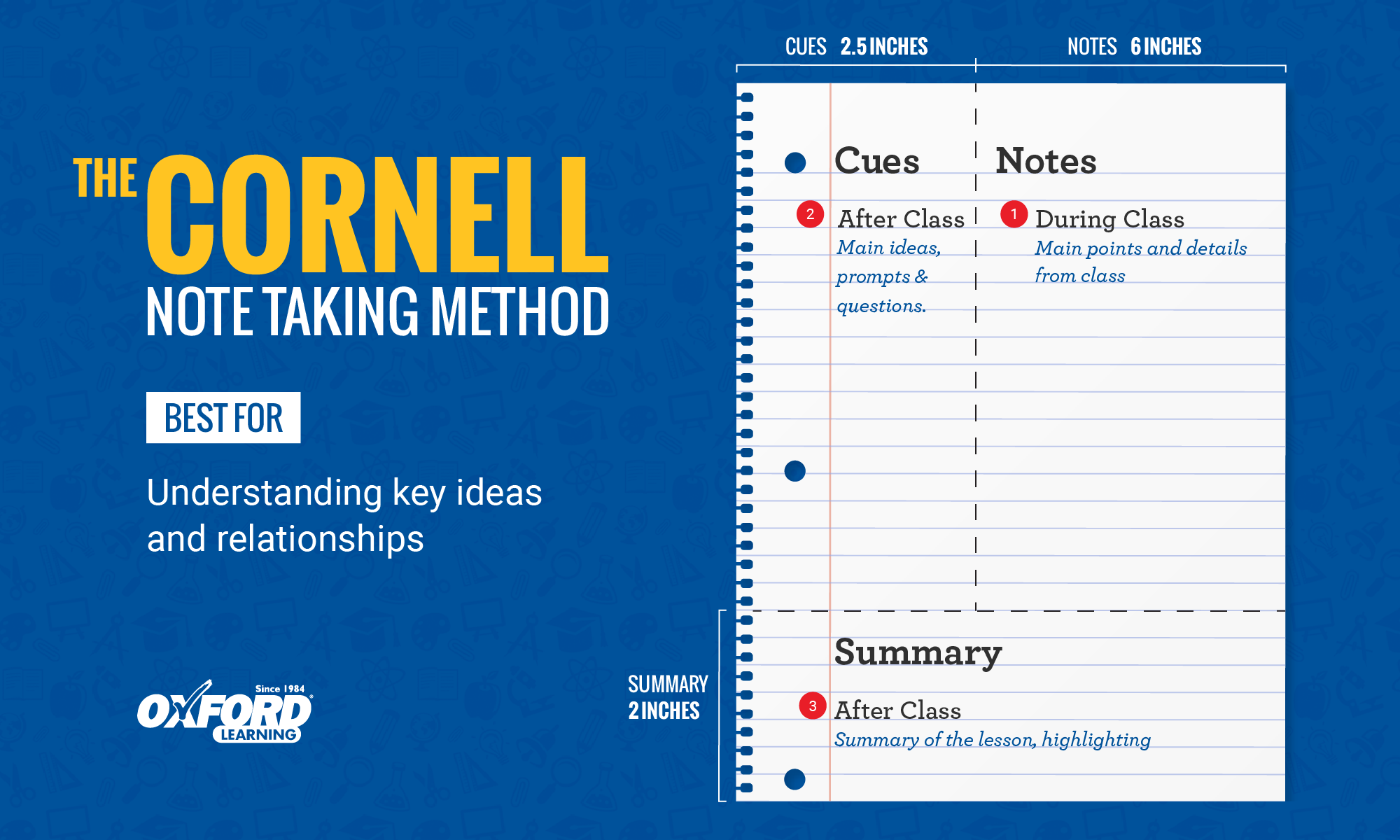
While the layout is simple, the power of the method is in its multi-step process.
This document from Gustavus Adolphus College provides a fantastic, process-oriented guide to the Cornell Method. It breaks the process down into six distinct steps that go far beyond simple recording.
Please read the sections 'Step One: Record' through 'Step Six: Review'. As you read, notice how steps like 'Question', 'Recite', 'Reflect', and 'Recapitulate' (summarize) are designed to force active engagement with the material.
How Cornell Aligns with Learning Principles
- Retrieval Practice: The system has retrieval built-in. After taking notes, you generate questions or keywords in the Cue column. Later, you can cover the main notes and use these cues to actively recall the information. The "Recite" step described in the PDF is explicit, powerful retrieval practice.
- Elaboration: The Summary section at the bottom forces you to synthesize the key takeaways in your own words—a classic form of elaboration. The "Reflect" step encourages you to ask questions and make connections between the material and your existing knowledge, a perfect fit for linking new UX principles to your past design projects.
Best for: Capturing and processing information from a single, structured source. For example, taking notes during a UX conference talk, a client meeting about project requirements, or while reading a chapter on accessibility guidelines.
3. Method 2: Zettelkasten — For Networked Thinking
The Zettelkasten, or "slip-box," method is fundamentally different. Instead of creating linear notes based on a source, you create a web of interconnected ideas. Each note is "atomic"—it contains a single idea—and is linked to other related notes in your system. This transforms your notes from a passive archive into a dynamic "second brain" that helps you think and generate new insights.
In your design work, this is analogous to creating a design system. Individual components (atomic notes) are created independently but are designed to be linked and combined in countless ways to form cohesive wholes (complex ideas).
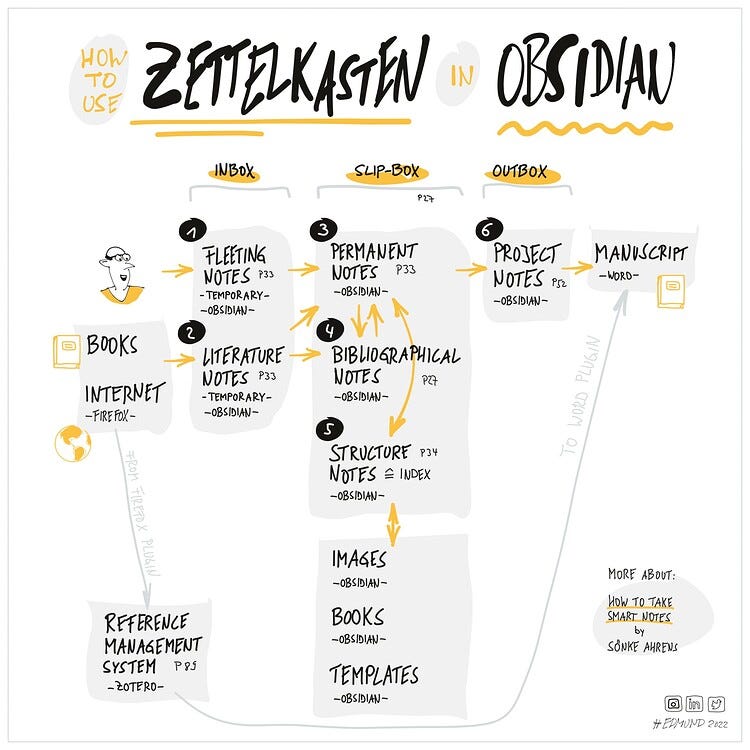
The following video explains the core principles that make this method so powerful for deep thinking and retention.
How To Take Smart Notes (3 methods no one's talking about)
Let's return to the 'How To Take Smart Notes' video to understand the principles behind Zettelkasten. It explains how making notes 'atomic' and 'connected' fosters a deeper level of understanding.
Watch from 03:00 to 07:02. Focus on the concepts of 'atomic' notes (one idea per note) and, crucially, 'connected' notes. Pay close attention to the 'Compass of Zettelkasten Thinking' as a practical way to create these connections.
How Zettelkasten Aligns with Learning Principles
- Retrieval Practice: When you add a new idea to your Zettelkasten, you are forced to ask, "What do I already know that relates to this?" The act of searching your existing notes and recalling relevant concepts to form a link is a powerful form of retrieval.
- Elaboration: This is the method's superpower. The entire process is built around elaboration. By creating links, you are explicitly defining relationships between ideas. The "Compass of Zettelkasten Thinking" (Where does it come from? What's similar? What competes? Where does it lead?) is a brilliant, structured exercise in elaboration.
Best for: Long-term knowledge synthesis and creative thinking. It's ideal for connecting ideas across different domains (e.g., linking a psychological principle of user motivation to a specific UI pattern) and seeing novel patterns in your knowledge over time.
Test your understanding!
Imagine you are learning about Jakob's Law ("Users spend most of their time on other sites. This means that users prefer your site to work the same way as all the other sites they already know.").
Briefly describe how your process and the final note would differ if you were capturing this concept using:
- The Cornell Method
- The Zettelkasten Method
Show answer
Here's one way to think about it:
-
Cornell Method:
- Process: You would likely be taking notes from an article or video about UX laws. You'd write the definition of Jakob's Law in the main notes column. In the cues column, you might write "What is Jakob's Law?" or "Why use familiar patterns?". At the bottom, in the summary, you'd paraphrase: "My site should follow common conventions because users expect it to work like other sites they use."
- Final Note: A single, self-contained page summarizing the key points about Jakob's Law from that specific source.
-
Zettelkasten Method:
- Process: You would create a new, single "atomic" note titled "Jakob's Law - Users prefer familiar designs." You'd write the definition in your own words. Then, the crucial step: you would actively think about and create links to other notes in your system. You might link to your note on "Mental Models," "Cognitive Load" (since familiar patterns reduce it), or even a specific project note where a non-standard design caused user confusion.
- Final Note: A small, focused note on Jakob's Law that is now connected to several other concepts, enriching both the new note and the ones it links to.
The key difference is that the Cornell note is an organized summary of a source, while the Zettelkasten note is an integrated piece of your personal knowledge graph.
4. Selecting Your Primary Method
So, which method should you choose? The goal is not to find the "one perfect method" but to select a primary approach that aligns with your goals and the type of learning you're doing.
Here is a table to help you compare them:
| Feature | Cornell Method | Zettelkasten Method |
|---|---|---|
| Structure | Linear, hierarchical (page/source-based) | Networked, non-linear (idea-based) |
| Best For | Discrete learning events (lectures, chapters) | Long-term knowledge synthesis, creative projects |
| Retrieval | Explicit (Cue column for self-quizzing) | Implicit (Recalling concepts to create links) |
| Elaboration | Good (Summary and Reflection steps) | Excellent (Core activity is linking to other ideas) |
| Effort to Start | Low | Medium (requires a system and habit of linking) |
| UX Example | Notes from a workshop on new Figma features. | Connecting Gestalt principles to multiple UI projects. |
Many people find success with a hybrid approach:
- Use the Cornell Method for initial capture during a lecture or while reading.
- Afterward, distill the most important, durable ideas from your Cornell notes and create new atomic notes for them in your Zettelkasten.
For your goal of debugging your learning process, starting with a robust system is key. I'd encourage you to experiment with both, but to lean into a Zettelkasten-inspired approach for the knowledge you want to retain and apply long-term.
Conclusion
Today we've reframed note-taking as a powerful tool for thinking, not just a method for transcription. To be effective, a note-taking system must support the core learning principles of elaboration and retrieval practice.
Key Takeaways:
- Effective note-taking is an active process of thinking and engagement, not passive recording.
- The Cornell Method is a structured system ideal for capturing and reviewing information from linear sources. It builds in retrieval and elaboration through its Cue and Summary sections.
- The Zettelkasten Method is a networked system for building a web of interconnected ideas. Its core strength is fostering deep elaboration by forcing you to link new knowledge to what you already know.
- The choice of method depends on your context, but for long-term retention and application, a system that prioritizes networked thinking (like Zettelkasten) is exceptionally powerful.
What's Next?
Now that you have evaluated the primary methods, the logical next step is to put one into practice. In our next lesson, we will address the learning outcome: "Choose and set up a tool (digital or analog) for your selected note-taking method." We'll explore popular options like Notion, Obsidian, or even simple index cards, and discuss how to configure them to best support your chosen workflow.