Recommended resources
The freely available resources this lesson will direct you to.
Introduction
In our last lesson, we established a conceptual framework for vector spaces using span, basis, and dimension. We learned that a basis is a minimal, non-redundant set of vectors that can describe an entire space. This gives us the language to talk about the structure of spaces.
Today, we shift our focus to a property of the transformations themselves. We will explore the determinant, a single, powerful number that encapsulates a fundamental geometric property of any linear transformation represented by a square matrix. Our goal is to understand the determinant not as an abstract algebraic formula, but as a concrete, visualizable concept: the factor by which a transformation scales area (in 2D) or volume (in 3D). This geometric interpretation is not just an academic curiosity; it's a cornerstone for understanding topics from invertibility to the behavior of objects in 3D graphics rendering.
The Geometric Meaning of the Determinant
A linear transformation can be visualized as a warping of space that keeps the grid lines parallel and evenly spaced. It might stretch, squish, shear, or rotate space, but it does so in a consistent way. The determinant answers a simple question: by what factor does this transformation change area?
To see this in action, let's start with the best visual explanation available.
The determinant | Chapter 6, Essence of linear algebra
The video "The determinant" from the 3Blue1Brown series "Essence of linear algebra" provides a powerful visual intuition for this concept.
Please watch the segment from the beginning up to the scaling factor. Focus on the core idea: the determinant is the factor by which the area of the unit square (formed by basis vectors \hat{i} and \hat{j}) changes. Crucially, notice how this single scaling factor applies to any shape, not just that initial square.
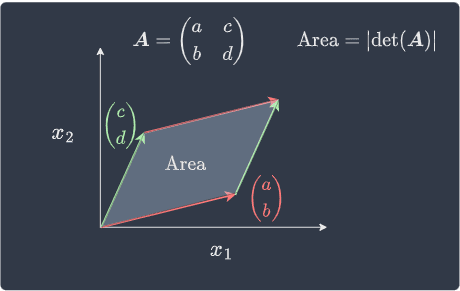
As the video illustrates, if a 2x2 matrix transforms the 1x1 unit square into a parallelogram with an area of 6, then the determinant of that matrix is 6. This means every area in the plane gets scaled by a factor of 6.
Let's pause here for a moment. Given this insight, consider the following: A linear transformation described by a matrix has a determinant of 3. If we apply this transformation to a circle with radius 2, what will be the area of the resulting ellipse?
The original area is . Since the transformation scales all areas by a factor of 3, the new area will be .
Orientation and the Sign of the Determinant
You might have noticed that determinants can also be negative. What could it mean to scale an area by a negative factor? This introduces the second key aspect of the determinant: orientation.
The determinant | Chapter 6, Essence of linear algebra
Let's return to the 3Blue1Brown video to see what a negative determinant signifies.
Watch the segment explaining negative determinants. Pay attention to how the relative positions of the basis vectors \hat{i} and \hat{j} change.
In 2D, the initial orientation has to the left of . If a transformation results in the new being to the right of the new , space has been "flipped" or inverted.
- Positive determinant: Preserves orientation.
- Negative determinant: Inverts orientation.
The absolute value of the determinant still tells you the area scaling factor. So, a determinant of -2 means the transformation flips the orientation of space and scales all areas by a factor of 2.
The Zero Determinant Case
What happens if the determinant is zero? This is a critically important special case. A zero determinant implies that the transformation squishes space into a lower dimension. In 2D, the entire plane is collapsed onto a line or even a single point.
The determinant | Chapter 6, Essence of linear algebra
The video briefly covers this crucial case.
Watch this short clip on the zero determinant.
This connects directly back to our previous lesson. A zero determinant means the output vectors (the columns of the matrix) are linearly dependent. They no longer span the full space. For instance, in 2D, if the columns are collinear, they span a line, not a plane. The area of the resulting "parallelogram" is zero. This is a profound link between a geometric property (collapsing space) and an algebraic one (linear dependence).
Extending to Three Dimensions
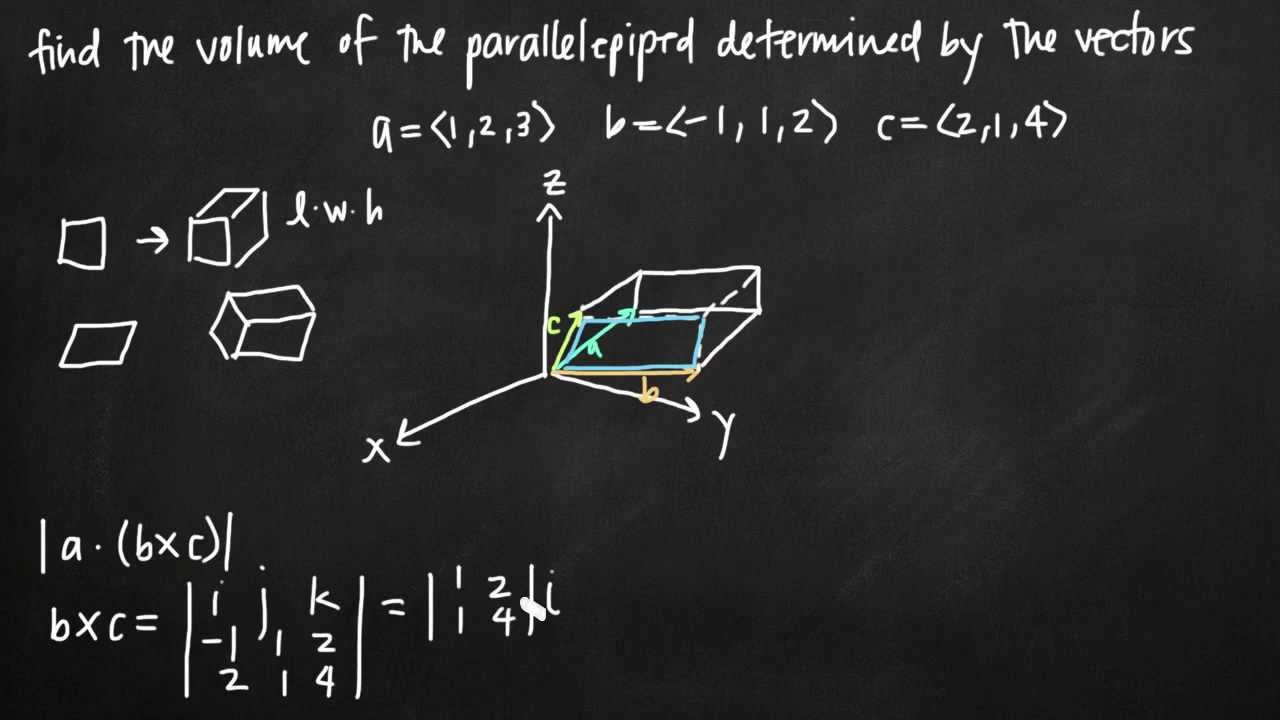
The intuition extends perfectly to 3D. The determinant of a 3x3 matrix is the factor by which volume is scaled.
The determinant | Chapter 6, Essence of linear algebra
Let's see how this plays out in 3D.
First, watch the segment that defines the determinant as a volume scaling factor. The unit square becomes a unit cube, and the resulting parallelogram becomes a parallelepiped. The determinant is the volume of this parallelepiped. Next, watch the explanation of negative determinants in 3D. The concept of orientation is now described by the right-hand rule. If the transformed basis vectors no longer obey the right-hand rule, the orientation has flipped, and the determinant is negative.
This concept of orientation is fundamental in computer graphics. Whether a coordinate system is right-handed or left-handed has significant implications for calculations involving rotations and surface normals.
Deriving the Determinant from First Principles
We now have a strong geometric intuition for what the determinant is. But why does the familiar formula, like for a 2x2 matrix, produce this scaling factor? We can actually derive the formula by starting with a few axiomatic properties that any "signed area" function should obey.
This next video takes a more formal, constructive approach. It shows that if we define a function with a few simple, intuitive properties of area, the standard determinant formula is the only possible result.
Why is the determinant like that?
This video, "Why is the determinant like that?" by broke math student, builds the determinant formula from the ground up.
Watch the first part of the video, which covers the 2D derivation. The key is to follow how three simple rules about area lead directly to the ad-bc formula: The area of the unit square is 1. If the two vectors are the same (collinear), the area is 0. The area function is linear in each of its vector inputs (this is called multilinearity).
To formalize these properties, please read the following short text, which lays out the mathematical foundation for this derivation.
A Constructive Derivation of the Determinant
This article by Akihiro Matsukawa formalizes the properties we just saw in the video.
Read the section titled "Volume, and it's Properties". This section explicitly defines the three core properties: multilinearity, the alternating property (which follows from the area being zero for identical vectors), and the normalization on the unit hypercube.
The combination of the video's derivation and this text's formalization shows how the algebraic formula for the determinant is a direct consequence of our geometric intuition about area and volume.
Computation and Properties
With a solid grasp of the intuition, we can now look at the mechanics of computation.
For a 2x2 matrix , where the columns are the vectors and , the determinant is:
Notice the video used b and d in the second column, resulting in ad-bc. The formula changes based on how you label the matrix elements, but the concept is identical.
For a 3x3 matrix, the most common manual method is cofactor expansion. For a matrix , the expansion along the first row is:
As you can imagine, this becomes cumbersome for larger matrices, which is why computational libraries handle this. The key is not to master the manual calculation, but to understand what the resulting number signifies.
Finally, the geometric interpretation makes several key properties of the determinant very intuitive:
- : The identity matrix doesn't change space, so area/volume scaling is 1.
- : The inverse transformation should reverse the scaling. If you scale area by 5, the inverse must scale it by 1/5 to get back to the original.
- : Applying two transformations in sequence (matrix then matrix ) means applying their scaling factors sequentially. A scaling of 2 followed by a scaling of 3 results in a total scaling of 6.
Conclusion
In this lesson, we demystified the determinant, moving it from a seemingly arbitrary formula to a rich geometric concept.
Key Takeaways:
- Geometric Interpretation: The determinant of a matrix is the factor by which its corresponding linear transformation scales area (2D), volume (3D), or hypervolume (nD).
- Orientation: The sign of the determinant indicates whether the transformation preserves (+) or inverts (-) the orientation of space.
- Linear Dependence: A determinant of zero signifies that the transformation collapses space into a lower dimension. This occurs if and only if the column vectors of the matrix are linearly dependent.
- Properties: The geometric view makes properties like intuitive; sequential transformations correspond to multiplicative scaling.
Understanding the determinant as a scaling factor is essential. In probability, it appears in the change of variables formula for probability density functions. In graphics, it can help determine if a 3D model has been inverted or "turned inside out." Most importantly, it gives us a quick test for matrix invertibility—a non-zero determinant is a prerequisite for a transformation to be reversible.
In our next lesson, we will explore another fundamental concept for quantifying vectors and matrices: norms. While the determinant measures a transformation's effect on space, norms measure the "size" or "magnitude" of the vectors and matrices themselves.