Recommended resources
The freely available resources this lesson will direct you to.
- AI vs Human Thinking: How Large Language Models Really Workwww.youtube.com
- Can AI Think? Debunking AI Limitationswww.youtube.com
- AI Myths Vs. Reality - Artificial Intelligence & Research - Research Guides at University of Colorado Colorado Springslibguides.uccs.edu
- Beginner’s Guide to AI Terminology | Plain-English AI Glossary | iMeta – iMeta Trainingimetatraining.co.uk
Hello, and welcome back to your course on AI.
In our last lesson, we created a mental map of the AI landscape, seeing how Artificial Intelligence is the broad field, Machine Learning is a specific approach within it, and Deep Learning is the modern engine powering today's most advanced systems. This hierarchy is crucial because it showed us that modern AI learns from data rather than being explicitly programmed with rules.
Today, we'll build directly on that idea to tackle one of the most significant and persistent questions in the field: Does AI actually "think"? We'll move beyond the science fiction portrayals of conscious machines to investigate what's really happening under the hood. Our goal is to identify the common myths about AI intelligence and replace them with a clear, conceptual understanding of how these systems truly operate. This distinction is fundamental to becoming AI-literate and to knowing when—and when not—to trust the outputs of tools like ChatGPT.
Myth vs. Reality: The Illusion of Thought
From HAL 9000 in 2001: A Space Odyssey to modern chatbots that can write poetry and express apparent emotion, it's easy to fall into the trap of anthropomorphism—attributing human-like thoughts, feelings, and intentions to AI. The image below perfectly captures this common misconception and contrasts it with the technical reality.
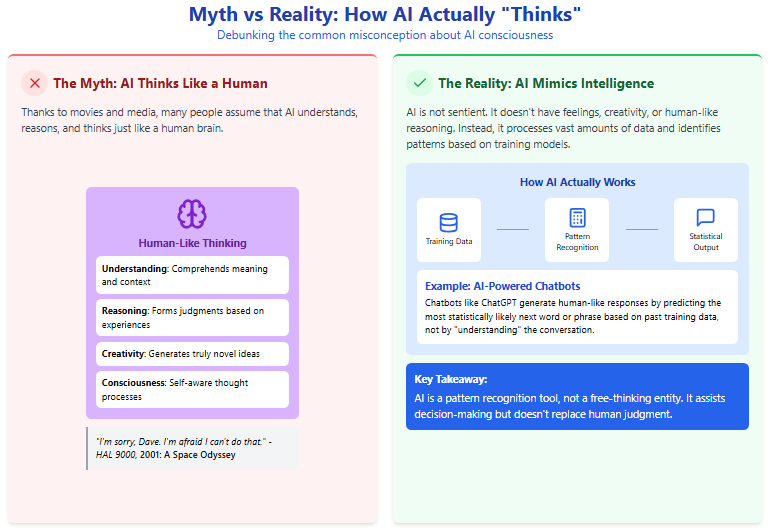
As the image shows, the reality is that AI is not sentient. It doesn't understand context, reason from experience, or possess self-awareness. Instead, today's AI, particularly the Large Language Models (LLMs) you've used, are incredibly sophisticated pattern-matching systems. They have been trained on vast amounts of text and can predict the most statistically probable next word in a sequence, creating fluent and coherent responses that mimic human thought.
Advanced Autocomplete, Not Genuine Reasoning
A powerful way to conceptualize this is to think of an LLM as "autocomplete on steroids." You've seen this on your phone: you type "The weather today is..." and it suggests "sunny." The phone doesn't know about the weather; it just knows that "sunny" is a very common word to follow that phrase. LLMs do the same thing, but on an unimaginably larger and more complex scale.
The following video from IBM Technology brilliantly illustrates this point using a simple math problem that trips up an AI. It shows how a model's focus on statistical patterns, rather than logical reasoning, can lead it to make obvious mistakes.
Can AI Think? Debunking AI Limitations
This video provides a clear, practical example of how an LLM's pattern-matching approach differs from human reasoning and introduces the "autocomplete on steroids" analogy.
Please watch these two segments: Start with the kiwi math problem. Notice how the AI gets distracted by an irrelevant detail ("five of them were smaller") because, in its training data, such details are usually important. This is pattern matching, not reasoning. Next, watch the explanation of autocomplete on steroids. This analogy is one of the most effective ways to understand how LLMs generate text without truly understanding it.
This idea that AI works like a "predictive text" system or a "paraphrase machine" is a core concept. The University of Colorado Springs Library offers a great, concise reading that reinforces this.
This guide directly confronts several key myths about AI, providing clear, real-world explanations for why they are misleading.
Please read the first two myth/reality pairings in the guide: The first addresses the myth that AI tools are intelligent, explaining that they function like advanced predictive text. The second tackles the myth that chatbots are like search engines, clarifying that they rearrange words rather than finding original information.
A Deeper Comparison: Six Dimensions of Thought
So, if AI isn't "thinking" in the human sense, what are the specific differences? The next video, also from IBM Technology, provides a fantastic, structured comparison across six key areas that separate human cognition from how LLMs operate. This will equip you with a much richer vocabulary for explaining the distinction.
AI vs Human Thinking: How Large Language Models Really Work
This video delves into the fundamental differences between the human brain and large language models across several dimensions of cognition.
As you watch, focus on how the process differs, even if the final output sometimes looks similar. Introduction: The video sets up the comparison across six key areas. Learning: Note the contrast between human neuroplasticity (learning from a few examples, constantly updating) and an LLM's training (learning from billions of examples, then becoming static). Processing: This is a key point. Humans process concepts and ideas; LLMs break everything down into mathematical units called "tokens." Reasoning: This section explains that while LLMs can be prompted to produce text that looks like reasoning (e.g., "Chain-of-Thought," which we'll cover later), it's a generated sequence, not a conscious application of logic. Embodiment: This is perhaps the most profound difference. Human understanding is grounded in physical, real-world experience. AI is "disembodied," learning about the world only through text written by others, which is why it lacks common sense. Conclusion: A great summary of the core differences.
Practical Consequences: Hallucinations and Other Flaws
This gap between mimicking thought and actual understanding isn't just a philosophical point; it leads to very real and practical limitations you may have already encountered.
The most famous of these is the hallucination. This is a term for when an AI confidently produces incorrect or completely fabricated information. It's not a "bug" but a natural side effect of its design. Since the model is just predicting the next most likely word, it has no internal concept of "truth." It will always try to complete the pattern, even if that means making things up that sound plausible.
The video you just watched drew an excellent parallel between AI hallucination and the human psychological phenomenon of "confabulation," where a person unknowingly creates false memories to fill in gaps. In both cases, there is no intent to deceive; it's the system's default way of producing a coherent narrative.
This core limitation—a lack of true understanding—is the root cause of many common AI myths and failures. A helpful glossary from iMeta Training clarifies several of these.
Beginner’s Guide to AI Terminology | Plain-English AI Glossary | iMeta – iMeta Training
This glossary provides simple, plain-English definitions for key AI terms, including common misunderstandings associated with them.
Please read the entries for the following terms, paying close attention to the "common misunderstanding" part for each. Generative AI: This clarifies that AI isn't "creative" in a human sense but recombines patterns. Hallucination: This reinforces the idea that an AI's confidence doesn't equal accuracy. Large Language Model (LLM): This directly states the crucial point that LLMs predict language patterns, not facts.
Conclusion
Today, we've peeled back the illusion of the "thinking machine" to reveal the reality of a powerful pattern-matcher. By moving past the myths, you've gained a more accurate and useful mental model of how AI truly works.
Here are your key takeaways:
- AI mimics, it doesn't think: Current AI systems are not conscious or sentient. They use statistical methods to generate responses that imitate human language and reasoning.
- It's advanced pattern-matching: The "autocomplete on steroids" analogy is a useful way to understand that LLMs are predicting the next most probable token, not comprehending meaning.
- Disembodiment is a key limitation: AI lacks the physical, sensory experience of the world that grounds human common sense and understanding.
- Lack of understanding causes flaws: Critical issues like "hallucinations" are a direct result of an AI's design as a pattern-generator, not a truth-teller.
This understanding is your first line of defense against AI hype and misinformation. You are now better equipped to evaluate the claims made about new AI tools and to use them with healthy, informed skepticism.
In our next and final lesson of this introductory module, we will explore a fascinating concept called Moravec's paradox. It explains why tasks that are incredibly difficult for humans (like calculating huge numbers or memorizing the entire internet) are easy for AI, while tasks that are trivial for us (like picking up a cup or understanding a simple story) remain profound challenges for machines. This will build perfectly on what we've learned today about embodiment and the true nature of AI's capabilities.