Recommended resources
The freely available resources this lesson will direct you to.
Welcome back. In our last lesson, we established a crucial concept: modern AI systems don't "think" or "understand" in the human sense. They are incredibly sophisticated pattern-matchers, operating without genuine consciousness, embodiment, or common sense. This understanding is key to using AI tools wisely.
Today, we will explore a fascinating and counter-intuitive consequence of this difference, known as Moravec's paradox. This paradox addresses a perplexing question: Why can an AI defeat a world champion at chess, a task requiring immense intellectual effort for a human, yet struggle with something as simple as recognizing a face in a crowd or picking up a laundry basket? By the end of this lesson, you will be able to explain this paradox and what it reveals about the fundamental differences between human and artificial intelligence. This is the final piece of our foundational module, setting the stage for us to explore the history of how these different kinds of intelligence came to be.
The Paradox: Hard is Easy, and Easy is Hard
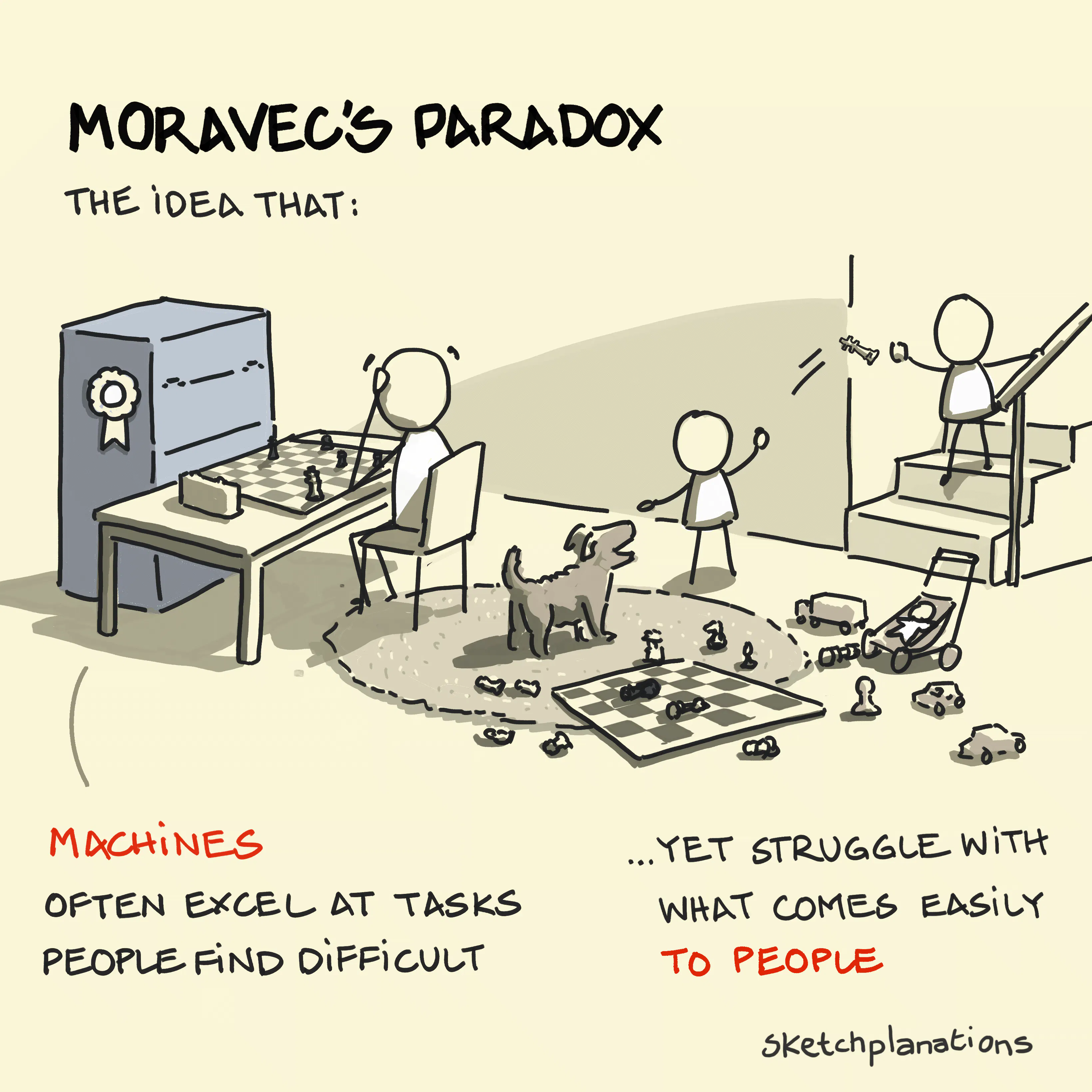
In the 1980s, a group of AI researchers, including Hans Moravec, observed a strange inversion. Tasks that are the pinnacle of human abstract thought—like mathematics, logic, and strategy games—were proving to be relatively straightforward for computers. Yet, the things a toddler learns effortlessly—like walking, seeing, and picking things up—were monumental challenges for AI.
Moravec famously summarized it this way: "It is comparatively easy to make computers exhibit adult-level performance on intelligence tests or playing checkers, and difficult or impossible to give them the skills of a one-year-old when it comes to perception and mobility."
This idea is captured perfectly in the illustration below.
The following video provides a great introduction to this concept with several relatable examples.
Moravec's Paradox: AI’s Strange Limitation
This video from the Tensor channel introduces Moravec's paradox by contrasting AI's superhuman abilities in complex games with its failures in simple, everyday tasks.
Please watch the first two sections of the video: The introduction sets up the paradox with a familiar example of a smart speaker failing at a simple request. The main explanation uses the concrete example of a robot grabbing a mug to illustrate what Moravec's paradox looks like in the real world.
Why Does This Paradox Occur?
The reason for this paradox lies in the vastly different origins and architectures of human and computer intelligence. There are two main drivers: evolution and the nature of knowledge.
1. The Weight of Evolution
Human brains are the product of hundreds of millions of years of evolution. The skills essential for survival—perceiving predators, navigating complex terrain, identifying food, and understanding social cues—have been relentlessly optimized over countless generations. These sensorimotor skills feel "easy" to us precisely because our biology has dedicated an immense amount of computational power to them, running them automatically in the background.
Abstract reasoning, on the other hand, is a very recent addition to our cognitive toolkit. Activities like formal logic and mathematics have only existed for a few thousand years. They require our conscious, deliberate attention because our brains don't have specialized, deeply-ingrained systems for them.
Computers are the exact opposite. They were designed from the ground up to be logic machines. They have no evolutionary history; their "brains" are built for calculation and following explicit rules, making them perfectly suited for the very tasks that are evolutionarily new and difficult for humans.
The following article from the AI for Everyone blog explains this distinction clearly.
Computers and people - the mystery of the Moravec paradox
This article provides a concise explanation of Moravec's paradox and delves into the evolutionary reasons behind it.
Please read the first part of the article: Start with the section The nature of Moravec's paradox for a formal definition. Then, read the section on Evolutionary determinants and the "different nature of computers." This is the core explanation for why the paradox exists.
2. Tacit vs. Explicit Knowledge
This evolutionary difference leads to a second key reason: the type of knowledge involved.
- Explicit knowledge is factual information that can be easily written down, explained, and programmed. The rules of chess, mathematical formulas, and the steps to solve an algebra problem are all explicit. Early AI, known as symbolic AI, tried to build intelligence by programming in millions of these explicit rules. It succeeded at logical tasks but failed spectacularly at common sense.
- Tacit knowledge is intuitive, experiential knowledge that is difficult or impossible to articulate. Think about riding a bike, catching a ball, or recognizing a friend's face. You just know how to do it, but you can't write a step-by-step manual that would allow a machine to replicate your skill.
The "easy" human tasks are steeped in tacit knowledge, which makes them incredibly difficult to code. The "hard" human tasks are based on explicit knowledge, making them ideal for computers.
The video below gives a fantastic overview of this, connecting the failure of early symbolic AI to its inability to handle the messy, tacit knowledge of the real world.
Moravec's Paradox - Why are machines so smart, yet so dumb?
This video from Up and Atom explains how the history of AI research itself demonstrates Moravec's paradox, contrasting the rule-based approach of Symbolic AI with the learning-based approach of neural networks.
Please watch the segment on Symbolic AI. Pay close attention to the example of building a tower of blocks (block tower). It perfectly illustrates how a task a toddler finds simple becomes a mind-bogglingly complex series of problems when you try to define it with explicit rules.
Examples in Action
Let's make this concrete. The table below categorizes tasks according to the paradox.
| Easy for Humans, Hard for AI | Hard for Humans, Easy for AI |
|---|---|
| Perception: Recognizing a friend in a crowd or a song from a few notes. | Calculation: Instantly finding the square root of a 10-digit number. |
| Mobility: Walking on uneven ground or navigating a cluttered room. | Data Analysis: Finding subtle patterns in millions of medical records. |
| Dexterity: Tying shoelaces or folding laundry. | Logic & Strategy: Playing chess or Go at a superhuman level. |
| Social Interaction: Detecting sarcasm or offering empathy. | Information Retrieval: Instantly recalling any fact from Wikipedia. |
| Common Sense: Knowing not to put a metal fork in a microwave. | Optimization: Calculating the most efficient delivery route for a fleet of trucks. |
The relationship between task difficulty for humans and for computers was expected to be linear—what's hard for us should be hard for them. Instead, we got something very different, as visualized in the charts below.

Conclusion: A Guiding Principle for AI
Today we've unpacked Moravec's paradox, a key concept for understanding the landscape of artificial intelligence. It's not just a curious observation; it's a guiding principle that has shaped the entire field of AI research and helps us predict its future.
Here are your key takeaways:
- Moravec's Paradox states that tasks easy for humans (perception, mobility) are hard for AI, while tasks hard for humans (logic, calculation) are easy for AI.
- The primary reason is evolutionary: Our brains have spent millions of years mastering sensorimotor skills, which feel effortless but are computationally immense. Abstract thought is a recent and conscious effort.
- It highlights the difference between tacit knowledge (intuitive, hard to explain) and explicit knowledge (rule-based, easy to program). AI excels at tasks based on explicit rules.
- The paradox explains why early AI failed and why modern AI focuses on learning from data (like a child) rather than being programmed with rules (like a calculator).
Understanding this paradox is crucial. It helps explain why we don't have robot butlers but do have AI that can help design drugs. It shows that the goal of AI is not necessarily to replicate human intelligence, but to create a complementary form of intelligence that excels where we do not.
This lesson concludes our first module, "Framing AI." You now have a solid conceptual foundation: you can define AI, distinguish it from its subfields, debunk common myths about it "thinking," and explain the fundamental puzzle of its capabilities through Moravec's paradox.
In our next lesson, we will begin a new module, "A Brief History: From Turing to Transformers." We will travel back in time to the very origins of AI to understand the ideas that started it all, beginning with Alan Turing and his famous "Turing Test."