Recommended resources
The freely available resources this lesson will direct you to.
- Tutorial on how to SUMMARISE NOTES for CONTENT HEAVY SUBJECTSwww.youtube.com
- How to Do ACTIVE RECALL Effectively (Study Less, Remember More)www.youtube.com
- [PDF] Active Reading Strategies - McGraw Center for Teaching and Learningmcgraw.princeton.edu
- Cornell method - Note-taking: a Practical Guidesubjectguides.york.ac.uk
Hello! Last time, you ranked upcoming assessments by weight, proximity, and confidence. That matrix tells you where to focus; it does not yet tell you what to do when you sit down to study. In this lesson, you’ll take one assessed syllabus topic and turn it into two useful tools: questions you can answer without notes and a concise sheet for checking your answers.
Allow about 40 minutes. Use a topic from a high-priority assessment if you have your matrix handy. The binary-search example below is only a demonstration—your finished sheet should cover a topic on your syllabus.
Turn familiarity into evidence of understanding
Reading a worked solution can make it feel obvious. An exam asks something harder: can you produce the reasoning when the solution is hidden? Active recall means attempting to retrieve or apply what you know before looking at your notes. Checking afterward is essential; otherwise, an incorrect answer may go uncorrected.
How to Do ACTIVE RECALL Effectively (Study Less, Remember More)
Watch “How to Do ACTIVE RECALL Effectively (Study Less, Remember More)” from simple, actually for the distinction between recognizing an answer and retrieving one.
Watch recall versus recognition, then recall and questions. Notice the order: study a small section, close the source, try to recall its main points, and check what you missed. We will use that order to build your sheet.
A question such as “Do I understand binary search?” does not reveal much. “Why can binary search discard half the remaining list after one comparison?” demands an explanation you can check. Good revision questions make the required knowledge visible—and make gaps visible too.
Convert the syllabus wording into questions
Start with the smallest assessable topic that fits a study session, rather than an entire subject. Check the syllabus or learning objectives, then look at the relevant lecture notes or assigned reading to establish its boundaries. For example, “searching algorithms” may be too broad for one sheet, while “binary search on a sorted list” is manageable. If the assessment requires code, include questions that require tracing or writing code; if it requires explanations, include questions that require reasons.
The Princeton McGraw Center’s Active Reading Strategies suggests a useful starting move: change headings into questions. It also recommends summarizing essential ideas in your own words rather than reproducing the source.
[PDF] Active Reading Strategies - McGraw Center for Teaching and Learning
Read the bulleted strategies to see how questions and a short summary can grow out of the same source material.
On the PDF page containing the bulleted strategies, begin with the bullet about writing questions in the margins. Read the question-to-summary guidance, stopping at the bullet about writing your own exam question, just before the sample-diagrams material. Focus on changing headings into questions and capturing the essential ideas in less than a page.
A heading is a starting prompt, not necessarily a finished recall question. Suppose a syllabus or lecture heading says Binary search. “What is binary search?” may check a definition, but it misses much of what an exam could test. Build a small set that covers different demands:
| Question type | Binary-search example | What a good answer must show |
|---|---|---|
| Condition | Why must the list be sorted? | Why a comparison lets you rule out one side |
| Mechanism | How do you change the search interval when the midpoint value is too small or too large? | The correct boundary in each case |
| Application | Which midpoint values are checked when searching for 20 in [2, 5, 9, 14, 20, 27, 31]? |
A trace, not just “20 was found” |
| Boundary | When does an unsuccessful search stop? | How the remaining interval becomes empty |
| Explanation | Why does binary search take logarithmic time? | The repeated reduction of the search interval |
These are not five required categories for every subject. They show how to move beyond five variations of “define this term.” Write questions that match the forms of understanding your assessment expects: explain, compare, trace, calculate, justify, or apply. A useful set for one narrow topic is often four to seven questions, each with an answer you can verify.
Make the revision sheet an answer key, not a smaller textbook
The sheet should hold the minimum information needed to answer and check your questions. The Cornell layout is well suited to this: questions on the left, compact answer notes on the right, and a short synthesis at the bottom.
Cornell method - Note-taking: a Practical Guide
Read the University of York’s guide for a practical way to place recall prompts and checking notes on one page.
Under “What is the Cornell method?”, start with the layout and review instructions. Continue through “Taking notes with the Cornell method” and its “Review” guidance; stop before “Cornell method example.” Pay particular attention to covering the note column while using the cue column.
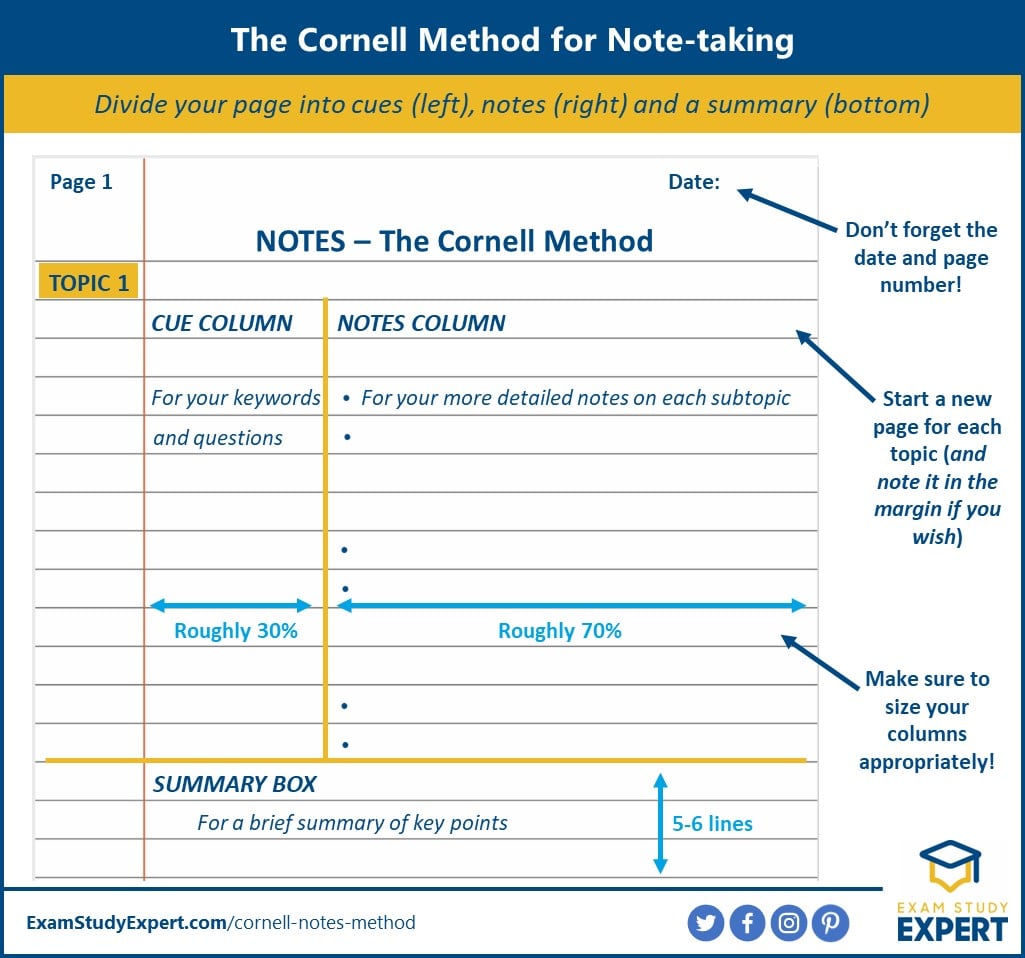
Here is a compact illustrative sheet for the binary-search topic. It assumes an iterative search with an inclusive interval, so its boundary rules are consistent throughout.
| Cue: cover the answers and respond | Notes: check after responding |
|---|---|
| Why sorted input? | If the midpoint value is too small, all values at or left of it can be ruled out; if too large, all values at or right of it can be ruled out. This reasoning depends on sorted order. |
| How are the boundaries updated? | With low and high included in the search: if the midpoint value is too small, set low to mid + 1; if too large, set high to mid - 1. |
Trace a search for 20 in [2, 5, 9, 14, 20, 27, 31]. |
Midpoint values checked: 14, 27, 20. |
| When is the target absent? | The search interval is empty when low > high. |
| Why logarithmic time? | Each comparison removes roughly half the remaining candidates, so the number of comparisons grows on the order of . |
Bottom-of-sheet summary: Binary search finds a target by repeatedly comparing it with the midpoint of a sorted search interval. The comparison determines which half can be discarded; the search ends when the target is found or the interval is empty.
Notice what is not on the sheet: a full lecture transcript or paragraphs copied from a textbook. The answers contain enough detail to catch a wrong boundary update or a missing sorted-input condition. If your course tests implementation, add a short, course-consistent code fragment; do not sacrifice correctness just to keep the sheet to one page.
Build and use your own pair of tools
Spend about 20 minutes producing a first version from your chosen topic:
- Set the boundary. Write the exact syllabus topic, its assessed learning objective if available, and the source you will check against. If a question falls outside that boundary, save it for another sheet.
- Study, then draft from memory. Read a short relevant section and close it. Write what you think its key ideas are before reopening it. This helps you discover which points need checking rather than copying everything indiscriminately.
- Write four to seven answerable questions. Include the kinds of reasoning the assessment demands. Replace broad prompts such as “Understand joins” with prompts that specify what you must produce, such as explaining which rows a particular join would retain.
- Write brief, verified answers. Check each against your course material. Put the questions and answers in separate columns or on opposite sides of cards, then write a two- or three-sentence summary in your own words.
- Test the result once. Hide the answers, respond to each question aloud or in writing, and uncover the notes only afterward. If an answer is incomplete, correct it. If a question is too vague to judge, rewrite it.
The goal is not a beautiful page. It is a page you can use without fooling yourself: the cues require retrieval, the notes let you check accuracy, and the summary preserves the topic’s main idea. Keep it available for later review rather than repeatedly rewriting it.
Takeaway
Your priority matrix identifies an assessment worth preparing for; an active-recall sheet turns one of its topics into a concrete study task. Choose a narrow assessed topic, write questions that test more than recognition, keep concise and accurate answers separate, and try the questions before checking the sheet.
Next, you’ll take this preparation into a timed, closed-book practice session and examine why any errors occurred.