Recommended resources
The freely available resources this lesson will direct you to.
Hello! This first module is about making exam preparation deliberate rather than simply studying whichever subject feels most urgent. It will move from deciding what deserves attention to revising and testing yourself effectively, then fitting that work around your other commitments. For now, the goal is a subject-priority matrix: a short, revisable view of your assessments that helps protect university results while you continue developing your coding skills and dishwash-liquid startup.
By the end of this lesson, you should have a ranked list of upcoming assessments based on how much each counts, how soon it occurs, and how well you currently know the material. Allow about 35–40 minutes, including time to make your own matrix.
Why “study the nearest exam” is not enough
Suppose a database quiz is in three days, but a data structures exam worth much more of its course grade is in six days. The quiz needs attention soon; it does not necessarily deserve all your study time. Conversely, a heavily weighted exam several weeks away should not crowd out preparation for tomorrow’s assessment.
The useful unit of planning is therefore an upcoming assessment, not just a subject name. A subject may have a small quiz and a major exam with different dates and priorities. Your matrix will give each assessment its own row and combine three signals:
- Assessment weight: What percentage of that course’s final grade does it determine?
- Proximity: How many days remain until it takes place or is due?
- Current confidence: How reliably could you answer questions on the assessed material without notes?
Watch how a study plan begins with an inventory of actual courses and units, then accounts for exam dates and strengths.
How to Make The Perfect Study Timetable That Actually Works! 💌🤍
Watch “How to Make The Perfect Study Timetable That Actually Works!” by GlowzzTips for its approach to identifying the workload before ranking it.
Watch inventory and ranking. Notice the distinction between listing a broad subject and naming its units, and between knowing an exam date and knowing how much preparation time is available. We will add assessment weight to that approach.
Gather evidence before assigning priorities
Open your course outlines or assessment portals and record the next significant quiz, exam, or graded submission for each course. Copy its date and percentage of the final course grade. Use the official weighting, not the number of questions or the number of times a topic appeared in class.
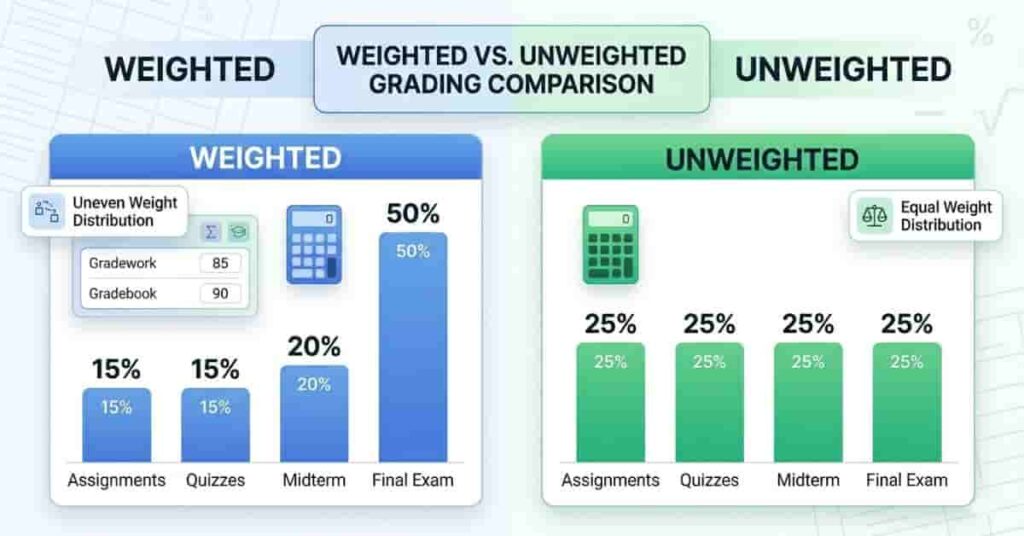
The comparison below illustrates why weights matter. On its weighted side, the final exam contributes 50% of the course grade, while quizzes contribute 15%. One quiz is not automatically as consequential as the final exam simply because both are upcoming assessments.
Next, check what each assessment actually covers. A course-wide confidence rating can hide an important weakness: you might be comfortable with SQL queries but uncertain about joins, for example. Rate your confidence against the material on the upcoming assessment.
The UNC Learning Center offers a practical three-level confidence scale. Read its guidance before filling in that column.
Preparing for Finals - UNC Learning Center
Read the “A helpful approach” subsection to turn a vague feeling of confidence into a rating tied to likely exam topics.
In “A helpful approach,” read the topic-rating guidance, from the opening advice on identifying likely topics through the paragraph about choosing what to review. Focus on what distinguishes “I don’t know,” “I sort of know,” and “I know well.”
Use that scale honestly: 1 means you do not know the material, 2 means you can handle some of it, and 3 means you could explain it or solve most relevant problems correctly. A brief attempt to recall an outline or solve a representative problem without notes is better evidence than simply recognizing a topic name.
Build a matrix you can actually use
Here is one planning heuristic. Its point is to make your decisions consistent, not to calculate an exact probability of earning marks.
| Signal | Score 1 | Score 2 | Score 3 |
|---|---|---|---|
| Weight (W) in course grade | Below 20% | 20–39% | 40% or more |
| Proximity (P) | 22 or more days away | 8–21 days away | Within 7 days |
| Need (N) from confidence | Confidence 3: know well | Confidence 2: partly know | Confidence 1: do not know |
For each row, add the three scores:
A higher total suggests more attention now. Keep the original weight, date, and confidence alongside the score so you can see why a row ranked where it did. The cutoffs are a starting rule, not a grading policy: adjust them if your term has unusually short intervals or differently structured assessments.
Here is a fictional example made on October 1. The dates and weights are illustrative, not a proposed schedule for your courses.
| Assessment | Weight | Days left | Confidence | W/P/N | Total | First focus |
|---|---|---|---|---|---|---|
| Data Structures exam | 40% | 6 | 1 | 3/3/3 | 9 | Identify weakest tested units |
| Database quiz | 10% | 3 | 2 | 1/3/2 | 6 | Check quiz topics and gaps |
| Operating Systems exam | 50% | 18 | 3 | 3/2/1 | 6 | Preserve an early review block |
Data Structures leads because it is substantial, close, and currently weak. The Database quiz cannot be ignored merely because its weight is small: it arrives first. The Operating Systems exam ties with the quiz numerically, but for a different reason—its high weight warrants some preparation now, even if confidence is strong.
A tie is a prompt for judgment, not a defect in the matrix. Check the actual dates, the amount of material, and what you can realistically improve before each assessment. A deadline tomorrow may require immediate action regardless of its score. Equally, do not let a succession of small imminent quizzes prevent any preparation for a major exam.
Make your own first version
Set aside about 15–20 minutes to create a table in a notebook or spreadsheet. You do not need to write code for this; a simple table is easier to update during a busy assessment period.
- Enter one row per upcoming assessment. Include its course, assessed material, date, and percentage of the final course grade. If a course has both a quiz and an exam coming up, give them separate rows.
- Calculate days remaining from today’s date. Check dates against the current official timetable. Mark missing dates or weights as unconfirmed rather than inventing them.
- Test and record confidence. Use the three-level scale on the material each assessment covers. If confidence varies sharply across topics, note the weak topics next to the row.
- Assign W, P, and N; then rank the rows. Add a short “first focus” note so each high-priority row points to a concrete piece of work rather than the vague instruction “study.”
- Recheck the ranking when circumstances change. A completed quiz, a changed exam date, or stronger performance on a previously weak topic should change your matrix.
Assessment percentages describe importance within a course. They are not a perfect measure of impact across different courses, particularly if courses carry different credits or your institution uses particular grade rules. Those details matter for later CGPA calculations. For this first matrix, keep the percentages visible and use the total score as a guide to allocating attention, not as a prediction of your final grade.
Takeaway
A useful subject-priority matrix makes three things visible at once: stakes, time remaining, and demonstrated confidence. Give each assessment its own row, use official dates and weights, rate only the material that will be tested, and revisit the ranking as you learn. The result should tell you where to begin without allowing one urgent task to obscure everything else.
In the next lesson, you will take a priority topic from that matrix and turn it into active-recall questions and a concise revision sheet.