Recommended resources
The freely available resources this lesson will direct you to.
Hello! Welcome back.
In our last lesson, we established an intuitive model for voltage as "electric height" or potential energy per unit charge. We saw that a source like a battery does work to "lift" charges to a higher potential, and these charges then release that energy as they move to a lower potential. The key takeaway was that a difference in potential is what makes things happen in a circuit.
Today, we'll explore what exactly that "happening" is. We'll focus on electric current, the flow of charge that is driven by the potential difference we just discussed.
Our learning outcome for this lesson is to explain current as the flow of charge, and predict its direction by reasoning about potential differences. By the end, you'll have a clear mental model connecting the "push" of voltage to the "flow" of current.
1. What is Current? The Flow of Charge
If voltage is the potential to do work, current is the work in action. It is the actual movement of charged particles.
To build our intuition, let's start with a video that defines current and provides a fascinating look at what's physically happening inside a wire.
An intuitive approach for understanding electricity
This video from AlphaPhoenix defines current as the flow of charge and introduces the unit of Amperes. It also gives a great sense of the physical reality by explaining the surprisingly slow 'drift velocity' of individual electrons.
Please watch the segment from 04:24 to 06:21. Pay attention to the definition of an Ampere (1 Coulomb per second) and the distinction between the speed of the electrical signal and the speed of the electrons themselves.
As the video explained, current () is the rate at which charge () flows past a point.
The unit for current is the Ampere (A), which is one Coulomb of charge flowing per second.
A key point that might seem counter-intuitive is the slow speed of individual electrons. If electrons move so slowly, why does a light turn on instantly? The following reading explains this with a classic and effective analogy.
L1: Voltage, Current, and Resistance | Physical Computing
This article from the Makeability Lab provides the excellent 'marbles in a tube' analogy to help explain how the effect of current can be nearly instantaneous even if the charge carriers themselves move slowly.
Read the sections titled 'What is current?' and 'Building intuition for current'. Focus on the marble analogy to understand the difference between drift velocity and the speed of the electrical signal.
Just like the marbles in the tube, the conductive wire is already full of mobile electrons. When a voltage is applied, it creates an electric field that pushes the electrons at one end, and this "push" propagates through the wire at nearly the speed of light, causing electrons at the other end to move almost immediately.
2. The Driving Force: Potential Difference Causes Current
We've established that current is charge in motion. But why does it move? This brings us back to our last lesson on potential.
Charge flows in response to a difference in electric potential, just as water flows in response to a difference in gravitational potential (height). A current will always flow from a region of higher potential to a region of lower potential.
This image provides a perfect side-by-side comparison.
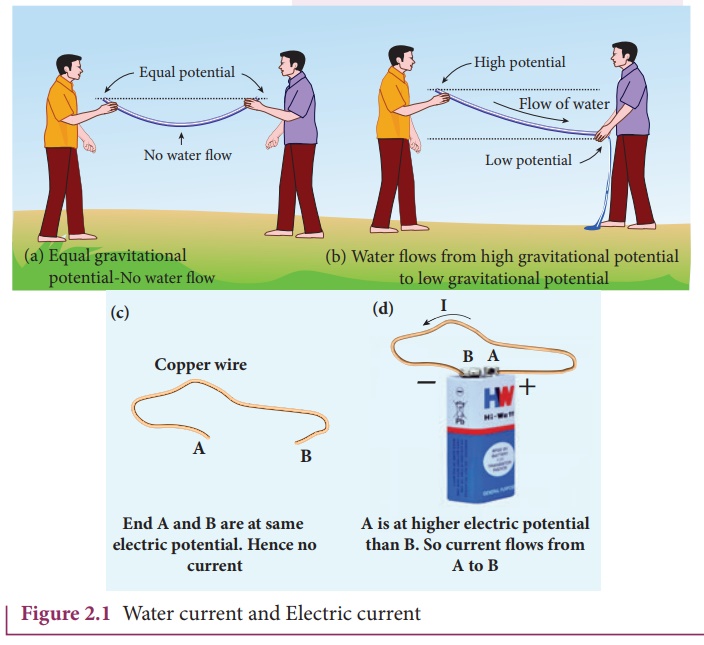
The connection is direct:
- High Gravitational Potential -> High Electric Potential
- Low Gravitational Potential -> Low Electric Potential
- Water Flow -> Electric Current
To see this principle visualized dynamically, let's return to the water trough model.
An intuitive approach for understanding electricity
This segment of the AlphaPhoenix video uses a fantastic water trough model to visualize how a potential difference drives current. You'll see the 'potential' (water level) drop as the current (water flow) moves through the circuit.
Watch from 19:40 to 22:15. Observe how the water level is high at the source and gradually decreases along the trough, representing the voltage drop. Notice the sharp drop in water level across the 'resistor'—an impediment to flow.
This is the central idea for predicting current direction: if you can identify which of two points in a circuit has a higher voltage (a higher "electric height"), you know that the current will flow from the higher point to the lower point.
3. Direction of Flow: Conventional vs. Electron Current
Now for a crucial clarification that can be a source of confusion. When we say current flows from high potential (+) to low potential (-), we are describing conventional current. This is the standard used in all circuit analysis.
However, in most metallic conductors, the actual charge carriers are negatively charged electrons, which are repelled from the negative terminal (low potential) and attracted to the positive terminal (high potential). This is called electron flow.
So, why the two models? It's a historical accident.
- Conventional Current: Flows from
+to-. This is a model of positive charge carriers. - Electron Flow: Flows from
-to+. This is the actual physical movement of electrons in a wire.
The following resources explain this historical "blunder" and why, for practical purposes, it doesn't matter as long as we are consistent.
First, a very direct and clear statement of the rule.
Electric Potential, Current, and Resistance
This short clip from Professor Dave Explains states the rule unambiguously.
Watch from 02:48 to 03:03. The key sentence is: 'The direction of the current is always opposite the movement of negative charges.'
Now, for a more detailed explanation.
L1: Voltage, Current, and Resistance | Physical Computing
This article from the Makeability Lab gives the historical context, blaming Benjamin Franklin for the convention, and reassures us that using conventional current works perfectly well for all calculations.
Read the section titled 'What’s conventional current vs. electron flow?'. It provides helpful diagrams comparing the two.
From now on, unless specified otherwise, "current" will always refer to conventional current (flow from + to -). This is the standard you will use for setting up and solving all circuit problems. A flow of negative charge in one direction is mathematically equivalent to a flow of positive charge in the opposite direction, so all the physical laws work out perfectly with this convention.
Conclusion
Let's summarize the key ideas from today's lesson:
- Current is the rate of flow of electric charge, measured in Amperes ().
- The effect of current is nearly instantaneous due to the propagation of the electric field, even though individual electrons drift very slowly.
- Current is driven by a potential difference (voltage). By convention, it flows from a point of higher potential to a point of lower potential.
- Conventional current (the standard for circuit analysis) models charge flowing from positive to negative. This is opposite to the physical electron flow in metallic conductors.
You now have the two most important foundational concepts in hand: voltage (the push) and current (the flow). You understand what they are and how they relate.
Next up: We will introduce the third key concept: resistance. We will see how resistance acts as a control on the rate of energy conversion and how it links voltage and current together in the fundamental relationship known as Ohm's Law.