Recommended resources
The freely available resources this lesson will direct you to.
Hello! Welcome to your first lesson. I'm excited to get started and help you build a strong, intuitive understanding of electrical circuits for your university qualifier exam.
Given your interest in the fundamental "why," we'll begin by exploring the most foundational concept in circuits: voltage. This lesson is designed to go beyond formulas and help you build a solid mental model of what voltage truly represents.
Our goal for today is to explain voltage as potential energy per unit charge and reason about how a charge gains and loses energy in a circuit. We'll see that thinking about voltage as a kind of "electric height" is a powerful way to understand how circuits work.
1. The Core Analogy: Voltage as "Electric Height"
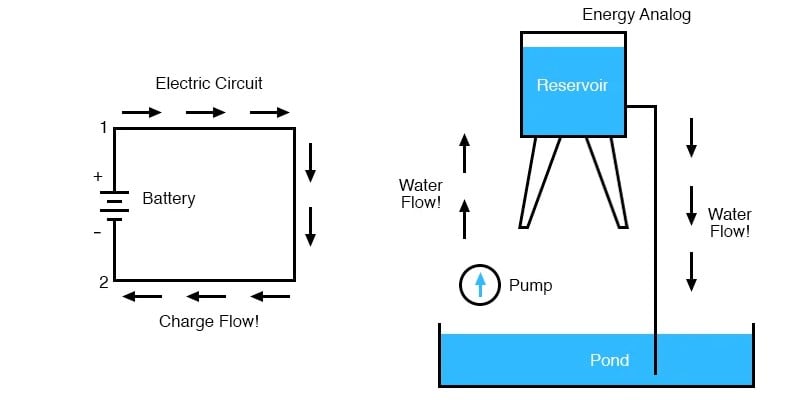
Let's start with an analogy you're already familiar with from physics: gravitational potential energy. An object has more potential energy when it's higher up and less when it's lower down. A charge in an electric circuit behaves in a very similar way.
To see this in action, the following video provides an excellent comparison between the energy of a mass being lifted and falling, and a charge moving through a simple circuit.
This video from Flipping Physics draws a direct and clear comparison between a mass gaining and losing gravitational potential energy and a charge doing the same in an electric circuit. It's a perfect starting point for building our intuition.
Please watch from 02:09 to 04:04. Focus on how the charge gains electric potential energy in the battery (like being lifted) and loses it in the resistor (like falling). Also, note what happens in the ideal wires.
As the video illustrates, we can map the energy changes directly:
- Gaining Energy: A battery acts like a person or a machine lifting a mass. It does work on the charge, increasing its electric potential energy and moving it to a point of higher potential (higher "electric height").
- Losing Energy: A resistor is like the fall back to the ground. As the charge moves through it, its electric potential energy is converted into other forms, like heat. The charge moves to a point of lower potential.
- Constant Energy: Ideal wires are like level ground. A charge can move along them without any change in its potential energy.
The "push" that a battery provides comes from an electric field it establishes. A charge's potential energy changes as it moves within this field.

A Quick Clarification: Energy vs. Momentum
It's tempting to think of electrons as tiny projectiles that transfer energy through collisions and momentum, especially given your work with networks where "packets" carry information. However, in circuits, this mental model can be misleading. The useful energy is transferred via the change in potential, not the kinetic energy or momentum of the electrons themselves.
The following short readings from a discussion among engineers and physicists clarify this important distinction.
How does electricity transfer energy? - Electronics Stack Exchange
This discussion on Stack Exchange directly addresses the misconception that energy is transferred via electron momentum. The selected answers provide a clear, concise explanation of why we focus on potential energy instead.
Please read the short answers provided by users 'JRE', 'Neil_UK', and 'Sophie Swett'. They effectively explain why potential energy, not momentum, is the key to understanding energy transfer in circuits.
The key takeaway is that an electron's energy comes from its position in an electric field (its potential), not its speed.
2. A Formal Definition for Voltage
Now that we have the intuition, let's connect it to the formal language of physics and engineering. The concept of "electric height" is formally called electric potential, or what we commonly call voltage.
This next resource provides the precise definition.
8.5: Electric Circuits - Physics LibreTexts
This text from Physics LibreTexts formalizes our analogy. It defines electric potential (voltage) as electric potential energy per unit of charge and presents the fundamental equation that governs energy changes in a circuit.
Please read the section titled 'The Complete Energy-Density Equation for Electric Circuits'. Focus on these key points: The definition of voltage as energy per charge (V = J/C). The meaning of the terms in the equation ΔV = E – IR, which describes energy gains from a source (E) and losses in a resistor (IR).
Let's break down the key definitions:
-
Electric Potential (Voltage): The electric potential energy () per unit of charge ().
The unit of voltage is the Volt (V), which is defined as one Joule of energy per Coulomb of charge (1 V = 1 J/C). -
Potential Difference (Voltage Drop): This is the difference in voltage between two points. It is the potential difference that drives the flow of charge. Charges will naturally move from a point of higher potential to a point of lower potential. When this happens across a component like a resistor, it's often called a voltage drop.
-
Electromotive Force (emf, or ): This is the energy per charge supplied by a source, like a battery. It's what "lifts" the charges to a higher potential. Despite the name, it is not a force; it is a potential difference, also measured in Volts.
3. Visualizing Energy Transfer in a Circuit
To solidify your intuition, it's helpful to see these concepts visualized with more dynamic analogies. The following video uses the idea of an "electric hill" and a water trough to show how potential is distributed and how energy is transferred.
An intuitive approach for understanding electricity
This video from the AlphaPhoenix channel is fantastic for building intuition. It uses several powerful analogies to help you visualize how a potential difference is created and how that leads to energy being delivered to circuit components.
Watch from 08:35 to 19:22. This is a longer segment, but it's packed with great visualizations. Pay close attention to: The analogy between voltage and the height of a hill (starts at 08:35). The idea that the 'electric hill' is formed by a slight redistribution of the electrons themselves (starts at 13:35). The deeper explanation of how energy is stored in the electric field when charges are pushed together (starts at 15:05). The water trough analogy, which vividly shows the potential 'dropping' across an obstacle (a resistor) (starts at 19:49).
Let's tie this all together with a simple diagram.
Summary and Key Takeaways
This lesson was all about building a solid, intuitive foundation for voltage. Before moving on, let's recap the main ideas:
- Voltage (Electric Potential) is potential energy per unit charge (). Thinking of it as "electric height" is a powerful analogy.
- A potential difference between two points is what causes charge to flow.
- Charges gain potential energy in a source like a battery (an emf source), which does work to move them to a higher potential.
- Charges lose potential energy in components like resistors, where this energy is converted into heat or light. This is called a voltage drop.
- The energy is transferred through the electric field, which exists throughout the circuit, not by the physical momentum of individual electrons.
Excellent work today! You've established the conceptual bedrock for everything that follows.
Next up: We'll explore electric current, which is the rate of charge flow, and connect it to voltage and resistance through the famous Ohm's Law. Now that we understand the "push" (voltage), we are ready to understand the "flow" (current) it creates.