Recommended resources
The freely available resources this lesson will direct you to.
Hello! Welcome to our final lesson in this module on framing and presentation.
In our last lesson, we had a hands-on workshop where you redesigned a pricing page using principles like anchoring and gain/loss framing. We focused on how to use these powerful psychological tools to influence user choice. Now, we're going to take a crucial step back and ask should we use them, and if so, how can we do so responsibly?
Today's learning outcome is to evaluate the ethical implications of using default options and the decoy effect in product design. This is one of the most important topics for a thoughtful product designer, as it sits at the intersection of user advocacy, business goals, and professional integrity.
We'll explore the fine line between helpful guidance and harmful manipulation, establish frameworks for evaluating your own design choices, and look at the real-world legal and reputational consequences.
1. The Central Tension: Nudging vs. Manipulation
At the heart of this discussion is a fundamental tension. Are we, as designers, creating "choice architecture" that helps users make better decisions, or are we designing "dark patterns" that manipulate them?
A nudge, in its original sense, is a gentle push that alters people's behavior in a predictable way without forbidding any options or significantly changing their economic incentives. The goal is to help people make choices that are in their own best interests.
Manipulation, on the other hand, involves using deception, pressure, or coercion to guide users toward an outcome that benefits the business, often at the user's expense.
Let's watch a short video that explains the classic ethical defense of nudging, a concept called "libertarian paternalism."
Nudge explained in less than 10 minutes
This clip from the video 'Nudge explained in less than 10 minutes' by Pete Judo clearly articulates the original argument for why nudging can be considered ethical.
Please watch the segment from 07:07 to 08:37. Pay close attention to the two core arguments: that choice environments are never neutral, and that nudges don't restrict freedom of choice.
The core argument is: since we have to design the choice environment one way or another, why not design it to help users? And as long as we don't take choices away, we are respecting their liberty.
However, this perspective is not without its critics. The power to "nudge" is the power to influence, and that power can be used in ways that are not so benevolent.
Behavioral Economics Critiques: The Economic Mythology of Technofeudalism?
For a more critical take, this video from The New Enlightenment with Ashley questions the power dynamics behind behavioral economics. It raises some profound questions for anyone involved in designing user experiences.
Please watch three short clips from this video: 00:45 - 02:00: The speaker frames the ethical dilemma: Is teaching and using behavioral economics a form of manipulation within a 'surveillance economy'? 11:55 - 13:00: This clip introduces the 'Who nudges the nudgers?' critique, highlighting that designers are often nudged by their employers to serve an organization's mission, which may not align with the user's best interests. 16:20 - 17:50: Here, the speaker discusses the cumulative effect of nudges. While one nudge might be harmless, being subjected to thousands of them can lead to negative emotional impacts like anxiety and distrust.
These critiques force us to move beyond a simple "is it a nudge?" question and ask more probing ones:
- Who benefits from the nudge?
- What are the cumulative and long-term effects on the user?
- Does the design respect the user's autonomy, or does it exploit their cognitive biases for commercial gain?
Let's use this critical lens to evaluate our two specific techniques: default options and the decoy effect.
2. Ethical Evaluation of Default Options
Defaults are arguably one of the most powerful and common nudges in digital products. They work because they leverage our natural inclination towards the path of least resistance (status quo bias).
The Potential for Good:
Defaults can be profoundly beneficial. They reduce cognitive load and simplify complex decisions, guiding users toward choices that are often demonstrably better for them or for society.
- Organ Donation: In countries where organ donation is the default (opt-out), participation rates are dramatically higher than in countries where it's opt-in.
- Retirement Savings: Programs like "Save More Tomorrow" automatically enroll employees in retirement savings plans, with the option to opt out. This has massively increased how much people save for their future.
- Sensible Settings: A software application might default to "auto-save on," protecting users from losing their work.
The Potential for Harm (Dark Patterns):
Defaults are also a primary tool for creating deceptive experiences.
- "Privacy Zuckering": This is a term for when a user interface, often through confusing defaults, tricks you into sharing more personal information than you intended. For example, a social media platform's privacy settings might default to "public" for all your posts.
- Pre-checked Marketing Consents: You've surely seen this—a checkbox that is already ticked, signing you up for newsletters you never asked for during a checkout process.
- Hidden Costs: A service might default to the "premium" shipping option, hoping you won't notice the extra cost.
A Framework for Evaluating Defaults
When implementing a default, you can use these questions as an ethical litmus test:
- Motive & Benefit: Whose interest does this default primarily serve? Is it designed to protect the user, simplify their experience, and lead to a better outcome for them? Or is its main purpose to drive a business metric (e.g., data collection, revenue) at the user's expense?
- Transparency & Awareness: Is it clear to the user that a choice has been made for them? Is the default option clearly highlighted? A benevolent default has no need to hide.
- Ease of Change: How easy is it for a user to change the default? If opting out requires navigating multiple screens, understanding jargon, or clicking a low-contrast link, you're moving from a nudge to a sludge (a dark pattern that creates friction).
This mind-map provides a great visual summary of the components of ethical privacy nudging, many of which apply to defaults in general.

3. Ethical Evaluation of the Decoy Effect
As we saw in the previous lesson, the decoy effect works by introducing a third, "asymmetrically dominated" option to make a "target" option seem more attractive.
The Potential for Good:
When users face complex choices, they can suffer from choice overload. A well-placed decoy can simplify the decision-making process by making the relative value of one option clearer.
- Clarifying Value: Imagine a SaaS product with two plans that are hard to compare. A decoy could help the user more easily identify which of the original two plans offers a better balance of price and features for their needs.
- Overcoming Paralysis: By making one option feel like a "smart choice," a decoy can help users confidently make a decision rather than abandoning the choice altogether.
The Potential for Harm (Dark Patterns):
The decoy effect is manipulative by its very nature—it's designed to influence your choice. The ethical line is crossed when that manipulation leads to a decision that isn't in the user's best interest.
- Pushing Unnecessary Upgrades: The classic example is manipulating a user into choosing a more expensive option than they actually need, simply because the decoy makes it look like a "deal."
- Inflating Perceived Value: A company could create a decoy with an absurdly high price to make the target option seem reasonably priced, when in fact it is overpriced.
A Framework for Evaluating the Decoy Effect
The following article offers an excellent, practical guide to using the decoy effect, including a dedicated section on ethics.
Decoy Effect: steer preferences smartly
Please read a section from the article 'Decoy Effect: steer preferences smartly' from Learning Loop. It provides a clear breakdown of the ethical tightrope you have to walk when using this technique.
Read the section titled 'Ethical recommendations'. Focus on the best practices it lists, such as transparency, fair pricing, and focusing on customer benefits.
Drawing from that reading, here is an ethical checklist for using the decoy effect:
- Genuine Value: Does the target option you're highlighting provide genuine and substantial value to the user segment you expect to choose it? Or are you simply trying to maximize revenue per user, regardless of their needs?
- Fair Pricing: Is the pricing strategy fair? Avoid creating decoys with completely unrealistic prices just to make the target look good. The prices should reflect some level of genuine (if inferior) value.
- Transparency: Are the differences between the options communicated clearly and honestly? The goal should be to help users make an informed decision, even if you are guiding their comparison. Don't hide the decoy's drawbacks or exaggerate the target's benefits.
- Avoid Exploitation: The goal should be to facilitate better decision-making, not to capitalize on psychological vulnerabilities to create buyer's remorse.
4. A Broader Ethical Framework for Designers
Evaluating individual patterns is useful, but it helps to have a more universal framework. The academic paper "A Scenario Analysis of Ethical Issues in Dark Patterns" lays out a robust way to think about ethical problems by using the three main branches of normative ethics. You don't need to be a philosopher to use these; they are practical lenses for analysis.
-
Deontology (The "Rules"):
- Focus: The morality of an action is based on whether the action itself is right or wrong under a series of rules, rather than based on the consequences of the action.
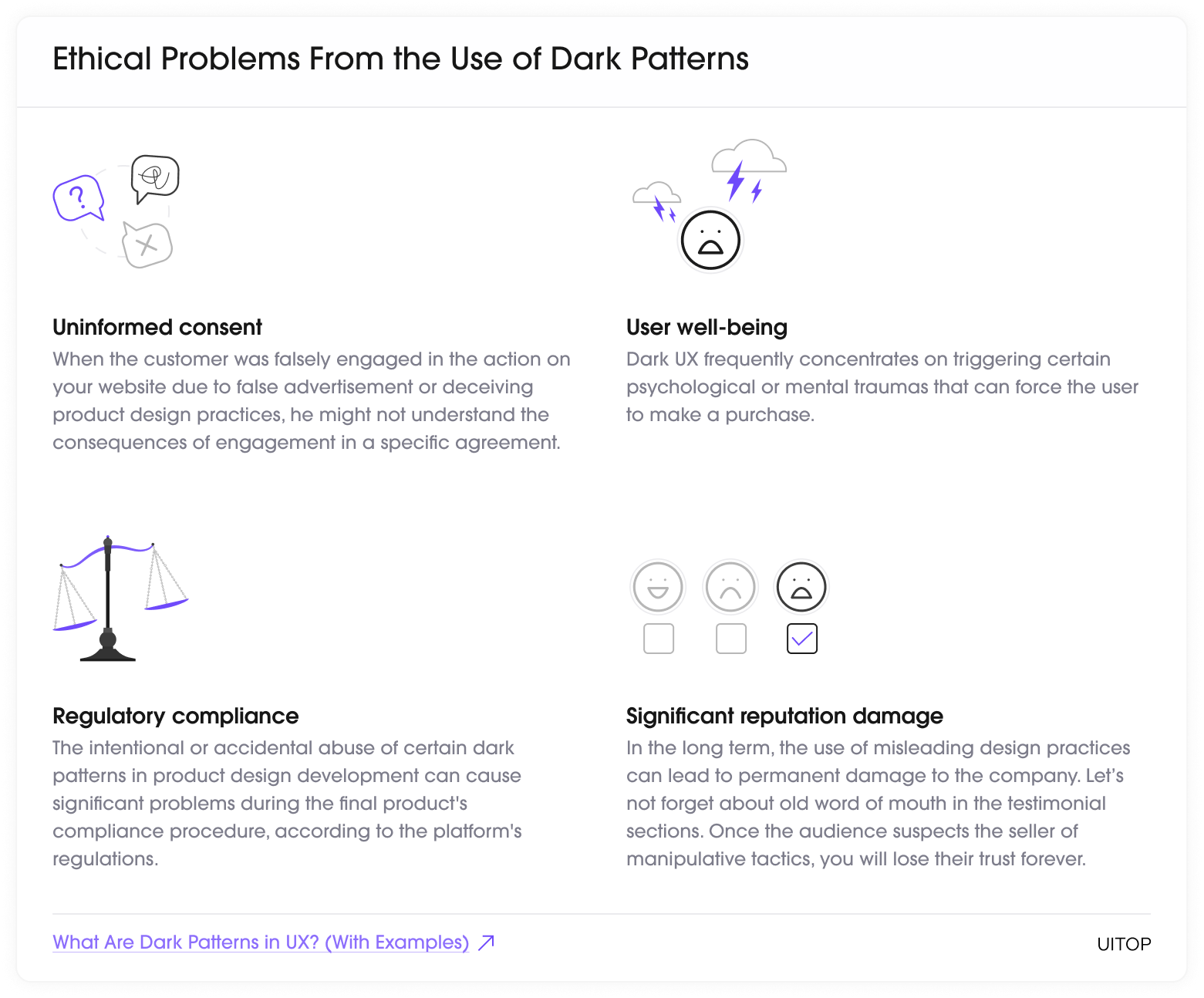
- In Product Design: This means respecting universal principles and laws. Does your design respect a user's autonomy and right to informed consent? Does it comply with regulations like the GDPR (General Data Protection Regulation) or the DSA (Digital Services Act) in Europe, which explicitly prohibit deceptive and manipulative interface designs? A design that breaks the law or violates a user's fundamental right to consent is deontologically unethical, regardless of the outcome.
-
Utilitarianism (The "Consequences"):
- Focus: The most ethical choice is the one that will produce the greatest good for the greatest number.
- In Product Design: This lens forces you to weigh the outcomes. Does your design create value, happiness, and efficiency for the majority of users? Or does it cause harm (financial loss, stress, privacy violations) for many, even if it benefits the business or a few users? A default that saves thousands of users from data loss is utilitarian. A decoy that tricks thousands into overpaying is not.
-
Virtue Ethics (The "Designer's Character"):
- Focus: This approach emphasizes the character of the moral agent. It asks, "What would a virtuous person do?"
- In Product Design: This translates to your professional integrity. What does it mean to be a good, responsible, user-centric designer? It means being honest, fair, and transparent. It means you wouldn't create a design that you wouldn't want used on yourself or your family. This aligns with professional codes of conduct, like those from the ACM, which mandate honesty and trustworthiness.
By combining these three lenses, you can perform a comprehensive ethical evaluation of any design choice.
Conclusion
Today we've navigated the complex ethical landscape of choice architecture. You've moved beyond simply knowing how to implement defaults and decoys to understanding how to evaluate their use.
Key Takeaways:
- Nudge vs. Manipulate: The line is often defined by intent and outcome. A nudge helps the user; manipulation benefits the business at the user's expense.
- Evaluate Defaults: Judge them based on who they benefit, how transparent they are, and how easy they are to change.
- Evaluate Decoys: Assess them based on whether they clarify genuine value or simply exploit biases to push a more profitable, but not necessarily better, option.
- Use a Robust Framework: For any ethical dilemma, consider the action itself (Deontology), the consequences for everyone (Utilitarianism), and what a person of integrity would do (Virtue Ethics).
This is not about finding a single right answer. It's about developing the critical thinking skills to make conscious, defensible, and ethical decisions in your work.
Next Up
This lesson concludes our module on the presentation of choice. You've learned how framing, defaults, decoys, and anchoring can shape decisions.
In our next module, we will dive into another powerful set of influences: Emotional and Social Drivers of Choice. We'll begin by exploring how integral emotions like anticipated regret and the "fear of missing out" (FOMO) can shape user choices within a product, opening up another fascinating—and ethically complex—dimension of product psychology.