Recommended resources
The freely available resources this lesson will direct you to.
Hello! Let's continue our exploration of scattering theory.
In our last lesson, we investigated resonances, seeing how these sharp peaks in the cross-section correspond to metastable, "quasi-bound" states. We found that the entire scattering process, including these dramatic phenomena, is encoded in the S-matrix, whose unitarity reflects the fundamental principle of probability conservation.
Today, we will explore a direct and powerful consequence of this principle: the Optical Theorem. This theorem establishes a remarkable and somewhat counter-intuitive connection between the total amount of scattering in all directions () and the behavior of the wave in the strictly forward direction (). Specifically, we will show that the total cross-section is proportional to the imaginary part of the forward scattering amplitude, .
1. The Physical Picture: Interference and Shadows
At its heart, the optical theorem is a statement about wave interference and the conservation of particles. The total wavefunction in a scattering experiment is the superposition of the incident wave and the scattered wave:
The total probability current, , is quadratic in , so it contains three terms:
where is the interference term between the incident and scattered waves.
Since probability (or particle number in a steady state) is conserved, the total flux of particles through any large, closed surface surrounding the scatterer must be zero.
- The flux from the incident wave () through a closed sphere is zero.
- The flux from the scattered wave () is, by definition, the total number of particles scattered per unit time, which is proportional to the total cross-section . This is an outgoing flux.
For the total flux to be zero, the outgoing scattered flux must be perfectly balanced by an incoming flux. This incoming flux comes from the interference term, . This interference is strongest where the incident and scattered waves overlap significantly, which is primarily in the forward direction ().
Destructive interference between the incident and scattered waves in the forward direction creates a "shadow" behind the scatterer. The optical theorem elegantly states that the total number of particles removed from the beam to create this shadow (which must equal all the particles scattered in other directions) is determined precisely by the properties of the wave in that forward direction.
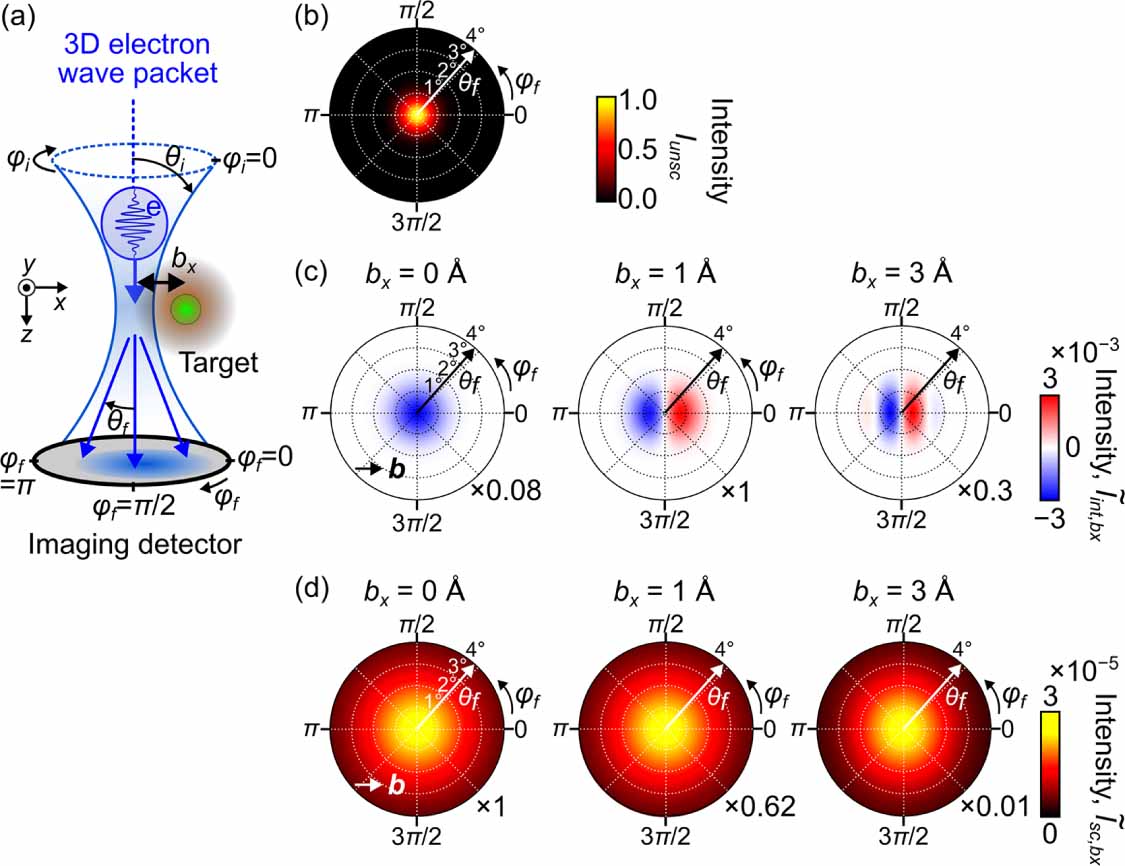
The image below, from a study of electron scattering, visually separates these components. Panel (c) shows the interference intensity, which has a significant structure in the forward direction (). It is the flux from this interference term that cancels the flux from the scattered term shown in panel (d).
2. Proof Using Partial Wave Expansion
For scattering from a central potential, we can prove the optical theorem with a straightforward algebraic argument using the partial wave expansions we've already derived. This is a special case of the more general theorem, but it's an excellent way to see the relationship emerge directly from the formalism.
The following video provides a concise derivation.
L20.4 Cross section in terms of partial cross sections. Optical theorem
In this video from MIT OpenCourseWare, Prof. Robert Jaffe first derives the total cross-section in terms of phase shifts and then uses the partial wave expansion of the forward scattering amplitude to derive the optical theorem.
Please watch the video from the beginning to 04:37 to see the derivation of the total cross-section, and then from 07:13 to 11:28 for the derivation of the optical theorem itself. Focus on how the two sums become directly proportional after taking the imaginary part of the forward amplitude.
Let's summarize the key steps from the video:
- Total Cross-Section: By integrating the differential cross-section over all solid angles and using the orthogonality of the Legendre polynomials, we find the total cross-section is an incoherent sum over the partial waves:
- Forward Scattering Amplitude: We evaluate the general partial wave expansion for in the forward direction, . Using the fact that , we get:
- The Connection: We then take the imaginary part of the forward amplitude. Using , the imaginary part of is simply .
Comparing the expressions for and , we immediately arrive at the optical theorem:
3. General Proof from Flux Conservation
The partial wave proof is elegant but limited to central potentials. The physical argument based on flux conservation can be made fully rigorous for any potential that falls off faster than . This proof is more general and provides deeper physical insight.
The derivation involves integrating the total probability current over a large sphere and carefully evaluating the contribution from the interference term. The following reading provides a clear, step-by-step derivation.
Introduction to Time-Independent Scattering Theory
These lecture notes by Prof. Robert G. Littlejohn provide an excellent derivation of the optical theorem from the principle of current conservation. This approach beautifully formalizes the physical intuition of the 'shadow' we discussed earlier.
Please read Section 17, 'The Optical Theorem' (pages 22-25). Follow the argument carefully: it starts with the statement of zero total flux (\oint \mathbf{J} \cdot d\mathbf{a} = 0), and then evaluates the flux for the incident, scattered, and interference currents separately. Pay close attention to the integration-by-parts trick used to handle the oscillating integral for the interference flux.
The key steps of this general proof are:
- Start from current conservation for a stationary state, , which implies the total flux through a large sphere is zero: .
- Decompose the total flux into three parts: , where is the interference current.
- The incident flux integral is zero.
- The scattered flux integral is, by definition, .
- The interference flux integral is therefore required to be . Direct evaluation of this integral in the limit shows it is equal to .
- Equating the two expressions for the interference flux yields the theorem.
Test your understanding!
The optical theorem states . What does this imply about the phase of the forward scattering amplitude ? Can be purely real for a particle scattering off a potential? What would that mean physically?
Show answer
If were purely real, then . According to the optical theorem, this would imply . This means that if there is no scattering whatsoever, the forward scattering amplitude must be purely real.
Conversely, if there is any scattering (), then the forward scattering amplitude must have a non-zero imaginary part. The scattering process necessarily modifies the phase of the wave in the forward direction. Physically, this imaginary component is the signature of the "shadow"—the depletion of the incident beam due to particles being scattered away.
4. Generalization to Inelastic Scattering
The optical theorem is even more powerful than it first appears. It also holds true when inelastic processes (where the target is excited or particles are created) can occur. In this case, the total cross-section is the sum of the elastic and inelastic cross-sections: .
The theorem becomes:
Notice that the right-hand side only involves the elastic forward scattering amplitude. This is because only the elastically scattered wave has the same energy as the incident wave and can therefore interfere with it to produce the forward shadow. The total attenuation of the beam, which accounts for all scattering channels (elastic and inelastic), is determined solely by the elastic amplitude in the forward direction.
Conclusion
In this lesson, we have derived and analyzed the optical theorem, a cornerstone of scattering theory.
Key Takeaways:
- The Optical Theorem, , connects the total scattering cross-section to the imaginary part of the forward elastic scattering amplitude.
- It is a direct consequence of probability conservation (or the unitarity of the S-matrix).
- Physically, it arises because the flux of particles scattered into all angles is balanced by a destructive interference effect between the incident and scattered waves in the forward direction, creating a "shadow".
- The theorem holds for both elastic and inelastic scattering, providing a profound link between the total interaction probability and the coherent forward scattering.
Preview of the Next Lesson:
We have now concluded our foundational study of scattering theory. We will now shift our focus to a more general framework for describing quantum systems, especially those that are not perfectly isolated. In the next lesson, we will introduce the density matrix. This powerful tool allows us to describe not only pure quantum states (like the wavefunctions we've been using) but also statistical mixtures, which are essential for understanding open quantum systems, decoherence, and the quantum measurement process. This will be our first step into the module on "Open Quantum Systems and Measurement".